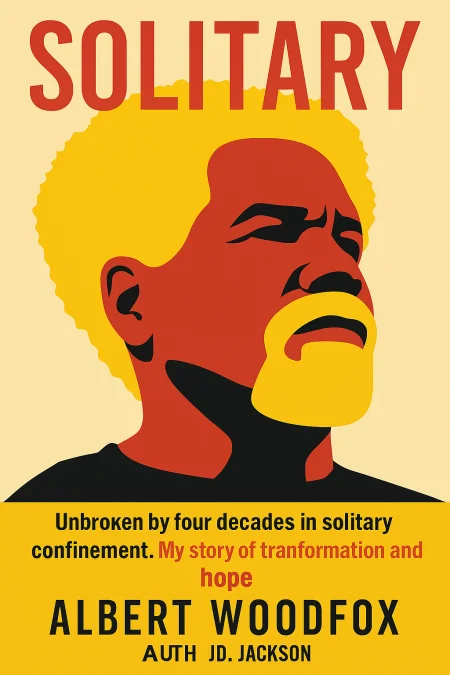
Solitary
Unbroken by Four Decades in Solitary Confinement. My Story of Transformation and Hope
byAlbert Woodfox, J.D. Jackson
Book Edition Details
Summary
In the echoing silence of a 6-by-9-foot cell, Albert Woodfox's story unfolds—an odyssey through despair and resilience that defies the brutality of Angola prison. For over 40 years, Woodfox endured solitary confinement for a crime he didn't commit, his spirit unbroken despite the relentless assault of an unjust system. His memoir, "Solitary," is not just a personal testament of survival; it is a searing indictment of institutional racism and the inhumanity of isolation. As Woodfox's life becomes a beacon for reform, his narrative challenges the very fabric of the U.S. criminal justice system, making this book a vital rallying cry for change. Witness the triumph of the human spirit in the face of unimaginable adversity and stand alongside a voice that refuses to be silenced.
Introduction
In the suffocating heat of a Louisiana prison cell measuring just six by nine feet, a man spent over four decades refusing to be broken. Albert Woodfox's story begins in the poverty-stricken streets of New Orleans in the 1940s, where a young Black boy learned early that survival meant choosing between being "a rabbit or a wolf." What followed was an extraordinary transformation from street criminal to revolutionary, from broken young man to unshakeable symbol of human dignity. Woodfox's journey intersected with some of the most turbulent periods in American history—the civil rights movement, the rise of the Black Panther Party, and the brutal realities of the prison industrial complex. His story reveals how institutionalized racism and systemic oppression can destroy lives, but also how the human spirit can transcend even the most dehumanizing conditions. Through his experiences, readers will discover the power of education as liberation, the strength found in unwavering principles, and the profound courage required to maintain one's humanity when the world seems determined to strip it away. This is not merely a tale of survival, but a testament to the transformative power of consciousness and the unbreakable bonds of solidarity forged in the crucible of injustice.
From Street Life to Revolutionary Awakening
Albert Woodfox was born into a world that had already decided his fate. Growing up in New Orleans' Sixth Ward in the 1950s, he witnessed his mother Ruby's daily struggle against poverty and racism. When domestic violence forced his family to flee their home, young Albert learned that safety was never guaranteed and that the strong preyed upon the weak. The segregated South offered few opportunities for a Black child, and the streets became both classroom and battleground. By his teens, Woodfox had embraced the life of a "wolf"—leading the 6th Ward High Steppers gang, stealing to survive, and eventually graduating to armed robbery. His early encounters with the criminal justice system revealed the harsh reality of institutionalized racism. Police regularly swept through Black neighborhoods, arresting men simply for existing in public spaces. The courts offered no justice, only predetermined outcomes based on skin color. The turning point came not in the familiar streets of New Orleans, but in the concrete corridors of New York City's Tombs prison. There, Woodfox encountered members of the Black Panther Party who challenged everything he thought he knew about himself and his place in the world. These men spoke of dignity, resistance, and the possibility of change. They introduced him to revolutionary literature and helped him understand that his criminal behavior was not a personal failing but a response to systemic oppression. Reading became a revelation. The story of characters who destroyed their own property rather than live under the shadow of their ancestors' enslavement resonated deeply with Woodfox's desire to break free from predetermined paths. For the first time, he began to see himself not as a criminal, but as a victim of circumstances who could choose a different destiny through consciousness and action.
Four Decades in Solitary: The Angola Three
When Woodfox arrived at Louisiana State Penitentiary at Angola in 1971, he entered what was essentially a modern plantation. The prison operated on the same land where slaves had once toiled, and the continuity was unmistakable. Black prisoners worked the fields by hand while white guards on horseback supervised with shotguns. Sexual slavery was endemic, violence was routine, and human dignity was systematically destroyed. Together with Herman Wallace and Robert King, Woodfox formed the first prison chapter of the Black Panther Party. Their mission was revolutionary: to organize prisoners, end sexual violence, and challenge the dehumanizing conditions that defined Angola. They created an "antirape squad" that protected vulnerable new prisoners, established educational programs, and demonstrated through their own conduct that change was possible even in the most oppressive circumstances. The prison administration viewed their organizing efforts as an existential threat. When guard Brent Miller was murdered in April 1972, authorities immediately targeted the three Panthers. Despite having alibis and no physical evidence linking them to the crime, Woodfox and Wallace were framed for the murder. The prosecution relied on testimony from known informants and prisoners who had been coerced, beaten, or promised better treatment in exchange for their lies. The trials that followed were travesties of justice. All-white juries, coached witnesses, and a legal system determined to silence the Panthers ensured guilty verdicts. Woodfox and Wallace were sentenced to life in prison and immediately placed in solitary confinement. King would later be framed for a separate murder. The three men, who became known as the Angola Three, would spend decades fighting not only for their freedom but for their very humanity in the face of systematic torture designed to break their spirits.
Fighting for Justice Against Systematic Oppression
Solitary confinement at Angola was designed as psychological warfare. Locked in cells measuring six by nine feet for twenty-three hours daily, prisoners were subjected to sensory deprivation, social isolation, and deliberate humiliation. Strip searches, contaminated food, extreme temperatures, and constant harassment were tools used to destroy the human spirit. Many prisoners broke under these conditions, but Woodfox chose a different path. Education became his salvation and weapon of resistance. Despite limited access to books and materials, he devoured everything from revolutionary theory to philosophy, from history to literature. Reading transformed his understanding of the world and his place in it. He taught himself law, filing countless motions and lawsuits that gradually improved conditions for all prisoners. When he encountered a cellmate who couldn't read, Woodfox spent months teaching him, considering it one of his greatest achievements. The three Panthers maintained their bond despite being kept on separate tiers. They developed a system of communication through notes, legal visits, and brief encounters in the prison hospital or during transfers. Their motto became their reality: "Separated but never apart, never touching but always connected." This solidarity sustained them through decades of isolation and gave them strength to continue their resistance. Their protests took many forms: hunger strikes lasting forty-five days to demand food slots in cell doors, refusal to submit to degrading strip searches, and constant legal challenges to unconstitutional conditions. Each act of resistance brought retaliation, but also incremental improvements that benefited all prisoners. Through their example, they demonstrated that even in the most powerless circumstances, human dignity could be maintained through principled action and unwavering commitment to justice.
Freedom and the Legacy of Unbroken Spirit
After more than four decades in solitary confinement, Albert Woodfox emerged not as a broken man, but as a symbol of unbreakable human spirit. His eventual release in 2016 marked the end of one of the longest periods of solitary confinement in American history. Herman Wallace had died in prison in 2013, just days after his conviction was overturned. Robert King was released in 2001 after his conviction was overturned, becoming the first of the Angola Three to taste freedom. Woodfox's transformation from street criminal to revolutionary intellectual illustrates the power of consciousness and education to transcend circumstances. His story challenges assumptions about crime, punishment, and the possibility of redemption. Despite enduring torture that would have destroyed most people, he maintained his humanity, his principles, and his commitment to justice. His resistance helped improve conditions for thousands of prisoners and brought international attention to the brutality of American mass incarceration. The legacy of the Angola Three extends far beyond their individual cases. They demonstrated that solidarity can survive the most determined efforts to destroy it, that education can flourish even in the most restrictive environments, and that the human spirit can remain unbroken despite systematic attempts to crush it. Their story serves as both an indictment of American injustice and a testament to the transformative power of principled resistance. Woodfox's post-release activism continued his lifelong commitment to justice. He traveled internationally, speaking about prison reform and human rights. His testimony before legislative bodies and human rights organizations helped build momentum for changes in how prisoners are treated and restrictions on prolonged isolation. His transformation from victim to advocate showed how even the most traumatic experiences could be channeled into positive change for society.
Summary
Albert Woodfox's life stands as proof that no system, however brutal, can ultimately destroy the human capacity for growth, dignity, and resistance when sustained by unwavering principles and unbreakable solidarity. His journey from the streets of New Orleans to the solitary cells of Angola reveals both the devastating impact of systemic racism and the extraordinary power of consciousness to transcend even the most oppressive circumstances. From his story, we learn that education truly is liberation, that maintaining one's humanity in dehumanizing conditions is itself a revolutionary act, and that solidarity can survive any attempt to destroy it. His example challenges us to examine our own capacity for resistance in the face of injustice and to recognize that transformation is possible at any stage of life, under any circumstances. Woodfox's unbroken spirit serves as an enduring reminder that the most powerful weapon against oppression is an awakened mind committed to justice, and that true freedom begins not when the cell door opens, but when consciousness is born.
Related Books
Download PDF & EPUB
To save this Black List summary for later, download the free PDF and EPUB. You can print it out, or read offline at your convenience.
By Albert Woodfox
