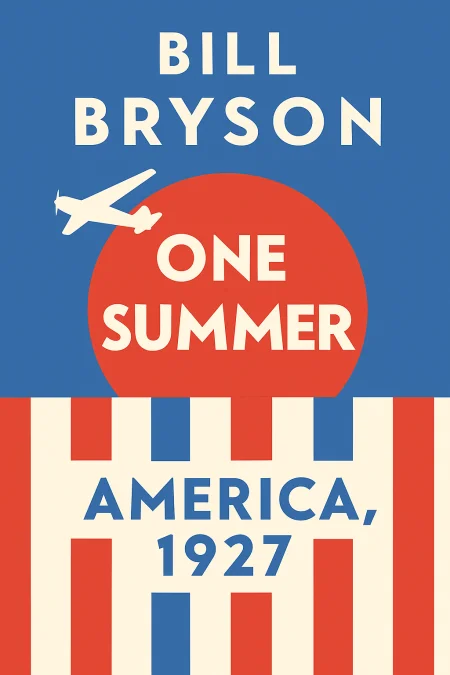
One Summer
America, 1927
Book Edition Details
Summary
In the sweltering heat of 1927, America found itself at the crossroads of destiny and drama. Bill Bryson, with his signature wit and vivid storytelling, sweeps readers into a whirlwind season where heroes soared, legends were born, and the world watched in awe. Charles Lindbergh catapulted to fame as he carved a path across the Atlantic skies, while Babe Ruth's bat cracked records that echoed through time. Amidst the spectacle, a housewife's crime of passion riveted tabloids, and a peculiar man balanced atop a flagpole captured imaginations. As floods ravaged the South and Al Capone's empire thrived on chaos, an unassuming group of bankers quietly set the stage for economic upheaval. With cinematic flair, Bryson unpacks a summer that redefined a nation, blending humor and history into a narrative masterpiece that resonates beyond the pages.
Introduction
The summer of 1927 stands as one of those rare moments when history seems to accelerate, when individual acts of courage and innovation converge to reshape an entire nation's destiny. In the span of just a few extraordinary months, America witnessed a young aviator's solo flight across the Atlantic Ocean, a baseball legend's pursuit of immortality, and the quiet decisions in corporate boardrooms that would soon trigger the greatest economic collapse in the nation's history. These seemingly separate events were actually interconnected threads in a larger tapestry of transformation that would define modern America. This pivotal season illuminates three profound questions that continue to resonate today: How do moments of technological breakthrough alter not just what we can accomplish, but who we believe ourselves to be as a people? When does the pursuit of prosperity and progress cross the line into dangerous speculation and moral compromise? And how do individual acts of heroism intersect with broader social forces to create lasting change that echoes through generations? The story of this transformative summer speaks to anyone curious about the origins of celebrity culture, the relationship between technology and human ambition, and the delicate balance between individual achievement and collective responsibility. For those seeking to understand how America emerged as a global superpower while grappling with the contradictions of rapid modernization, this remarkable period offers invaluable insights into the forces that continue to shape our world today.
The Flight That Changed Everything: Lindbergh's Atlantic Crossing
The spring of 1927 found aviation in a state of deadly competition, as multiple teams gathered at Roosevelt Field on Long Island, each determined to claim the $25,000 Orteig Prize for the first non-stop flight from New York to Paris. The Atlantic had already claimed several lives in failed attempts, creating an atmosphere of both excitement and dread around what many considered an impossible challenge. Into this dangerous arena stepped Charles Lindbergh, a relatively unknown twenty-five-year-old airmail pilot from the Midwest, carrying with him a revolutionary approach that would change everything. While his competitors relied on multi-engine aircraft and experienced crews, Lindbergh made the audacious decision to fly alone in a single-engine plane, sacrificing safety equipment and even forward visibility for the extra fuel capacity needed to cross the vast ocean. His meticulous preparation and innovative navigation techniques demonstrated a level of precision and calculated risk-taking that distinguished him from the more flamboyant aviators competing for the same prize. On May 20, 1927, after a sleepless night of final preparations, his overloaded Spirit of St. Louis barely cleared the telephone wires at Roosevelt Field's muddy runway. What followed was thirty-three and a half hours of solitary flight through storms, fog, and the disorienting effects of sleep deprivation. Lindbergh's navigation by dead reckoning across the trackless Atlantic required not just technical skill but extraordinary mental discipline and courage. His arrival at Le Bourget airfield outside Paris triggered an unprecedented explosion of global celebration, as over 100,000 people rushed onto the field to greet the young American who had accomplished what seemed impossible just hours before. Lindbergh's achievement transcended aviation to become a powerful symbol of American ingenuity and determination at precisely the moment when the nation was eager to assert its technological leadership on the world stage. His flight marked the true beginning of the modern age of international travel and communication, while simultaneously creating the template for twentieth-century celebrity culture that would transform how societies celebrate and consume heroic achievement for generations to come.
Heroes and Contradictions: Celebrity Culture and Social Tensions
While Lindbergh captured global headlines with his transatlantic triumph, another American icon was quietly building toward his own legendary achievement on baseball diamonds across the country. Babe Ruth, already the most recognizable athlete in America, began the 1927 season with modest expectations after struggling with personal scandals and declining performance in previous years. Yet as spring turned to summer, Ruth embarked on what would become the most celebrated individual athletic performance in American sports history, pursuing his own home run record with a determination that captivated the nation. Ruth's march toward sixty home runs became a national obsession that paralleled the Lindbergh phenomenon, demonstrating how mass media was creating entirely new forms of shared cultural experience. Newspapers provided daily updates on Ruth's progress, while radio broadcasts brought the excitement of each game into American homes with unprecedented immediacy. The Bambino's larger-than-life personality, combined with his extraordinary athletic gifts, made him the perfect figure for an era that was learning to celebrate both genuine achievement and manufactured celebrity with equal enthusiasm. The summer revealed the emergence of a distinctly American approach to hero worship, one that combined sincere admiration for exceptional accomplishment with a voracious appetite for personal details and dramatic narratives. Both Lindbergh and Ruth became objects of intense public fascination that extended far beyond their professional achievements, as Americans demonstrated their hunger for figures who could embody their aspirations and dreams on a grand scale. This transformation of individual success into mass entertainment established patterns that would define American culture for decades. Yet beneath the celebration lay deeper contradictions that exposed the tensions within American society. The same nation that elevated these heroes was simultaneously grappling with Prohibition's failures, racial segregation, and growing economic inequality. The ability of both men to capture and hold national attention revealed how technological advances in communication were creating new possibilities for shared experiences, while also highlighting the complex relationship between genuine accomplishment and manufactured fame that continues to shape public discourse today.
Prosperity's Peak: Technology, Progress and Hidden Dangers
President Calvin Coolidge spent much of the summer of 1927 on an extended vacation in South Dakota's Black Hills, embodying the era's confidence in minimal government and maximum economic freedom. His relaxed approach to presidential duties reflected the broader national mood of prosperity and optimism, as Americans enjoyed unprecedented economic growth, technological innovation, and cultural dynamism. The stock market seemed to climb endlessly upward, unemployment remained low, and the nation's industrial capacity appeared limitless in its potential for generating wealth and opportunity. The Roaring Twenties had created a society of remarkable technological advancement and cultural liberation. Radio was connecting the nation in ways previously unimaginable, while automobiles were transforming both urban and rural life. The entertainment industry was flourishing, with Hollywood producing films that captivated audiences worldwide and established America as the global center of popular culture. These innovations represented genuine progress that improved millions of lives and demonstrated the nation's capacity for innovation and adaptation. Yet beneath this surface prosperity lay dangerous contradictions and systemic risks that few recognized at the time. Prohibition had created a vast underground economy controlled by organized crime, undermining respect for law and order while generating enormous profits for criminal enterprises. Meanwhile, the stock market's seemingly endless rise was encouraging speculation and risk-taking behavior that was creating dangerous bubbles in asset prices. Income inequality was growing rapidly, as the benefits of economic growth concentrated among the wealthy while ordinary workers saw their purchasing power stagnate. Coolidge's philosophy of government non-interference allowed these contradictions to flourish unchecked, as his administration prioritized business interests and economic growth over regulatory oversight or social reform. The summer of 1927 represented the peak of this experiment in laissez-faire capitalism, offering a compelling case study in how periods of rapid technological change and economic expansion can create both tremendous opportunities and devastating vulnerabilities that ultimately threaten the very prosperity they initially generate.
Seeds of Change: Legacy of a Pivotal Summer
The events of summer 1927 established templates and precedents that would shape American culture and society for generations to come. Lindbergh's experience revealed both the intoxicating power and the crushing burden of instant global celebrity, as his later struggles with fame and his controversial political views demonstrated how heroic achievement in one sphere provides no guarantee of wisdom in others. His story became a cautionary tale about the dangers of conflating technical competence with moral authority, a lesson that remains particularly relevant in our current age of celebrity experts and social media influencers. The technological breakthroughs and cultural innovations of this period accelerated trends that would fundamentally reshape American society. Aviation development spurred by Lindbergh's achievement led directly to the creation of commercial airlines and the transformation of international travel and commerce. The mass media techniques perfected during Ruth's record-breaking season established the foundation for modern sports marketing and entertainment culture. Radio's role in creating shared national experiences pointed toward television's even greater impact on American consciousness in the decades that followed. Perhaps most significantly, the economic and social contradictions exposed during this golden summer foreshadowed the challenges that would soon devastate the nation. The speculative excess that Coolidge's policies encouraged would culminate in the stock market crash of 1929 and the Great Depression that followed. The social tensions between traditional values and modern behavior, between prosperity and inequality, between individual achievement and collective responsibility, would intensify throughout the twentieth century and continue to shape American politics and culture today. The legacy of this pivotal summer demonstrates how moments of greatest triumph often contain the seeds of future challenges, and how the choices made during periods of rapid change can have consequences that echo through history in ways that contemporaries rarely anticipate or fully understand.
Summary
The summer of 1927 illuminated the central tension that would define modern America: the ongoing struggle between extraordinary individual achievement and the collective wisdom needed to manage the consequences of rapid technological and social change. Lindbergh's historic flight and Ruth's legendary season demonstrated America's remarkable capacity for innovation, courage, and excellence, inspiring millions and establishing the nation's leadership in both technology and popular culture. Yet the economic speculation, social contradictions, and institutional failures that flourished during this same period revealed the dangers of progress without corresponding growth in moral and regulatory wisdom. This transformative season offers three enduring lessons that remain highly relevant for contemporary society. First, technological advancement must be accompanied by careful consideration of its broader social implications, as the unintended consequences of innovation often prove as significant as the intended benefits. The aviation revolution that began with Lindbergh's flight would eventually transform warfare, commerce, and daily life in ways that few could have anticipated. Second, the celebration of individual heroes and celebrities requires critical evaluation of their character and judgment beyond their specific achievements, as fame and expertise in one area do not automatically confer wisdom in others. Finally, democratic societies must remain vigilant about the relationship between prosperity and inequality, ensuring that economic growth benefits all citizens rather than concentrating among the few. The speculative excess and regulatory failures of the 1920s led directly to the Great Depression, demonstrating how short-term thinking and inadequate oversight can transform prosperity into catastrophe. By understanding how previous generations navigated similar tensions between individual achievement and collective responsibility, between technological progress and social wisdom, we can better prepare ourselves to address the complex challenges of our own era of rapid transformation and change.
Related Books
Download PDF & EPUB
To save this Black List summary for later, download the free PDF and EPUB. You can print it out, or read offline at your convenience.

By Bill Bryson
