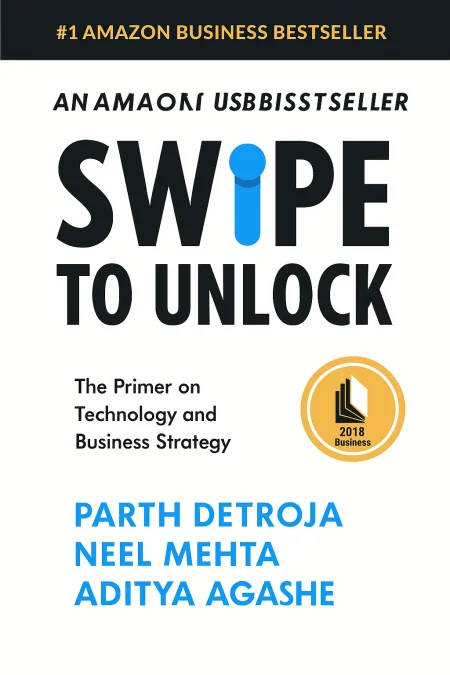
Swipe to Unlock
The Primer on Technology and Business Strategy
byParth Detroja, Neel Mehta, Aditya Agashe
Book Edition Details
Summary
Ever wonder what fuels the digital giants of today? "Swipe to Unlock" is your backstage pass to the world of technology and business strategies that shape our digital landscape. Crafted by tech insiders from Google, Microsoft, and Facebook, this bestselling guide peels back the curtain on the internet's most pressing questions: How does Google turn a profit while offering free services? What’s the secret sauce behind those eerily accurate ads? It demystifies tech jargon and reveals the seismic shifts technology is making in our lives. Whether you're aiming to thrive in tech or simply wish to navigate the digital world with savvy, this book is your essential companion for understanding the forces at play in our connected age.
Introduction
Every day, you tap, swipe, and click your way through a digital world that seems almost magical. Your phone knows exactly where you are, Netflix suggests the perfect show for your mood, and Amazon anticipates what you want to buy before you even know it yourself. But behind every app icon and website lies a fascinating web of algorithms, business strategies, and technological innovations that most of us never think to question. How does Google return millions of search results in milliseconds? Why are most apps free when they clearly cost millions to develop? What invisible forces shape the digital experiences we take for granted? This exploration reveals the hidden mechanics powering our connected world, from the clever ways companies turn free services into billion-dollar empires to the intricate dance of data that makes modern technology possible. You'll discover how understanding these fundamental principles can transform you from a passive consumer into someone who truly comprehends the digital age we're living in.
How Software Powers Our Digital World
Software is the invisible foundation that makes our digital lives possible, yet most of us interact with it without understanding what's actually happening behind the screen. When you open an app or visit a website, you're essentially communicating with a computer using a translator called an operating system. Think of your phone's operating system like the manager of a busy restaurant, coordinating between what you want and what the kitchen can actually prepare. The magic begins with algorithms, which are simply step-by-step instructions that computers follow to solve problems. Google's search algorithm, for instance, doesn't actually search the entire internet every time you type a query. Instead, it maintains a massive index of web pages and uses sophisticated ranking systems to determine which results are most relevant to you. Similarly, when Spotify creates your weekly playlist, it's using algorithms that analyze your listening habits and compare them to millions of other users to predict what you might enjoy next. What makes modern software truly powerful is how different applications work together through APIs, or application programming interfaces. These are like standardized electrical outlets that allow different devices to connect and share power. When you use Uber, the app doesn't create its own maps from scratch, it plugs into Google Maps' API to show you where your ride is located. This interconnectedness allows developers to build sophisticated applications by combining the specialized capabilities of many different services. The constant evolution of software is driven by continuous experimentation. Companies like Facebook and Amazon are constantly running A/B tests, showing different versions of features to different users to see which performs better. This scientific approach to software development means that the apps and websites you use today are the result of thousands of small experiments, each one designed to make your experience just a little bit better.
The Business Behind Free Apps and Services
The most counterintuitive aspect of the modern digital economy is how companies can offer sophisticated services for free while generating billions in revenue. The secret lies in understanding that when you're not paying for a product with money, you're paying with something else, usually your attention and data. This fundamental shift has created entirely new business models that would have been impossible in the pre-digital era. The freemium model is perhaps the most straightforward of these new approaches. Companies like Spotify and Dropbox give away basic versions of their services to attract users, then convert a small percentage of them into paying customers who want premium features. The mathematics work because the cost of serving additional free users is often very low, while the paying customers generate enough revenue to subsidize everyone else. It's like a gym that gives free day passes knowing that some visitors will eventually sign up for expensive memberships. Advertising-based models represent a more complex value exchange. Google and Facebook have built their empires by creating detailed profiles of their users' interests, behaviors, and preferences, then selling access to these audiences to advertisers. The more accurately they can target ads, the more advertisers are willing to pay. This creates a virtuous cycle where better targeting leads to higher revenues, which can fund better services, which attract more users and even more detailed data. Platform businesses like Amazon and Uber take yet another approach, acting as intermediaries between buyers and sellers while taking a commission on each transaction. These companies don't need to manufacture products or own physical assets, they simply facilitate connections and take a percentage of the value they help create. The scalability of this model is extraordinary because once the platform is built, adding more users or transactions doesn't proportionally increase costs, but it does increase revenue.
Technology Policy and Future Trends
The increasing power and pervasiveness of technology has inevitably led to complex policy challenges that governments around the world are struggling to address. Issues like net neutrality, data privacy, and antitrust regulation represent fundamental questions about how much control technology companies should have over information flow and market competition. These aren't just abstract policy debates, they have real implications for innovation, consumer choice, and even democratic participation in society. The concept of net neutrality illustrates how technical infrastructure decisions become political battlegrounds. Internet service providers want the flexibility to prioritize certain types of traffic or charge content providers for faster delivery, while advocates argue this creates an uneven playing field where wealthy companies can essentially buy better internet access. The debate reflects deeper tensions between market freedom and equal access to information, with both sides presenting compelling arguments about innovation and fairness. Privacy regulations like Europe's Right to be Forgotten law demonstrate how different cultures approach the balance between individual privacy and information transparency. While Americans tend to prioritize free speech and open access to information, Europeans place greater emphasis on personal privacy and the ability to control one's digital reputation. These cultural differences are creating a patchwork of global regulations that technology companies must navigate. Looking toward the future, artificial intelligence and automation represent perhaps the most significant technological shift since the internet itself. Self-driving cars, natural language processing systems like Siri, and machine learning algorithms are moving from science fiction to everyday reality. However, these advances raise profound questions about employment, privacy, and even the nature of human creativity. The companies that successfully navigate both the technical challenges and the societal implications of these technologies will likely define the next era of digital innovation.
Summary
The digital world that surrounds us is far more deliberate and strategically designed than most people realize, with every swipe, click, and notification the result of careful business planning and technological optimization. Understanding how companies turn free services into profitable businesses, how algorithms shape the information we see, and how policy decisions affect technological development reveals the hidden forces that increasingly govern our daily lives. As artificial intelligence, automation, and data collection become even more sophisticated, the questions we face will become more complex: How do we balance innovation with privacy? What happens when machines can perform most human jobs? How do we ensure that technological progress benefits everyone, not just those who control the platforms? By grasping these fundamental concepts, you're better equipped not just to navigate the digital world as it exists today, but to participate in shaping how it evolves tomorrow.
Related Books
Download PDF & EPUB
To save this Black List summary for later, download the free PDF and EPUB. You can print it out, or read offline at your convenience.
By Parth Detroja
