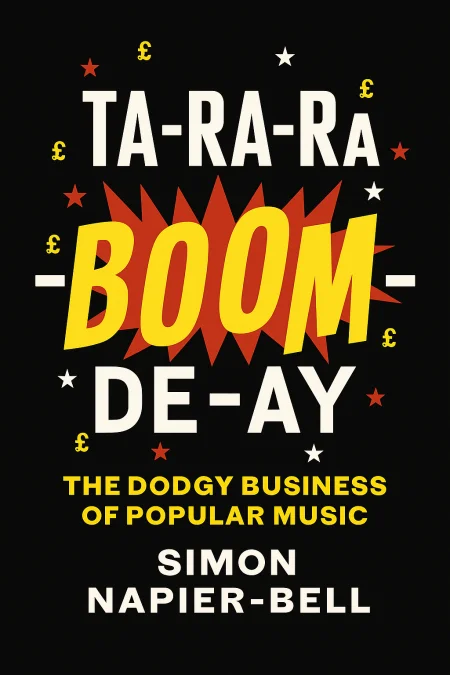
Ta-Ra-Ra-Boom-De-Ay
The (Dodgy) Business of Popular Music
Book Edition Details
Summary
Legendary music manager Simon Napier-Bell pulls back the curtain on the tumultuous and electrifying history of the music industry in "Ta-ra-ra-boom-de-ay." From the British parliament's first nod to intellectual property in 1713 to today's sprawling global empire dominated by foreign powers, Napier-Bell crafts an intoxicating narrative that reveals the industry's wild evolution. Bursting with insider anecdotes and sharp wit, he uncovers the secret recipe behind 50,000 hit songs and the transformative power of jazz's cheek-to-cheek dances. He charts how Hollywood's golden era stifled music's potential and how teenage rebellion rewrote the rules forever. Unraveling the rise of rap from friendly DJ banter to a powerhouse genre, this book promises a captivating odyssey through the forces that shaped what we hear today. Prepare to never hear music the same way again.
Introduction
Picture a bustling street corner in 1890s Manhattan where the clatter of piano keys mingles with the shouts of sheet music salesmen hawking the latest hits. This chaotic scene from Tin Pan Alley represents the birth of an industry that would grow to shape global culture and generate billions in revenue. Yet behind every catchy melody lay a complex web of copyright laws, marketing schemes, and technological innovations that transformed simple songs into commercial empires. The story of the music business reveals how creative expression becomes commodified, how technological disruption repeatedly reshapes entire industries, and how power shifts between artists, entrepreneurs, and corporate giants across generations. From the first copyright laws of 1710 to today's streaming algorithms, this industry has consistently pioneered new forms of both exploitation and innovation, creating templates that extend far beyond entertainment into every corner of the modern economy. This narrative will resonate with music lovers curious about the hidden forces behind their favorite songs, entrepreneurs fascinated by industry transformation, and anyone seeking to understand how creative industries evolve when art meets commerce. The patterns revealed here illuminate not just how we consume music today, but how technological change creates opportunities for those bold enough to embrace disruption rather than resist it.
Birth of Commercial Music: Copyright Laws to Tin Pan Alley (1710-1920)
The music industry's foundation was laid not by artists, but by a legal innovation that changed everything. When Britain's Parliament passed the Statute of Anne in 1710, extending copyright protection to written works including musical compositions, they inadvertently created the framework for transforming melodies into property that could be owned, bought, and sold. This legal breakthrough established the principle that would define the industry for centuries: whoever controlled the rights to music controlled the profits. The early pioneers understood this opportunity instinctively. In London, Samuel Chappell transformed his Bond Street piano store into a publishing empire by recognizing that owning popular songs could be far more profitable than selling instruments. His partnership with pianist Johann Baptist Cramer in 1810 created the template for the modern music business, proving that systematic promotion and strategic partnerships could turn compositions into cultural phenomena while generating substantial returns. Across the Atlantic, America's music industry emerged from the entrepreneurial hunger of immigrants and outcasts who found opportunity in entertainment when other industries remained closed to them. The stretch of Manhattan that became known as Tin Pan Alley in the 1880s was populated by sharp-eyed businessmen like Charles K. Harris and Leo Feist, who industrialized songwriting by employing armies of "song pluggers" to ensure their melodies reached every corner of American society. These men pioneered the concept of manufactured hits, proving that with enough marketing muscle and strategic bribery of performers, almost any song could become popular. The genius of these early music moguls lay in understanding that songs were just raw material for a much larger business. They created distribution networks, developed promotional strategies, and established the corrupt but effective system of payola that would plague the industry for generations. By the time Thomas Edison's phonograph arrived in the 1890s, the infrastructure was already in place to transform recorded music from a novelty into a mass market phenomenon that would reshape popular culture worldwide.
Mass Media Revolution: Radio Wars and Hollywood's Golden Age (1920-1960)
The 1920s transformed music from a local cottage industry into a national mass entertainment juggernaut, driven by the revolutionary power of radio broadcasting. What had once been a business of selling sheet music to families gathered around pianos suddenly became a battle for control over the soundtrack of American life. Radio created the first truly national music market, but it also sparked the industry's first major war over who would control and profit from this new medium. The conflict erupted when ASCAP, the collection society representing established publishers and songwriters, demanded substantial licensing fees from radio stations. Broadcasters fought back by creating their own rival organization, BMI, in 1939, leading to a year-long ban on ASCAP music from radio airwaves in 1941. This battle accidentally democratized American music by opening radio to blues, country, and jazz artists who had been excluded from ASCAP's elite membership, proving that audiences were hungry for sounds beyond the established Tin Pan Alley formulas. Hollywood's entry into music publishing during this era represented the industry's first major consolidation wave. When Warner Brothers spent nine million dollars acquiring major publishing houses like Witmark and Harms, they weren't just buying song catalogs but attempting to control the entire pipeline from composition to consumption. The strategy worked brilliantly during the early sound film era, as movie studios could guarantee their songs would be heard by millions of moviegoers, but the Great Depression forced a strategic retreat that revealed the limits of vertical integration. The big band era that dominated the 1930s and 1940s demonstrated how technological innovation could create entirely new markets while destroying old ones. Bandleaders like Benny Goodman and Count Basie became the first music superstars of the electronic age, their performances amplified by radio and recordings to reach audiences that previous generations of musicians could never have imagined. Yet this golden age also institutionalized the industry's persistent problems with corruption, as publishers routinely bribed bandleaders to play their songs, creating a system where commercial success often bore little relation to artistic merit.
Rock Transformation and Corporate Consolidation Era (1960-2000)
The emergence of rock and roll in the 1950s represented far more than a musical revolution; it was a generational transfer of power that caught the established industry completely unprepared. When Sam Phillips recorded Elvis Presley at Sun Studios in Memphis, or when the Chess brothers captured Muddy Waters in Chicago, they weren't trying to overthrow the established order but simply serving audiences that mainstream labels had ignored. The major record companies, still focused on adult audiences and established crooners, initially dismissed rock as a passing teenage fad, allowing independent labels to dominate the most vital new music of the era. The independents succeeded because they understood something the majors had missed: teenagers had become a distinct market segment with their own musical tastes and significant spending power. Labels like Atlantic Records, run by the Ertegun brothers, built their success by treating black artists with more respect and offering better royalty deals than the major labels provided. This wasn't pure altruism but smart business, as it allowed them to sign the most innovative musicians and develop the sounds that would define popular music for decades. However, the corporate world eventually recognized the enormous profit potential in youth music and began a systematic campaign to regain control. The payola scandals of the late 1950s, while exposing real corruption, also served to eliminate many independent operators and consolidate power in fewer hands. Major corporations bought up successful independent labels, hired away their key personnel, and gradually transformed rock and roll from rebellious outsider music into a corporate product with predictable formulas and mass market appeal. By the 1970s and 1980s, the industry had evolved into a handful of multinational corporations controlling most of the world's popular music distribution. The Warner Music Group, CBS Records, and other giants operated with unprecedented resources and global reach, but they also brought corporate bureaucracy and risk-averse thinking to what had once been an entrepreneurial business. The introduction of the compact disc created windfall profits that masked underlying creative stagnation, while MTV's visual requirements raised barriers to entry for new artists who now needed not just musical talent but photogenic appeal and substantial production budgets.
Digital Disruption: From Napster to Streaming Dominance (2000-Present)
The digital revolution that began with Napster in 1999 represented the most fundamental challenge to the music industry's business model since the invention of recorded sound itself. File-sharing networks demonstrated that music could be distributed globally at virtually no cost, undermining the artificial scarcity that had made record companies profitable for over a century. The industry's initial response was purely defensive, launching thousands of lawsuits against file-sharing services and even individual consumers while failing to develop viable digital alternatives that addressed changing consumer expectations. This period exposed the industry's deepest structural weakness: its business model depended on controlling distribution rather than creating genuine value for consumers. For decades, record companies had forced customers to buy entire albums to access desired songs, charged premium prices for CDs that cost pennies to manufacture, and restricted how people could use music they had purchased. Digital technology eliminated these artificial constraints, and consumers enthusiastically embraced the freedom to access any song instantly and share music freely with friends and family. Apple's iTunes Store, launched in 2003, provided the first successful legal alternative to piracy, but it also marked a fundamental shift in industry power dynamics. Steve Jobs understood that consumers valued convenience and fair pricing over the industry's elaborate packaging and marketing campaigns. By offering individual songs for 99 cents with simple, transparent pricing, iTunes proved that people would pay for digital music if the terms were reasonable, but it also reduced record companies to mere content suppliers for technology platforms controlled by others. The transformation accelerated with streaming services like Spotify and Apple Music, which changed music from a product people owned to a service they subscribed to access. This shift fundamentally altered the industry's economics, making catalog depth more valuable than individual hit songs and giving unprecedented power to the algorithms that determined what millions of people heard each day. The industry that had once controlled every aspect of how music reached consumers found itself dependent on technology companies and their opaque recommendation systems, completing a revolution that began with teenage file-sharers and ended with Silicon Valley giants controlling the future of musical culture.
Summary
The evolution of the music business reveals a fundamental paradox that extends far beyond entertainment: industries built on human creativity and cultural expression inevitably become ruthlessly commercial enterprises, yet this very commercialization enables art to reach and unite audiences on an unprecedented global scale. From the copyright laws of 1710 to today's streaming algorithms, every major transformation emerged from the productive tension between artistic expression and entrepreneurial ambition, creating new opportunities for both creators and business innovators. The industry's history demonstrates that technological disruption follows predictable patterns, often appearing threatening to established players while ultimately expanding total market opportunities for those adaptable enough to embrace change rather than resist it. Radio seemed to threaten sheet music publishers, television challenged radio's dominance, and digital streaming appeared to destroy traditional record sales, yet each disruption created new revenue streams and reached previously untapped audiences. The key insight for today's entrepreneurs and creators is that periods of apparent chaos often represent the greatest opportunities for those willing to serve emerging consumer needs rather than defend obsolete business models. Perhaps most importantly, this history shows that cultural gatekeepers are never as powerful as they appear, and that the next revolution typically emerges from the margins rather than established centers of power. The immigrant entrepreneurs who built Tin Pan Alley, the independent record producers who launched rock and roll, and the technology innovators who created streaming platforms all succeeded by understanding their audiences better than industry experts. Today's creators and entrepreneurs can draw inspiration from this pattern: the future belongs to those who focus on serving audiences directly rather than navigating existing power structures, and who recognize that in creative industries, adaptability and audience connection matter far more than size or established market position.
Related Books
Download PDF & EPUB
To save this Black List summary for later, download the free PDF and EPUB. You can print it out, or read offline at your convenience.
By Simon Napier-Bell
