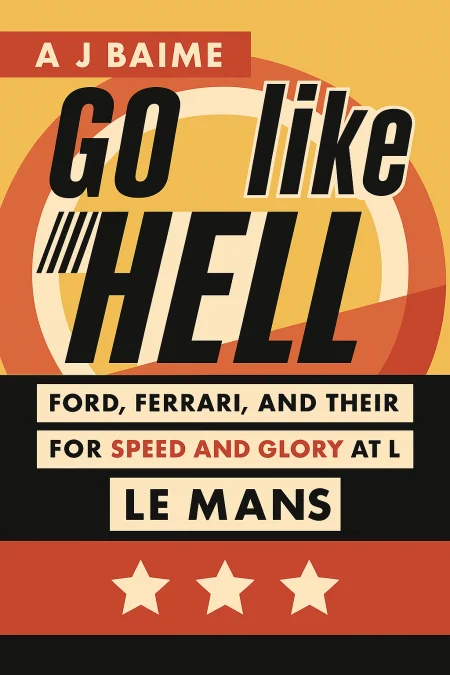
Go Like Hell
Ford, Ferrari, and Their Battle for Speed and Glory at Le Mans
Book Edition Details
Summary
In the throes of the 1960s automotive revolution, two titans clashed on the world's most unforgiving stage: the 24 Hours of Le Mans. On one side, Henry Ford II, grappling with the shadow of his legendary grandfather, sought to invigorate his family's legacy. With an audacious plan and the genius of Lee Iacocca and Carroll Shelby at his side, Ford aimed to topple the king of speed—Enzo Ferrari, whose cars were both masterpieces and deathtraps. "Go Like Hell" plunges readers into this high-octane saga, where daring visionaries risked everything to transform the humdrum Ford into a racing legend. This thrilling narrative paints a vivid picture of ambition, rivalry, and the relentless pursuit of glory, where the roar of engines was matched only by the clamor of ambition and the drive for victory at any cost.
Introduction
In the early 1960s, two automotive titans found themselves locked in a battle that would reshape not only motor racing but the very nature of corporate competition itself. On one side stood Henry Ford II, heir to America's automotive empire, determined to prove that American engineering could conquer Europe's most prestigious racing circuits. On the other stood Enzo Ferrari, the enigmatic Italian craftsman whose red racing machines had dominated Le Mans for years, becoming symbols of European sophistication and speed. This extraordinary confrontation reveals how personal pride, national identity, and corporate ambition converged to create one of history's most compelling industrial rivalries. The story illuminates the transformation of racing from a gentleman's sport into a high-stakes marketing battlefield, where victory meant not just trophies but millions in sales and global prestige. It demonstrates how technological innovation accelerates under pressure, as both companies pushed the boundaries of automotive engineering to achieve speeds that seemed impossible. The narrative offers profound insights into leadership styles, corporate culture, and the price of obsession. Readers interested in business strategy, automotive history, or the psychology of competition will discover how two very different approaches to manufacturing and management clashed on the world's most dangerous racetracks. The tale serves as both thrilling sports drama and penetrating business case study, showing how the pursuit of speed became a metaphor for the broader struggle between American industrial might and European craftsmanship.
Empires in Conflict: The Seeds of Industrial Rivalry (1960-1963)
The stage was set in the early 1960s when two automotive empires stood at crossroads that would define their legacies. Henry Ford II, known as "The Deuce," had spent fifteen years rebuilding his grandfather's company from near-collapse into America's second-largest corporation. By 1960, Ford Motor Company was selling over six million cars annually, yet Henry II faced a troubling reality: his cars lacked the glamour and performance reputation that drove customer desire. Meanwhile, in the ancient Italian city of Modena, Enzo Ferrari had transformed from a failed racing driver into the world's most revered constructor of racing machines. Operating from a modest factory that produced fewer cars in a year than Ford made in a day, Ferrari had achieved something Henry II desperately wanted: his name had become synonymous with speed, beauty, and victory. Ferrari's red racing cars dominated Le Mans, Europe's most prestigious endurance race, while his road cars commanded prices that exceeded most Americans' annual salaries. The catalyst for confrontation came in 1962 when General Motors began secretly funding racing programs despite industry agreements to avoid such competition. Henry II watched helplessly as Chevrolet and Pontiac dominated American racetracks, translating victories into soaring sales. "We're going in with both feet," Henry II declared as he withdrew Ford from the safety resolution that had banned factory racing support. The decision marked more than a return to competition; it represented a fundamental shift in how automotive companies would market their products. This period established the philosophical divide that would define their coming war. Ford represented American industrial might: massive resources, committee decision-making, and the belief that any problem could be solved by throwing enough money and engineering talent at it. Ferrari embodied European craftsmanship: intuitive design, individual genius, and the conviction that racing cars were works of art that happened to go fast. These contrasting worldviews would soon collide on the world's most dangerous racetracks.
Engineering Revolution: American Power vs European Craftsmanship (1964-1965)
The spark that ignited open warfare came from an unexpected source: a failed business negotiation that wounded Henry Ford II's pride and set in motion one of automotive history's most ambitious projects. In spring 1963, Ferrari had secretly approached Ford about selling his company, leading to months of complex negotiations. When the deal collapsed at the final moment—with Ferrari dramatically storming out of the meeting—Henry II felt personally humiliated. "We'll beat his ass," he declared, launching what would become the GT40 program. Ford's challenge was unprecedented: no major American manufacturer had won a significant European race since 1921. The company assembled a team of brilliant engineers led by Roy Lunn, who had previously designed winning cars for Aston Martin. Working from a facility near London's Heathrow Airport, they had less than a year to create a car capable of beating Ferrari at Le Mans. The project represented a collision of American ambition with European expertise, as Ford recruited talent from across the continent while pouring unprecedented resources into the effort. The resulting machine, dubbed GT40 for its 40-inch height, embodied revolutionary thinking. Unlike traditional American cars with their emphasis on straight-line speed, the GT40 featured a mid-mounted engine, sophisticated aerodynamics, and lightweight construction. Every component was sourced from the world's best suppliers, creating what Ford called "The World Car." Yet the project's rushed timeline created enormous risks, as the first cars had barely been tested before facing Ferrari's proven machines. The GT40's debut at Le Mans in 1964 became a masterclass in the difference between engineering brilliance and racing reality. While Ford's cars were theoretically faster than anything Ferrari had built, they suffered catastrophic failures that eliminated them from competition before the race was half over. The humiliation was complete and public, broadcast live to American television audiences who watched their automotive champions fail spectacularly. This defeat, however, only strengthened Henry II's resolve and set the stage for an even more determined assault on Ferrari's dominance.
Total War: Corporate Mobilization and Technological Arms Race (1965-1966)
The year 1965 marked a dramatic escalation in both the technological arms race and the personal animosity between the two automotive titans. Henry Ford II, stung by his public humiliation at Le Mans, authorized unlimited spending to develop a new generation of racing cars. The centerpiece was the Mk II, powered by Ford's massive 427-cubic-inch NASCAR engine—a brute force approach that doubled down on American philosophy of solving problems through sheer power. Ferrari responded with the elegant 330 P2, a masterpiece of Italian engineering that proved lighter, more fuel-efficient, and more reliable than Ford's approach. The philosophical divide had never been clearer: Ford's cars were technological marvels that often broke down, while Ferrari's machines were works of art that consistently finished races. John Surtees, Ferrari's English world champion, dominated early season races while Ford's expensive prototypes continued to suffer embarrassing mechanical failures. The rivalry took on nationalistic overtones as American media portrayed the contest as a battle for technological supremacy between the New World and Old Europe. Carroll Shelby, the charismatic Texan who managed Ford's racing program, became the face of American determination, while Enzo Ferrari remained the mysterious "Magician of Maranello" who seemed to conjure victories through some combination of genius and dark magic. The press coverage transformed what had begun as a corporate rivalry into a cultural phenomenon. By 1966, Ford had transformed the Le Mans project from a racing program into a corporate crusade that mobilized resources across the entire company. The establishment of the Le Mans Committee represented unprecedented coordination between engineering, manufacturing, and racing departments. This systematic approach reflected broader changes in American corporate culture, where traditional boundaries between departments were dissolving in favor of project-based collaboration. The methodical persistence would soon transform early failures into the foundation for ultimate victory.
Victory's Price: Le Mans Triumph and the New Era (1966-Beyond)
The climactic year of 1966 brought both triumph and tragedy as the Ford-Ferrari rivalry reached its devastating conclusion. Henry Ford II, having spent an estimated $25 million on his racing program, issued an ultimatum to his engineers: win Le Mans or find new jobs. The pressure transformed Ford's racing effort from a marketing campaign into a corporate crusade, with every department in the company contributing to the effort. Meanwhile, Ferrari faced his own crisis as his star driver John Surtees lay hospitalized from a near-fatal crash, forcing the Italian master to rebuild his team while under unprecedented assault from American resources. The 1966 Le Mans race became a watershed moment in automotive history. Ford's new Mk IV cars, refined through countless hours of testing and development, finally achieved the reliability that had eluded them in previous years. In a dramatic finish orchestrated for maximum publicity impact, three Ford GT40s crossed the finish line in formation, ending Ferrari's dominance and achieving Henry II's long-sought victory. The image of American cars conquering Europe's most prestigious race became an instant symbol of technological triumph. Yet victory came at an enormous cost that extended far beyond the millions spent on development. The relentless pursuit of speed had claimed numerous lives, including several of Ferrari's most talented drivers. The racing world had been transformed from a gentleman's sport into a high-stakes industrial battlefield where human lives were sacrificed to corporate ambition. Enzo Ferrari, devastated by the deaths of his drivers and the loss of his Le Mans supremacy, began to withdraw from the sport that had defined his life. The Ford-Ferrari war fundamentally changed how automotive companies approached competition and marketing. Racing victories became essential to brand identity, leading to an arms race in performance that continues today. The rivalry demonstrated how personal obsession could drive technological innovation, but also revealed the dark side of unchecked corporate ambition. The lessons learned on the racetracks of Europe would influence automotive design for decades, as the pursuit of speed became inseparable from the business of selling cars.
Summary
The Ford-Ferrari rivalry of the 1960s represents more than a corporate competition; it embodies the eternal tension between industrial might and artisanal craftsmanship, between American ambition and European tradition. At its core, the conflict revealed how personal pride and national identity could transform business decisions into existential struggles, driving innovation at unprecedented speed while exacting terrible human costs. The story offers three profound lessons for modern leaders and organizations. First, the power of obsession to drive breakthrough innovation cannot be underestimated—both Ford and Ferrari achieved technological advances that seemed impossible when the rivalry began, proving that extraordinary challenges can produce extraordinary solutions. Second, the importance of understanding that competition is ultimately about more than products or profits; it involves culture, identity, and the stories organizations tell about themselves. Finally, the narrative demonstrates that victory without wisdom can be hollow—Ford's triumph at Le Mans came at such enormous cost in resources and human lives that it raises questions about whether the prize was worth the price paid. Today's business leaders facing disruptive competition or technological challenges can draw inspiration from both protagonists while learning from their mistakes. The key lies in channeling competitive fire toward innovation and excellence rather than allowing rivalry to become destructive obsession. True victory comes not from defeating opponents but from pushing entire industries toward higher standards of performance and achievement, creating value that transcends any single competition or moment of triumph.
Related Books
Download PDF & EPUB
To save this Black List summary for later, download the free PDF and EPUB. You can print it out, or read offline at your convenience.
By A.J. Baime
