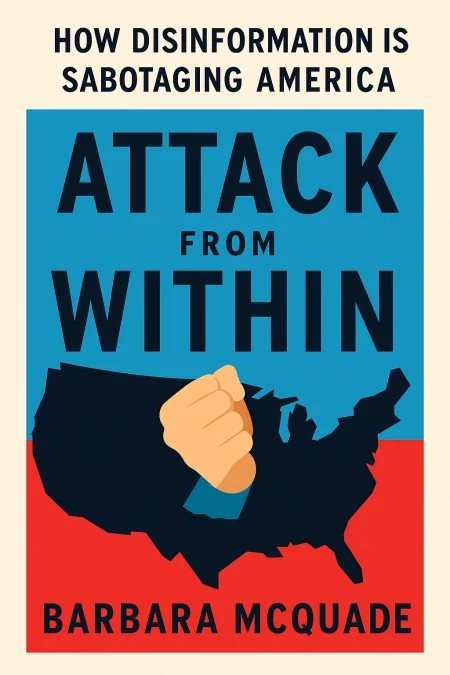
Attack from Within
How Disinformation Is Sabotaging America
Book Edition Details
Summary
In the digital age, truth is under siege, with disinformation sowing discord and threatening the core of democracy. MSNBC's Barbara McQuade wields her legal acumen in "Attack from Within," exposing how calculated deceit fractures public trust, skewers political discourse, and undermines societal institutions. As polarized narratives deepen rifts, the book reveals the machinations behind these destructive forces, spotlighting the urgent need for vigilance and action. With the specter of advanced AI amplifying falsehoods, McQuade issues a clarion call to reclaim democratic integrity before it’s too late. Here, readers find not just a diagnosis of a grave threat, but a roadmap to fortify the future, demanding we recognize and confront the invisible puppeteers manipulating our perceptions.
Introduction
Democratic societies face an unprecedented threat that operates not through military conquest or economic coercion, but through the systematic weaponization of false information designed to fracture the shared foundation of truth upon which self-governance depends. This assault exploits the very openness and freedoms that define democratic culture, turning constitutional protections and technological innovations into instruments of destruction against the system they were meant to serve. The phenomenon transcends traditional propaganda or partisan messaging, representing instead a coordinated campaign to eliminate citizens' capacity to distinguish fact from fiction, creating conditions where authoritarian control becomes not only possible but seemingly necessary. The investigation employs a multi-dimensional analytical framework that combines historical examination of authoritarian tactics with contemporary case studies, revealing how age-old strategies of manipulation have been supercharged by digital technology and social media platforms. The methodology traces both the supply and demand sides of disinformation, examining how false narratives are crafted and disseminated by malicious actors while analyzing the psychological and social vulnerabilities that make democratic populations susceptible to coordinated deception. This approach illuminates the pathway from individual lies to systemic democratic breakdown, demonstrating how disinformation campaigns create cascading effects that compromise elections, undermine public safety, and erode the rule of law itself. The analysis reveals that successful disinformation operations function as sophisticated psychological warfare, designed not necessarily to convince people of specific falsehoods but to create such profound confusion and cynicism that citizens withdraw from civic engagement altogether. Understanding this dynamic requires examining how modern information warfare exploits cognitive biases, amplifies existing social divisions, and systematically destroys trust in the institutions and expertise that democratic governance requires to function effectively.
The Authoritarian Disinformation Playbook: Weaponizing Falsehood for Political Control
Authoritarian movements throughout history have relied on remarkably consistent tactics to seize and maintain power, with disinformation serving as the catalyst that makes other strategies effective. The playbook begins with emotional manipulation that appeals to fear and grievance rather than reason and evidence, cultivating a sense of decline and victimhood that convinces populations their way of life faces existential threats requiring a powerful leader's intervention. This approach transforms political discourse from policy debates into apocalyptic battles between good and evil, where compromise becomes impossible and opposition appears treasonous. The strategy of deliberate division follows naturally from emotional manipulation, exploiting existing social fault lines through disinformation campaigns that demonize and scapegoat targeted groups while portraying the movement as defenders of traditional values. These operations create artificial either-or choices that force citizens to pick sides, eliminating the middle ground where democratic compromise typically occurs. Through careful branding and symbolism, authoritarian movements build tribal loyalty that transcends rational policy considerations, making followers willing to accept any action that advances their cause regardless of legal or moral constraints. Systematic suppression of criticism represents another crucial element, transforming independent media into the "enemy of the people," civil servants into the "deep state," and courts into partisan weapons rather than neutral arbiters. By methodically undermining sources of accountability, authoritarian leaders create space for their disinformation to flourish unchallenged while normalizing political violence as legitimate response to perceived threats. This conditioning process makes followers view aggression as patriotic duty rather than criminal behavior. The final component involves crafting a cult of personality around the leader, who simultaneously presents himself as both an ordinary person and a superhuman savior. This paradox allows followers to identify with the leader while viewing him as uniquely capable of solving complex problems through force of will alone. The leader becomes the embodiment of the movement itself, making criticism of his actions equivalent to attacks on followers' own identity and values, thereby creating psychological immunity to factual correction or legal accountability.
Psychological Vulnerabilities: Why Democratic Societies Fall for Coordinated Deception
Democratic societies contain inherent psychological and structural vulnerabilities that make them particularly susceptible to disinformation campaigns, beginning with the fear of rapid social change that creates anxiety making people more receptive to simple explanations and scapegoating narratives. As demographic shifts, technological advancement, and cultural evolution accelerate, significant portions of the population experience disorienting "future shock" where the familiar world seems to be disappearing. This psychological state makes conspiracy theories and authoritarian promises of restoration particularly appealing, offering coherent explanations for complex changes that feel overwhelming and threatening. Cognitive biases compound these vulnerabilities by systematically distorting how people process information, with confirmation bias leading individuals to seek sources that reinforce existing beliefs while dismissing contradictory evidence. The backfire effect means that attempts to debunk false claims often strengthen rather than weaken belief in them, while conformity bias drives people to adopt positions that signal membership in their preferred social group even when those positions conflict with personal interests or observable reality. These natural human tendencies become weaponized in information warfare designed to exploit rather than educate. Social media and digital technology amplify these psychological vulnerabilities by creating echo chambers where false beliefs can flourish without challenge, with algorithmic curation ensuring users primarily encounter information confirming preexisting views while the speed and volume of online content overwhelms people's ability to fact-check what they consume. The decline of local news and shared information sources means citizens increasingly inhabit separate information universes with incompatible versions of reality, making democratic deliberation nearly impossible when basic facts cannot be agreed upon. The democratic commitment to free speech, while essential to self-governance, creates additional vulnerabilities that authoritarian movements systematically exploit. The marketplace of ideas assumes truth will emerge through open debate, but this model breaks down when bad actors flood the zone with deliberate falsehoods designed to create confusion rather than illuminate truth. Legal protections for political speech make it difficult to hold disinformation peddlers accountable, while cultural norms against censorship prevent platforms from aggressively moderating harmful content, creating an asymmetric battlefield where democratic values become weapons against democracy itself.
Democratic Breakdown: From Information Warfare to Institutional Collapse
Electoral democracy depends fundamentally on citizens' shared belief that votes are counted accurately and losing candidates will accept defeat gracefully, creating the peaceful transfer of power that distinguishes democratic systems from authoritarian ones. Disinformation attacks this foundation by promoting baseless claims of fraud and rigging that create doubt about electoral legitimacy, succeeding not by proving actual fraud occurred but by generating sufficient suspicion that significant portions of the population lose faith in the entire system. This erosion of electoral trust creates justification for increasingly extreme measures presented as necessary reforms to restore integrity. The phenomenon of the "Big Lie" about electoral fraud exemplifies how disinformation can systematically undermine democratic norms through persistent repetition despite overwhelming contradictory evidence. Even after dozens of failed court challenges and confirmation from election officials across the political spectrum, millions of citizens continue believing elections were stolen, providing justification for efforts to restrict voting access, remove professional election administrators, and place partisan loyalists in positions of electoral oversight. The lie becomes self-perpetuating, with each new restriction cited as evidence that the system was indeed compromised, creating a feedback loop of increasing authoritarianism. Disinformation campaigns particularly target communities of color and other groups likely to support democratic candidates through tactics including spreading false information about voting procedures, creating confusion about registration requirements, and promoting conspiracy theories designed to discourage participation. These efforts represent modern versions of historical voter suppression tactics, using psychological manipulation rather than physical intimidation to achieve the same antidemocratic goals while maintaining plausible deniability about discriminatory intent. The erosion of electoral integrity creates cascading effects throughout the democratic system, as significant portions of the population viewing election results as illegitimate become more willing to support extraconstitutional measures to "restore" preferred outcomes. Politicians who benefit from this skepticism have little incentive to correct false narratives, instead amplifying them to maintain base support, creating a dynamic where disinformation generates the very problems it claims to address while justifying ever more extreme responses that further undermine democratic institutions and norms.
Defending Truth: Legal and Social Strategies Against Information Warfare
Defending democracy against disinformation requires coordinated action across multiple fronts that addresses both the supply of false information and the demand for it, beginning with legal reforms that strengthen accountability by updating defamation laws for the digital age, requiring transparency in political advertising, and closing loopholes that allow dark money to fund disinformation campaigns. Technology platforms need stronger content moderation policies and algorithmic changes that prioritize accuracy over engagement while maintaining respect for legitimate free speech, creating systems that slow the viral spread of false information without becoming arbiters of political truth. Educational initiatives must help citizens develop better media literacy skills and resistance to manipulation techniques through programs that teach recognition of common disinformation tactics, source verification methods, and critical thinking about emotionally charged content. Civic education should emphasize the importance of democratic norms and the dangers of political violence, helping people understand why these principles matter for their own wellbeing rather than treating them as abstract ideals. These educational efforts must be sustained and systematic rather than reactive responses to immediate crises. Rebuilding trust in democratic institutions requires transparency, accountability, and consistent adherence to professional standards, with election officials communicating clearly about security measures and vote-counting procedures while law enforcement agencies demonstrate impartiality in their investigations. Media organizations should recommit to rigorous fact-checking and avoid amplifying false claims even when debunking them, recognizing that repetition of lies can strengthen rather than weaken their impact on public consciousness. The most crucial element of any solution involves citizen engagement and responsibility, as democracy cannot survive if people withdraw from civic participation or abandon their commitment to truth and evidence-based reasoning. Citizens must actively seek reliable information sources, engage respectfully with those holding different views, and support leaders who prioritize democratic values over partisan advantage. The battle against disinformation ultimately depends on millions of individual choices to value truth over tribal loyalty and democratic principles over short-term political gains, requiring sustained commitment to the difficult work of democratic citizenship.
Summary
The fundamental threat posed by weaponized disinformation extends far beyond partisan politics to strike at the epistemological foundation that makes democratic governance possible, revealing that when citizens cannot agree on basic facts about their shared reality, they cannot engage in the reasoned debate and compromise that democracy requires to function. The analysis demonstrates that this threat proves particularly insidious because it exploits the very freedoms and openness that make democratic societies valuable, turning constitutional protections and technological innovations into weapons against the system they were designed to protect. Defending democracy therefore requires not merely protecting voting rights and electoral procedures, but actively cultivating a civic culture that values truth, evidence, and good-faith dialogue over tribal loyalty and emotional manipulation, demanding sustained commitment from citizens willing to choose the difficult path of democratic engagement over the seductive simplicity of authoritarian certainty.
Related Books
Download PDF & EPUB
To save this Black List summary for later, download the free PDF and EPUB. You can print it out, or read offline at your convenience.
By Barbara McQuade
