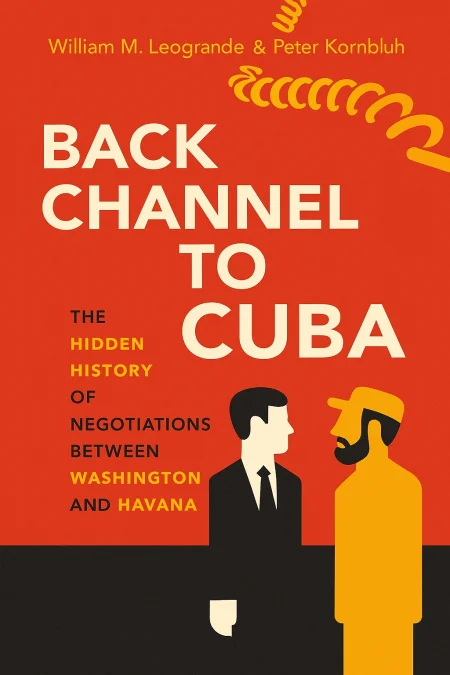
Back Channel to Cuba
The Hidden History of Negotiations Between Washington and Havana
byWilliam M. Leogrande, Peter Kornbluh
Book Edition Details
Summary
In the shadowy dance of diplomacy and enmity, "Back Channel to Cuba" illuminates an intriguing narrative that defies the expected animosity between two storied nations. From the covert chess moves of Kennedy and Kissinger to the bold overtures of Obama, authors LeoGrande and Kornbluh unravel a tapestry of secret dialogues and whispered promises that have woven through decades of icy standoffs and fleeting thaws. With unparalleled access to newly declassified materials, this compelling account uncovers the clandestine efforts that have shaped U.S.-Cuban relations since 1959, challenging the simplistic story of relentless hostility with tales of surprising rapprochement. Here lies a gripping exploration of missed opportunities and the enduring hope for a bridge between worlds, offering fresh insights into a fifty-year saga of covert negotiations and diplomatic tightrope walks.
Introduction
On a humid afternoon in November 1963, Fidel Castro sat across from French journalist Jean Daniel in a seaside villa, discussing President Kennedy's secret overtures for reconciliation. Suddenly, a phone call shattered the moment: Kennedy had been assassinated in Dallas. "This is an end to your mission of peace," Castro declared, his face grave with the weight of lost possibilities. This dramatic scene captures one of history's most fascinating paradoxes: for over six decades, while politicians publicly denounced each other as mortal enemies, American and Cuban officials have conducted an intricate dance of secret diplomacy in hotel rooms, airport lounges, and foreign capitals. This hidden history reveals three profound questions that extend far beyond the Caribbean. How do nations maintain communication even during periods of intense hostility? What happens when domestic politics consistently override strategic interests in foreign policy? And why do some diplomatic breakthroughs succeed while others collapse at the moment of greatest promise? The answers illuminate not just the peculiar dynamics of Cold War confrontation, but the broader challenges facing any democracy trying to conduct rational foreign policy in an era of electoral pressures and interest group influence. This account will fascinate policymakers seeking to understand the mechanics of international negotiation, historians interested in the gap between public rhetoric and private pragmatism, and citizens wondering why some conflicts persist despite obvious mutual benefits from resolution. The story demonstrates that even the most bitter adversaries recognize the need for dialogue when survival is at stake.
Early Revolutionary Tensions and Failed Reconciliation (1959-1968)
The seeds of perpetual conflict between Washington and Havana were planted not in ideological hatred, but in a series of tragic miscalculations during the revolution's first months. When Castro's bearded rebels marched triumphantly into Havana in January 1959, neither side seemed destined for permanent hostility. American Ambassador Philip Bonsal pursued a policy of "patience and forbearance," believing that economic ties and respectful engagement could moderate Castro's revolutionary zeal and keep Cuba within the Western orbit. The critical turning point came through accumulated misunderstandings rather than any single dramatic confrontation. Castro's radical land reforms threatened American business interests worth hundreds of millions of dollars, while his increasingly anti-American rhetoric alarmed Washington policymakers already primed by Cold War anxieties. The Eisenhower administration's decision to authorize covert operations against Castro, even while maintaining diplomatic relations, established a pattern of contradictory signals that would plague the relationship for decades. The Bay of Pigs invasion in April 1961 seemed to slam the door on reconciliation, yet paradoxically opened new channels of secret communication. President Kennedy, despite his public tough stance, privately explored accommodation through intermediaries like lawyer James Donovan and journalist Lisa Howard. These clandestine initiatives revealed both leaders' recognition that their conflict served neither country's fundamental interests. The Cuban Missile Crisis of 1962 further demonstrated how quickly regional tensions could spiral toward global catastrophe, creating powerful incentives for back-channel dialogue. Kennedy's assassination in November 1963 abruptly ended the most promising early attempt at rapprochement, establishing a tragic pattern that would repeat throughout the decades. Whenever diplomatic progress seemed within reach, external events or domestic political calculations would intervene to derail carefully constructed negotiations, leaving both nations trapped in a cycle of missed opportunities and mutual recrimination.
Secret Negotiations and Cold War Constraints (1974-1988)
The mid-1970s witnessed the most sustained and promising attempt at normalization until the Obama era, as Henry Kissinger applied his détente philosophy to America's Caribbean nemesis. Just as Nixon and Kissinger had opened relations with Communist China and pursued arms control with the Soviet Union, they sought to transform Cuba from an implacable enemy into a manageable adversary. Kissinger's secret message to Castro in 1974, carried by Democratic operative Frank Mankiewicz, launched eighteen months of clandestine negotiations that brought the two countries closer to reconciliation than they had been since 1959. The talks revealed both the possibilities and limitations of realpolitik in superpower relations. Meeting in airport cafeterias and hotel suites, American and Cuban diplomats explored a step-by-step process of mutual concessions that would gradually dismantle the apparatus of hostility. Cuba agreed to compensate American companies for nationalized properties and to halt support for Latin American revolutionaries. The United States prepared to lift trade restrictions and restore diplomatic relations, explicitly stating that Cuba's internal political system was not an obstacle to better relations. The negotiations foundered on Cuba's military intervention in Angola, where Castro deployed thirty-six thousand troops to support the Marxist government against South African-backed forces. For Kissinger, this represented an intolerable challenge to American global leadership at a moment when the United States was reeling from defeat in Vietnam. The collision revealed a fundamental mismatch between American and Cuban priorities: while Washington saw Angola as a test of Cuba's willingness to behave responsibly, Castro viewed it as natural solidarity with fellow revolutionaries fighting colonialism and apartheid. Jimmy Carter's presidency brought renewed hope through his human rights focus and commitment to patient diplomacy. The establishment of Interest Sections in both capitals in 1977 provided the first formal diplomatic presence since 1961, while secret negotiations secured the release of thousands of political prisoners. Yet Cuba's involvement in Ethiopia's conflict again derailed progress, as National Security Advisor Zbigniew Brzezinski convinced Carter that Cuban actions in Africa were incompatible with normalized relations, perpetuating the cycle of diplomatic promise followed by geopolitical disappointment.
Post-Cold War Engagement and Political Obstacles (1989-2016)
The end of the Cold War paradoxically made reconciliation both more feasible and more difficult. With Soviet subsidies disappearing and Cuba's economy in crisis, Havana had compelling reasons to seek accommodation with Washington. However, the collapse of the communist threat removed America's strategic incentive for engagement, while the growing political influence of Cuban-American exiles created new domestic obstacles to policy change. The expectation of Castro's imminent collapse made American policymakers reluctant to negotiate with what they saw as a dying regime. Bill Clinton's presidency embodied these contradictions most clearly. While privately acknowledging that the embargo was counterproductive, Clinton subordinated Cuba policy to electoral calculations in Florida, leading to the paradox of a president who understood the need for engagement but lacked the political courage to pursue it systematically. The 1994 migration crisis demonstrated both the possibilities and limits of this approach, as secret negotiations successfully resolved the immediate humanitarian emergency while failing to address underlying tensions. The tragedy of Brothers to the Rescue in 1996 marked a decisive turning point, transforming Cuba policy from a presidential prerogative into a congressional mandate through the Helms-Burton Act. This legislation codified the embargo into law, removing future presidents' flexibility to pursue engagement and ensuring that domestic political considerations would continue to trump strategic thinking. As Clinton himself later acknowledged, supporting the bill was "good election-year politics in Florida, but it undermined whatever chance I might have had to lift the embargo in return for positive changes within Cuba." Barack Obama's breakthrough in December 2014 succeeded where previous efforts had failed because both sides finally recognized that the status quo served neither country's interests. Years of secret negotiations, often conducted through Pope Francis and the Canadian government, created the necessary trust for a dramatic announcement of normalized diplomatic relations. The exchange of prisoners, including contractor Alan Gross and members of the Cuban Five, demonstrated how humanitarian gestures could unlock broader diplomatic possibilities. Yet even Obama's achievement remained fragile, as congressional opposition prevented lifting the trade embargo and the Trump administration's partial reversal showed how vulnerable diplomatic progress remains without broader institutional support.
Summary
The hidden history of American-Cuban negotiations reveals a central paradox of democratic foreign policy: the persistent tension between strategic rationality and domestic political imperatives. For over six decades, every American president privately recognized that the Cuba embargo served no meaningful strategic purpose and that normalized relations would benefit both countries. Yet these same leaders found themselves constrained by electoral calculations, interest group pressures, and the inertia of established policy, creating a recurring cycle of diplomatic promise followed by political retrenchment. This pattern illuminates broader truths about how democracies conduct international relations in an era of partisan polarization and interest group influence. The Cuba case demonstrates that even when policymakers acknowledge the failure of their approach, changing course requires not just presidential will but sustained political commitment across multiple administrations and favorable circumstances that rarely align. The repeated success of back-channel communications, even amid public hostility, shows that professional diplomats understand mutual interests that political rhetoric obscures. Three crucial lessons emerge for contemporary foreign policy challenges. First, humanitarian cooperation can create pathways to broader political dialogue, as demonstrated by prisoner exchanges and migration agreements that survived even the most hostile periods. Second, sustained engagement requires patient, long-term commitment that transcends electoral cycles and partisan changes in government. Finally, the most intractable conflicts often persist not because of irreconcilable differences, but because political systems reward confrontation over compromise, trapping nations in counterproductive policies long after their original strategic rationale has disappeared. Understanding these dynamics is essential for navigating the complex intersection of domestic politics and international relations in our interconnected world.
Related Books
Download PDF & EPUB
To save this Black List summary for later, download the free PDF and EPUB. You can print it out, or read offline at your convenience.
By William M. Leogrande
