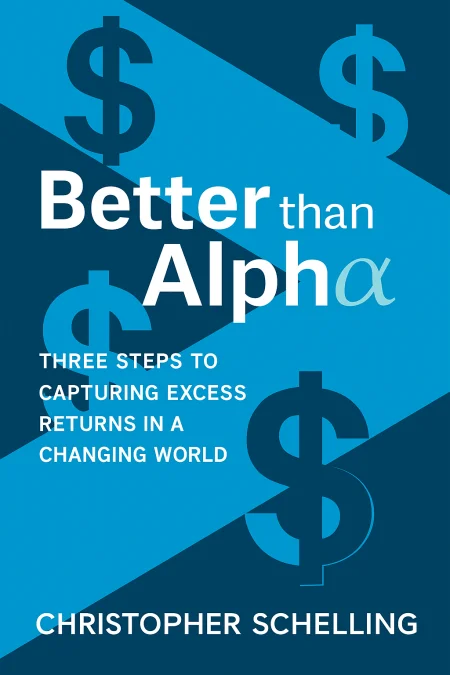
Better than Alpha
Three Steps to Capturing Excess Returns in a Changing World
Book Edition Details
Summary
In the ever-evolving dance of market dynamics, "Better Than Alpha" offers a refreshing pivot away from the elusive quest for alpha—those mythical above-market returns. Chris Schelling invites investors to embrace a paradigm shift, moving beyond futile market-chasing to a strategic triad of smart thinking, smart habits, and smart governance. This isn’t just about numbers; it’s about the psychology of investing, where understanding behavioral pitfalls can transform your portfolio's fate. Discover why yesterday’s strategies may falter today and how true value lies in insightful decision-making. Whether you're steering pension funds or safeguarding insurance assets, this guide illuminates a path to financial clarity and success, tailored to your unique goals.
Introduction
The pursuit of alpha—superior investment returns above market benchmarks—has consumed the financial industry for decades, yet this quest reveals a fundamental paradox that challenges our understanding of market efficiency and investment skill. Through rigorous analysis of public markets, hedge funds, and private equity across multiple decades, a compelling case emerges that traditional alpha is not merely declining but may never have existed in the form investors believed. What appeared to be superior stock-picking ability or market-beating strategies often masked systematic factor exposures that became commoditized once discovered and widely adopted. This systematic erosion of alpha opportunities reflects broader changes in market structure, information flow, and computational power that have fundamentally altered the investment landscape. The investigation extends beyond mere performance analysis to examine the behavioral biases, organizational failures, and misaligned incentives that perpetuate the alpha illusion. Rather than accepting defeat, however, this analysis points toward a reconceptualization of alpha itself—one that focuses on improving decision-making processes, organizational governance, and the probability of meeting investment objectives rather than simply beating benchmarks.
The Historical Discovery and Systematic Erosion of Alpha Across Markets
The story of alpha begins with legendary investors like Alfred Winslow Jones and Warren Buffett, whose seemingly superior market-beating returns appeared to validate the existence of genuine investment skill. These early practitioners developed systematic approaches to identifying undervalued securities and market inefficiencies, generating consistent outperformance that attracted widespread attention and imitation. However, academic research beginning with Eugene Fama and Kenneth French revealed that much of this apparent alpha could be explained by systematic factor exposures—value, momentum, size effects, and other measurable characteristics that predictably influenced returns across different securities and time periods. The factor revolution fundamentally challenged the alpha narrative by demonstrating that what investors perceived as superior security selection was often systematic tilts toward known return drivers. Small-cap stocks, value stocks, and momentum strategies all generated excess returns not through individual brilliance but through exposure to underlying risk premia that rewarded patient capital. These factors worked precisely because they represented systematic patterns in investor behavior, market structure, or fundamental business characteristics that persisted across long time periods. The democratization of factor knowledge through academic research and investment products led to the systematic arbitrage of these opportunities. As more capital pursued value strategies, momentum investing, and small-cap tilts, the excess returns from these approaches compressed toward market levels. Index providers began offering "smart beta" products that provided cheap access to factor exposures, eliminating the need for expensive active managers who had previously been the primary means of accessing these return streams. This pattern of discovery, exploitation, and eventual arbitrage represents the fundamental lifecycle of alpha in efficient markets. Once an investment edge becomes widely known and easily accessible, competitive forces ensure that excess returns disappear, transforming yesterday's alpha into today's commoditized beta.
From True Alpha to Factor Exposures: The Hierarchy of Investment Skill
Rather than viewing alpha and beta as a binary distinction, investment skill exists along a spectrum that reflects both the scarcity of the underlying opportunity and the difficulty of accessing it. True alpha—genuinely uncorrelated excess returns from pure security selection—represents the rarest form of investment skill, exemplified by Renaissance Technologies' Medallion fund with its decades of consistent outperformance through proprietary quantitative methods. Such pure alpha requires continuous innovation and computational advantages that few organizations can sustain over time. More common forms of skill involve what can be termed "manufactured alpha"—returns generated through active value creation rather than passive asset selection. Private equity managers who grow portfolio company revenues, real estate investors who reposition properties, and activist shareholders who drive operational improvements all create value through direct intervention rather than market timing or security selection. This manufactured alpha proves more durable because it relies on operational capabilities rather than informational advantages that can be competed away. Transitional alpha emerges from temporary market dislocations where structural forces prevent natural buyers from participating in specific markets. Regulatory changes, forced selling by institutions, or spin-off situations create opportunities for investors who can provide temporary liquidity until normal market functioning resumes. While these opportunities require skill to identify and execute, they depend more on market structure than on fundamental analytical advantages. The hierarchy continues down to inaccessible risk premiums—strategies that were once alternative alpha sources but remain available only to certain investor types due to regulatory, scale, or structural barriers. Finally, alternative beta represents the commoditized version of former alpha strategies, now available through liquid, low-cost products that provide systematic exposure to what were once exclusive alternative investment approaches. This evolutionary process demonstrates how investment skill continuously migrates from alpha toward beta as markets adapt and democratize access to once-exclusive strategies.
Behavioral Biases and Organizational Failures in Alpha Generation
The persistent belief in alpha despite overwhelming evidence of its scarcity reflects deep-seated cognitive biases that systematically impair investment decision-making. Overconfidence leads investors to attribute market-matching returns to skill while dismissing underperformance as temporary bad luck, creating a systematic misattribution of random outcomes to personal ability. This bias becomes particularly pronounced among less skilled investors who lack the metacognitive ability to recognize their own limitations—a phenomenon known as the Dunning-Kruger effect. Confirmation bias compounds these problems by encouraging investors to seek information that supports their existing beliefs while dismissing contradictory evidence. Fund managers consistently present performance narratives that emphasize skill-based explanations for success while attributing failures to external factors beyond their control. Investors willingly accept these narratives because they confirm their hopes for superior returns and justify the fees they pay for active management. Organizational structures often amplify these individual biases through poor governance and misaligned incentives. Investment committees populated by non-investment professionals make decisions based on incomplete information and political considerations rather than empirical evidence. Consultant recommendations frequently follow momentum patterns, hiring managers after strong performance and firing them after weak results—exactly the opposite of value-oriented decision-making that might improve outcomes. The familiarity bias leads investors toward well-known, heavily marketed funds rather than smaller, newer managers who demonstrate stronger statistical evidence of skill. Large, established fund complexes benefit from this bias despite extensive research showing that smaller, younger managers consistently outperform their larger, older competitors across multiple asset classes. These behavioral patterns create systematic inefficiencies in capital allocation that perpetuate poor investment outcomes while maintaining the illusion that superior managers simply need to be identified and hired.
Beyond Benchmarks: Process and Governance as New Sources of Alpha
The failure of traditional alpha suggests a fundamental reframing of investment objectives from beating benchmarks to meeting real-world financial goals with higher probability. This shift requires recognizing that portfolio success should be measured not by relative performance against arbitrary indexes but by the achievement of required returns for specific purposes—funding retirement income, supporting university operations, or meeting pension obligations. True investment risk becomes the probability of failing to meet these objectives rather than short-term volatility around market averages. Process alpha emerges from systematic improvements in investment decision-making through better research methods, more rigorous due diligence, and disciplined portfolio management. Evidence from venture capital, private equity, and hedge fund investments demonstrates that thorough due diligence correlates directly with superior outcomes, while rushed or superficial analysis leads to predictably poor results. The key lies not in finding superior managers but in implementing processes that consistently identify and avoid inferior ones while maintaining appropriate diversification and risk controls. Organizational alpha requires aligning decision-making authority with relevant expertise while maintaining appropriate oversight and accountability. Investment governance succeeds when it places technically qualified professionals in positions to make complex investment decisions while ensuring that broader organizational objectives guide overall strategy. This means delegating security selection and manager research to investment professionals while reserving policy-setting and performance oversight for governing bodies. The most successful investment organizations demonstrate that alpha can still be generated not through superior market timing or security selection but through the systematic application of behavioral insights, process improvements, and governance reforms. By acknowledging cognitive limitations, implementing decision-making frameworks that reduce bias, and aligning organizational incentives with long-term success, investors can improve their probability of meeting objectives even as traditional alpha opportunities continue to disappear from increasingly efficient markets.
Summary
The decades-long search for alpha reveals a profound evolution in market efficiency that has systematically eliminated most sources of excess returns while creating new opportunities for those willing to abandon the benchmark-beating paradigm entirely. The core insight transcends simple performance measurement to embrace a fundamental truth about successful investing: superior outcomes result from superior processes, better governance, and behavioral discipline rather than from mythical stock-picking abilities or market-timing skills. This transformation demands that investors redirect their efforts from the futile search for alpha generators toward the systematic improvement of their own decision-making capabilities, organizational structures, and risk management practices, ultimately achieving better investment outcomes through the disciplined application of evidence-based methods rather than through the illusory pursuit of market-beating returns.
Related Books
Download PDF & EPUB
To save this Black List summary for later, download the free PDF and EPUB. You can print it out, or read offline at your convenience.
By Christopher Schelling
