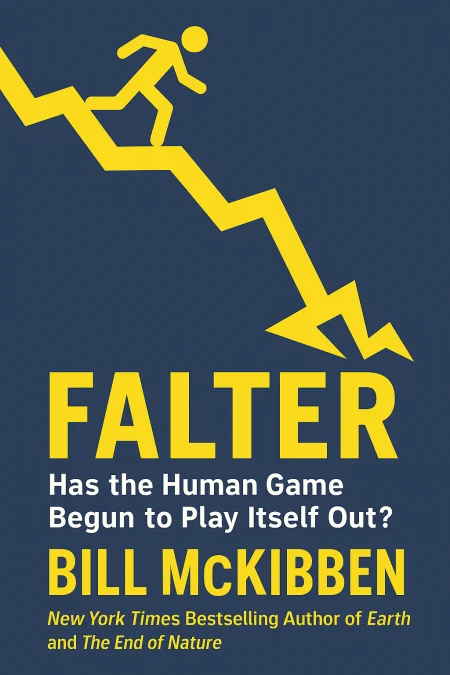
Falter
Has the Human Game Begun to Play Itself Out?
Book Edition Details
Summary
In "Falter," Bill McKibben takes us beyond the mere specter of climate change to a haunting crossroads where humanity's very essence stands in jeopardy. As artificial intelligence and robotics advance, they threaten to erase the rich tapestry of human experience, leaving a monochrome future in their wake. With the passion of a seasoned activist, McKibben weaves together tales of ecological peril and technological dominance, urging us to confront the ideologies that bind us to this precarious path. Drawing upon his pivotal role in founding 350.org, he offers glimmers of hope—strategies to reclaim our world from impending desolation. This gripping narrative isn't just a warning; it's a compelling plea to safeguard not just our planet, but the soul of civilization itself.
Introduction
In the summer of 1988, NASA scientist James Hansen walked into a sweltering Senate hearing room and delivered testimony that would change everything. "The greenhouse effect has been detected," he declared, "and it is changing our climate now." That moment marked the beginning of humanity's most consequential challenge, yet thirty years later, we've emitted more greenhouse gases than in all previous history combined. This sweeping examination reveals how we arrived at this precipice through three interconnected forces that have shaped our modern world. First, we explore how early climate scientists discovered the fundamental threat of global warming, piecing together evidence from remote observatories and sophisticated computer models to warn of unprecedented planetary changes. Their work established the scientific foundation that remains largely unchanged today, yet their urgent warnings would face decades of organized resistance. Second, we delve into the sophisticated campaign of deception orchestrated by fossil fuel companies who knew the truth but chose profits over planetary survival. Through meticulous research into internal corporate documents, the narrative exposes how oil giants funded think tanks, front groups, and political campaigns designed to manufacture doubt about settled science. This story of institutional betrayal reveals how a handful of powerful corporations delayed action during the crucial decades when solutions would have been far easier and less expensive. Finally, we examine how Silicon Valley's rise brought both promise and peril to the climate fight, as tech entrepreneurs promised technological fixes while often avoiding the systemic changes that physics demanded. This exploration reveals the complex relationship between innovation and ideology, showing how technological optimism sometimes became another form of delay. This book speaks to anyone seeking to understand how corporate power shaped humanity's response to its greatest existential threat. It's essential reading for those who want to grasp why we've struggled to address a problem that science identified decades ago, and what it might take to overcome entrenched interests while time remains.
Scientific Awakening: Early Climate Warnings (1950s-1980s)
The story of climate science begins in the pristine air atop Hawaii's Mauna Loa volcano, where a young researcher named Charles David Keeling installed instruments in 1958 to measure atmospheric carbon dioxide with unprecedented precision. His meticulous recordings revealed something that would change our understanding of humanity's relationship with the planet: carbon dioxide levels were rising steadily, year after year, creating what became known as the Keeling Curve. This simple graph became humanity's first clear evidence of its growing impact on the atmosphere. Throughout the 1960s and 1970s, climate scientists at institutions like NASA's Goddard Institute began connecting these rising greenhouse gas concentrations to observable changes in global temperature patterns. Researchers developed increasingly sophisticated computer models that painted an alarming picture of the future. The scientific community, initially cautious and methodical, gradually reached consensus that human activities, particularly the burning of fossil fuels, were fundamentally altering Earth's climate system in ways that could prove catastrophic. The breakthrough moment came during the scorching summer of 1988, when James Hansen's dramatic Senate testimony thrust climate change into public consciousness. Speaking during a record-breaking heat wave that gripped Washington D.C., Hansen declared with scientific certainty that global warming had begun and that human activity was the cause. His words carried the weight of decades of research and the urgency of mounting evidence from melting ice sheets to shifting weather patterns. This period of scientific awakening established the foundation of climate knowledge that remains largely unchanged today. The basic physics of greenhouse gases, the role of human emissions, and the potential consequences of continued warming were all clearly understood by the late 1980s. Scientists had done their job, providing clear warnings about unprecedented planetary changes. What followed would test whether human institutions could respond to scientific truth with the speed and scale that physics demanded, setting the stage for one of history's most consequential battles between knowledge and power.
Deception and Delay: The Fossil Fuel Industry Response (1980s-2000s)
As climate science solidified into overwhelming consensus, a parallel universe of denial and deception began taking shape in corporate boardrooms across America. Internal documents later revealed through lawsuits and investigations showed that major oil companies had conducted their own climate research throughout the 1970s and 1980s, reaching conclusions that closely matched those of academic scientists. ExxonMobil's own researchers warned company executives about the risks of continued fossil fuel use, with internal memos describing potential catastrophic consequences from global warming. Yet instead of sharing this knowledge with the public, the fossil fuel industry chose a different path. Drawing heavily from the tobacco industry's playbook, oil companies employed many of the same public relations firms and strategies that had successfully delayed action on smoking and health for decades. Rather than dispute the science directly, they chose to manufacture doubt, funding a sprawling network of think tanks and front groups designed to amplify uncertainty and delay policy action. Organizations like the Global Climate Coalition and the Heartland Institute became vehicles for spreading confusion about scientific consensus, producing reports that cherry-picked data and amplified the voices of a tiny minority of contrarian scientists. This campaign of manufactured doubt proved remarkably effective at shaping public opinion and political discourse. By the 1990s, climate change had become a partisan issue in American politics, with Republicans increasingly skeptical of both the science and proposed solutions. The industry's influence extended far beyond public opinion into the halls of power, where sophisticated lobbying efforts successfully prevented meaningful climate legislation and weakened international commitments. Every year of delay meant higher concentrations of greenhouse gases in the atmosphere, more severe climate impacts, and greater difficulty in achieving necessary emissions reductions. The window for gradual, manageable change steadily narrowed, replaced by the need for rapid, transformative action that would prove far more challenging to achieve. This deliberate campaign of deception transformed a scientific problem into a political battle, creating decades of delay precisely when rapid action was most needed.
Silicon Valley Rise and Technological Solutions (2000s-Present)
As traditional energy industries fought to maintain the status quo, a new power center emerged in Silicon Valley, bringing characteristic confidence and ambition to humanity's greatest challenge. Tech entrepreneurs and venture capitalists, flush with success from the digital revolution, turned their attention to climate change with promises of innovation and disruption. Companies like Tesla pioneered electric vehicles that transformed them from niche curiosities into desirable consumer products, while others developed renewable energy technologies and energy storage solutions that began competing with fossil fuels on cost. This technological optimism brought both remarkable progress and troubling blind spots to the climate fight. On one hand, Silicon Valley's innovations accelerated the deployment of clean energy technologies at unprecedented rates. Solar panels and wind turbines became increasingly competitive with fossil fuels, while battery costs plummeted and performance soared. The tech industry's approach to scaling solutions globally offered hope that market forces could finally align with climate necessity. Yet the industry's faith in technological fixes often reflected a deeper reluctance to confront systemic change. Many Silicon Valley leaders embraced geoengineering schemes and carbon capture technologies as alternatives to the difficult work of actually reducing emissions. This technological hubris sometimes served as another form of delay, suggesting that innovation alone could solve problems that required fundamental changes to economic and political systems. The same exponential thinking that drove digital disruption was applied to climate change, often overlooking the physical and political constraints that made planetary-scale problems different from software challenges. The industry's own environmental impact also raised questions about its climate credentials. The massive energy consumption of data centers, the carbon footprint of global supply chains, and the planned obsolescence of consumer electronics all contributed to the very emissions that tech companies claimed to be addressing. Meanwhile, the social media platforms they created became vehicles for spreading climate misinformation and deepening political polarization, making collective action even more difficult to achieve in the crucial years when rapid decarbonization became essential for avoiding catastrophic warming.
Summary
The climate crisis emerges from this history not as a failure of knowledge or technology, but as a consequence of power structures that prioritized short-term profits over long-term survival. The fossil fuel industry's campaign of deception, enabled by anti-government ideology and technological overconfidence, created decades of delay precisely when rapid action was most needed. This manufactured uncertainty transformed a scientific problem into a political battle, making rational policy responses nearly impossible even as the physical evidence of climate change became undeniable. Understanding this history reveals that today's climate challenge isn't primarily about developing better technologies or convincing people of scientific facts, but about overcoming entrenched interests that have successfully delayed action for decades. The path forward requires strengthening democratic institutions against corporate capture, building movements capable of challenging fossil fuel power, and developing economic systems that account for environmental costs rather than externalizing them onto future generations. The window for preventing dangerous climate change continues to narrow, but recognizing how we arrived at this moment remains essential for anyone hoping to change course. The same corporate strategies that created our current predicament continue to shape climate policy today, making historical awareness crucial for effective action. Only by understanding the forces that have shaped our inadequate response can we hope to build the political power necessary to overcome them while time remains.
Related Books
Download PDF & EPUB
To save this Black List summary for later, download the free PDF and EPUB. You can print it out, or read offline at your convenience.
By Bill McKibben
