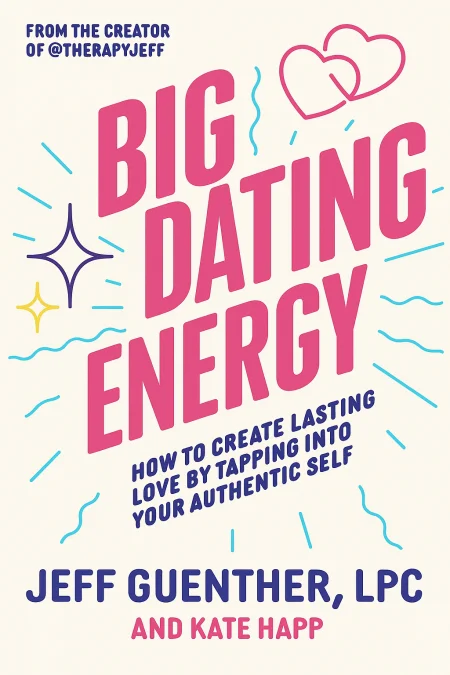
Big Dating Energy
How to Create Lasting Love by Tapping Into Your Authentic Self
Book Edition Details
Summary
In the digital age where love feels like a riddle wrapped in an algorithm, Jeff Guenther—your go-to therapist and social media sensation—delivers the ultimate guide to modern romance with "Big Dating Energy." Navigating the minefield of dating apps and emotional entanglements, Guenther uses his trademark humor and wisdom to unravel the complexities of today’s relationships. Whether you're exploring commitment or just flirting with the idea of love, he equips you with practical insights to decode red flags, craft your ideal partner checklist, and gracefully exit when necessary. With nearly 4 million followers soaking up his advice, Guenther transforms dating into an adventure in authenticity and self-discovery, proving that with the right mindset, finding connection can be as delightful as it is daunting. Get ready to revamp your love life and maybe even enjoy the ride!
Introduction
Sarah sits across from me in my therapy office, tears streaming down her face as she recounts yet another dating disaster. "I don't understand," she whispers. "I followed all the rules, played it cool, waited three days to text back, and he still ghosted me after the third date." Her story echoes thousands of others I've heard over two decades of practice. We live in an era where dating apps promise endless possibilities yet deliver crushing disappointment, where social media creates highlight reels that make everyone else's love life seem effortless while our own feels like an uphill battle through broken glass. The truth is, modern dating isn't broken because you're doing it wrong. It's challenging because we've been taught to approach relationships as performances rather than authentic connections. We've internalized messages from capitalism, Disney movies, and reality TV that tell us love should be a competition where we market ourselves to the highest bidder, hide our flaws until we've "locked someone down," and settle for relationships that trigger our deepest wounds rather than heal them. But what if there was a different way? What if dating could actually be enjoyable, relationships could be healing spaces for growth, and you could show up as your complete, authentic self while finding someone who celebrates every weird, wonderful part of who you are? This journey isn't about changing yourself to find love. It's about understanding who you truly are beneath all the societal programming and family baggage, then using that clarity to create connections that nourish rather than deplete you.
Breaking Free from Family and Social Programming
Emma came to me convinced she was "broken" because every relationship followed the same pattern. She'd meet someone wonderful, feel intense chemistry, then find herself walking on eggshells within weeks, desperately trying to avoid conflict while her partner grew increasingly distant. During one particularly raw session, she described her parents' marriage as "a masterclass in passive aggression," where her father would shut down completely whenever her mother expressed any emotion, and her mother would respond with days of icy silence that filled their home with suffocating tension. As Emma spoke, the pieces clicked into place. That little girl who learned that emotions were dangerous, that conflict meant abandonment, was still running the show in her adult relationships. She was unconsciously choosing partners who mirrored her father's emotional unavailability, then recreating her mother's desperate attempts to maintain connection through self-sacrifice. The "chemistry" she felt wasn't attraction to a good match, it was the familiar pull of unhealed wounds recognizing their counterpart. Emma's story illustrates one of the most profound truths about dating: we don't just bring our conscious desires into relationships, we bring our entire emotional history. Every message we received about love, conflict, and worthiness from our earliest caregivers becomes the invisible blueprint guiding our romantic choices. The parent who disappeared when you needed comfort teaches you that love is conditional. The family where anger meant violence programs you to avoid all conflict, even healthy disagreement. Society amplifies these early lessons through countless subtle and not-so-subtle messages about how relationships should look. We're sold fairy tales where love conquers all without any actual work, reality shows that confuse drama with passion, and capitalist messaging that treats partners like commodities to acquire rather than whole humans to connect with. Breaking free means recognizing these inherited patterns not as personal failures, but as understandable adaptations that once kept us safe but now keep us stuck in cycles that prevent the very intimacy we crave.
Dating with Intention: From Apps to Authentic Connection
Marcus had been on forty-seven first dates in six months when he walked into my office, exhausted and cynical. He'd optimized his dating profile with professional photos and witty one-liners, studied pickup techniques, and approached each interaction like a job interview where he had to prove his worthiness. Despite all this effort, nothing lasted beyond a few weeks. "I feel like I'm performing Shakespeare for an audience that wants stand-up comedy," he told me, slumping in his chair. The breakthrough came when Marcus realized he'd been so focused on being likeable that he'd forgotten to notice whether he actually liked the people he was dating. He was swiping based on surface-level attraction, crafting messages designed to impress rather than connect, and showing up to dates as a curated version of himself rather than the bookish introvert who loved terrible sci-fi movies and had strong opinions about coffee brewing methods. He was dating from scarcity, convinced he needed to cast the widest possible net, when what he actually needed was radical specificity about who he truly was and what he genuinely wanted. When Marcus finally rewrote his dating profile to reflect his authentic interests and started asking questions that mattered to him, something magical happened. He went on fewer dates, but every single one was with someone who was genuinely excited to meet the real him. Within three months, he was in a relationship with someone who not only tolerated his quirks but found them endearing. The coffee snob who'd seemed like a liability became charming to someone who shared his passion for the perfect brew. The modern dating landscape can feel like a numbers game, but intention changes everything. When you know who you are beneath the performance, understand what actually matters to you versus what you think should matter, and show up authentically from the first interaction, you stop wasting time on connections that were never going to work. You start attracting people who are drawn to your specific brand of wonderful rather than settling for anyone who's willing to tolerate your perceived flaws. The goal isn't to find someone who loves you despite who you are, but because of who you are.
Building Lasting Love Through Vulnerability and Growth
Six months into couples therapy, David and Maria sat on opposite ends of my couch, arms crossed, radiating the kind of cold fury that develops when two people have stopped fighting and started keeping score. Their relationship had begun with the intoxicating intensity of finding someone who "just got them," but somewhere along the way, that understanding had curdled into resentment. David felt criticized and controlled; Maria felt unseen and unheard. They'd reached that dangerous place where every small irritation confirmed their growing belief that their partner simply didn't care about their happiness. The turning point came during a session where Maria finally voiced her deepest fear: "I'm terrified that if I show you how much I need you, you'll leave." David, stunned, responded with his own vulnerability: "I'm scared that no matter what I do, I'll never be good enough for you." In that moment, they realized they'd been so busy defending against each other that they'd forgotten they were supposed to be on the same team. Their fights weren't really about dishes or social plans; they were about two wounded people trying to protect themselves from the very intimacy they desperately wanted. The work that followed wasn't easy. It required David to recognize when his instinct to withdraw was triggered by old shame about never being able to please his critical father. Maria had to learn to voice her needs directly rather than expecting David to read her mind like her overwhelmed mother had demanded. They had to practice staying present during conflict instead of retreating to their respective corners to nurse grievances. Most importantly, they had to learn that true intimacy isn't the absence of problems, but the ability to face those problems together with curiosity rather than contempt. Real love isn't the effortless harmony promised in movies; it's the choice to keep showing up authentically even when it's uncomfortable, even when your partner sees parts of you that aren't pretty, even when growth requires admitting you were wrong. It's learning to fight well, to repair ruptures quickly, and to use the inevitable challenges of sharing a life as opportunities to know each other more deeply rather than evidence that you're incompatible. The couples who make it aren't the ones who never struggle; they're the ones who've learned to struggle together, transforming their relationship into a place where both people can heal old wounds while building something beautiful and new.
Summary
The path to authentic love begins with a radical act of self-acceptance: recognizing that you are already worthy of the deep, nourishing connection you crave, exactly as you are right now. Every failed relationship, every painful pattern, every moment of feeling "too much" or "not enough" has been preparing you for this understanding. The goal was never to fix yourself into someone more loveable, but to peel back the layers of programming and protection to reveal the magnificent, complex, perfectly imperfect human you've always been. True dating energy comes not from perfecting your profile or mastering the right techniques, but from the courage to show up as your complete self and trust that the right person will recognize your particular magic. This means choosing vulnerability over safety, authenticity over approval, and growth over comfort. It means learning to see conflict as an opportunity for deeper understanding rather than evidence of incompatibility, and treating your relationship as a sacred space where two people can heal old wounds while creating something entirely new together. When you date from this place of self-knowledge and intentionality, you stop wasting energy on connections that were never meant to last and start investing in relationships that have the potential to transform both people involved. You discover that the love you've been seeking isn't something you have to earn or achieve, but something you can build, moment by moment, choice by choice, with someone brave enough to join you in the beautiful, messy, miraculous work of truly knowing another human being.
Related Books
Download PDF & EPUB
To save this Black List summary for later, download the free PDF and EPUB. You can print it out, or read offline at your convenience.
By Jeff Guenther
