
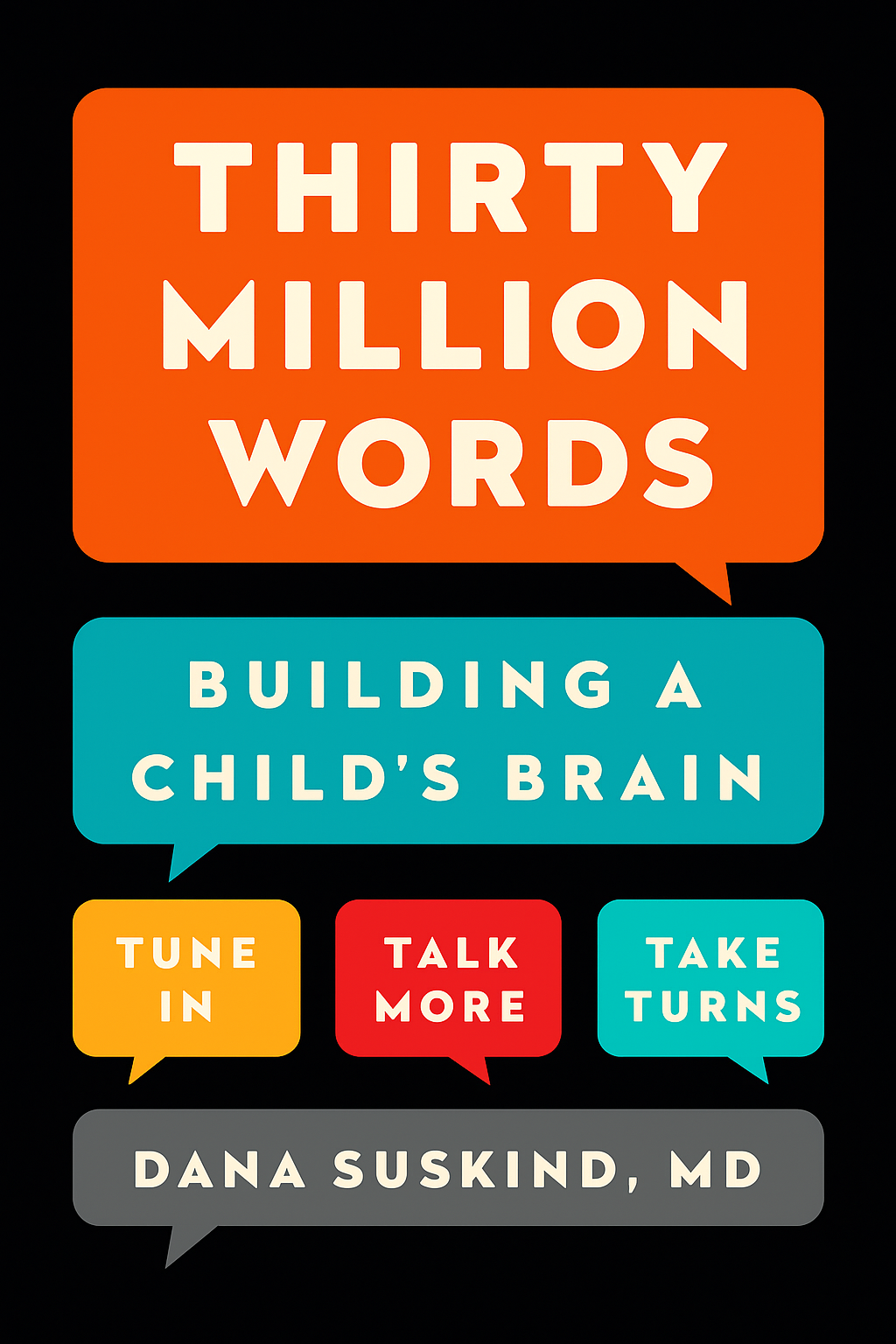
Thirty Million Words
Building a Child’s Brain
Book Edition Details
Summary
In the world of early childhood development, words weave the fabric of future success. Professor Dana Suskind, a trailblazing surgeon and researcher, brings a revelation that is both astonishingly simple and profoundly powerful: the language a child hears from birth shapes their destiny. Armed with groundbreaking findings, Suskind unravels the mystery of the "thirty million word gap," a chasm discovered by Betty Hart and Todd Risley that marks the difference between those who thrive and those who struggle. Through the Thirty Million Words Initiative, Suskind empowers parents to harness the transformative power of conversation, crafting environments rich in verbal interaction that ignite young minds. By embracing the three Ts—tuning in, talking more, and taking turns—caregivers can sculpt a fertile ground for intellectual and emotional growth. This compelling narrative isn't just a guide; it's a call to action for anyone invested in nurturing the potential of the next generation.
Introduction
Imagine discovering that you possess a superpower capable of literally shaping another human being's brain, yet this power costs nothing and requires no special training. For parents and caregivers, this isn't fantasy—it's scientific reality. Every word spoken to a young child acts as a building block for their developing mind, creating neural pathways that will influence their intelligence, emotional stability, and life success for decades to come. Yet many parents remain unaware of this extraordinary ability they wield simply by talking, reading, and engaging with their children during those crucial early years. The research reveals a startling truth: by age three, children from talkative families have heard thirty million more words than their peers from less verbal households, creating differences in brain development that persist throughout life. This knowledge transforms our understanding of child development and reveals how the simple act of conversation can be one of the most powerful gifts we give our children. The implications extend far beyond individual families, offering insights into addressing educational inequality and unlocking human potential on a societal scale.
The Science of Early Brain Development
The human brain arrives in this world remarkably unfinished, unlike other organs that function from day one. While hearts pump and lungs breathe from birth, the brain embarks on an extraordinary construction project that will largely determine a person's intellectual capacity, emotional regulation, and ability to navigate life's challenges. During the first three years, this neural construction site operates at breakneck speed, forging an astounding 700 to 1,000 new connections every single second. Think of early brain development like building a city's infrastructure. Genetics provides the basic blueprint, much like an architect's plans, but the quality of materials and skilled construction crews—represented by a child's early experiences—determines whether the finished product will be a thriving metropolis or a struggling settlement. The brain's billions of neurons are like isolated buildings until language and loving interaction create the highways, bridges, and communication networks that allow them to work together effectively. The timing of this construction is crucial because the brain operates on a "use it or lose it" principle. Connections that are frequently activated through rich language experiences become superhighways of thought, while unused pathways are pruned away to increase efficiency. This process, called neuroplasticity, is most powerful during these early years, creating a window of opportunity that, once closed, becomes increasingly difficult to reopen. Research reveals that the quality of early language environment literally sculpts brain architecture. Children immersed in rich, responsive conversations develop robust neural networks supporting not just vocabulary, but also emotional regulation, problem-solving abilities, and social skills. Conversely, those experiencing limited language input miss critical opportunities for optimal brain development, effects that echo throughout their educational journey and beyond.
Hart and Risley's Groundbreaking Word Gap Research
In the 1960s, two determined researchers named Betty Hart and Todd Risley stumbled upon a mystery that would reshape our understanding of child development. Their intensive preschool program had initially boosted children's vocabulary, but these gains mysteriously disappeared by kindergarten. Rather than accepting defeat, they embarked on an unprecedented investigation that would take them into the living rooms of American families for thousands of hours of observation. What Hart and Risley discovered was both shocking and transformative. Following 42 families from different socioeconomic backgrounds, they meticulously recorded every interaction between parents and children from ages 9 months to 3 years. The differences they documented were staggering: children in professional families heard an average of 2,153 words per hour, while children in working-class families heard 1,251 words per hour, and children in welfare families heard just 616 words per hour. When extrapolated across early childhood, this created a 30-million-word gap by age three. But the differences went beyond mere quantity. The researchers found that higher socioeconomic families didn't just talk more—they talked differently. These children heard richer vocabulary, longer sentences, more questions, and crucially, far more affirmations than prohibitions. Professional families provided their children with six encouragements for every discouragement, while welfare families delivered two discouragements for every encouragement. This emotional tone of language proved as important as volume in shaping children's developing brains. The most remarkable finding emerged years later when Hart and Risley tracked down these same children at ages 9 and 10. The early language differences had predicted not just vocabulary size, but also IQ scores, reading comprehension, and overall academic success. Children who had experienced rich early language environments continued to thrive, while those with limited early exposure struggled to catch up, regardless of later interventions. This research revealed that the achievement gap visible in schools actually begins in the cradle, rooted in the everyday conversations between parents and their youngest children.
The Three Ts: Practical Strategies for Parents
Understanding the power of early language is one thing, but knowing how to harness it effectively requires practical strategies that busy parents can implement in their daily routines. This is where the Three Ts framework transforms scientific knowledge into actionable steps: Tune In, Talk More, and Take Turns. These principles don't require special equipment, dedicated study time, or perfect conditions—they work during diaper changes, grocery shopping, and bedtime routines. "Tune In" means following your child's lead and focusing on what captures their attention. Instead of trying to redirect a toddler from stacking blocks to reading a book, parents learn to join the block-stacking adventure with enthusiasm and rich language. This child-led approach ensures that words land in fertile ground—a brain primed and interested in the topic at hand. When parents tune in, they discover that even mundane activities like sorting laundry become opportunities for learning about colors, textures, and categories. "Talk More" involves narrating daily life and expanding on your child's interests with descriptive, varied language. Rather than simply saying "car," parents learn to explore: "Look at that red car driving fast down the street. I wonder where it's going. See how it's bigger than our blue car?" This rich language input provides the raw materials for brain construction, introducing new vocabulary, sentence structures, and concepts that will become the foundation for future learning. "Take Turns" transforms monologue into conversation, even with babies who can't yet speak. Parents learn to pause after speaking, giving children time to respond with sounds, gestures, or eventually words. This back-and-forth exchange, the serve-and-return of conversation, builds the neural pathways for social interaction, emotional regulation, and executive function. A baby's gurgle becomes part of a meaningful dialogue when parents respond as if it were the most fascinating comment they've ever heard, creating the social foundation upon which all future learning depends.
Closing the Achievement Gap Through Language
The implications of early language research extend far beyond individual families to address one of society's most persistent challenges: educational inequality. Traditional approaches to closing achievement gaps have focused on school-age interventions, but research reveals that significant disparities in learning readiness already exist by kindergarten entry. Children arriving at school with strong language foundations can focus on acquiring new knowledge, while those with weaker foundations must simultaneously catch up on basic skills while trying to keep pace with new learning. The power of language-based interventions lies in their accessibility. Unlike many factors that contribute to educational inequality—such as neighborhood resources, school funding, or family income—rich language experiences require no financial investment. Every parent, regardless of education level or economic status, possesses the vocabulary necessary to provide their child with optimal brain-building experiences. A mother narrating her cooking process or a father explaining how traffic lights work provides the same neural stimulation as expensive educational toys or programs. Research demonstrates that language-focused interventions can level the playing field remarkably effectively. When parents learn to maximize their everyday interactions through rich, responsive conversation, their children show improvements not just in vocabulary, but in attention span, social skills, and school readiness. These gains persist over time, creating lasting advantages that compound throughout a child's educational journey. The societal implications are profound. If we can help all parents understand and harness the power of their everyday words, we can address educational inequality at its roots rather than trying to remediate problems years later. This represents a shift from expensive, intensive interventions to empowering parents with knowledge and simple strategies that transform ordinary moments into extraordinary opportunities for brain development. The research suggests that closing the word gap could be one of the most effective and cost-efficient approaches to ensuring that all children, regardless of their starting circumstances, have the opportunity to reach their full potential.
Summary
The most powerful tool for shaping a child's future costs nothing, requires no special training, and happens naturally in loving families who understand its importance: rich, responsive conversation during the critical early years when brains are under construction. This research revolutionizes our understanding of child development by revealing that parents aren't just caregivers—they're neurosculptors, literally shaping their children's brain architecture through every interaction, story, and conversation. The implications challenge us to reconsider how we support families and address educational inequality, suggesting that the path to a more equitable society might begin not in schools or policy offices, but in the everyday moments when parents and children share words, wonder, and connection. How might our communities change if every parent understood their incredible power to build their child's brain through talk? What would happen if we supported all families in creating language-rich environments where every child could thrive from their very first days?
Related Books
Download PDF & EPUB
To save this Black List summary for later, download the free PDF and EPUB. You can print it out, or read offline at your convenience.
By Dana Suskind
