
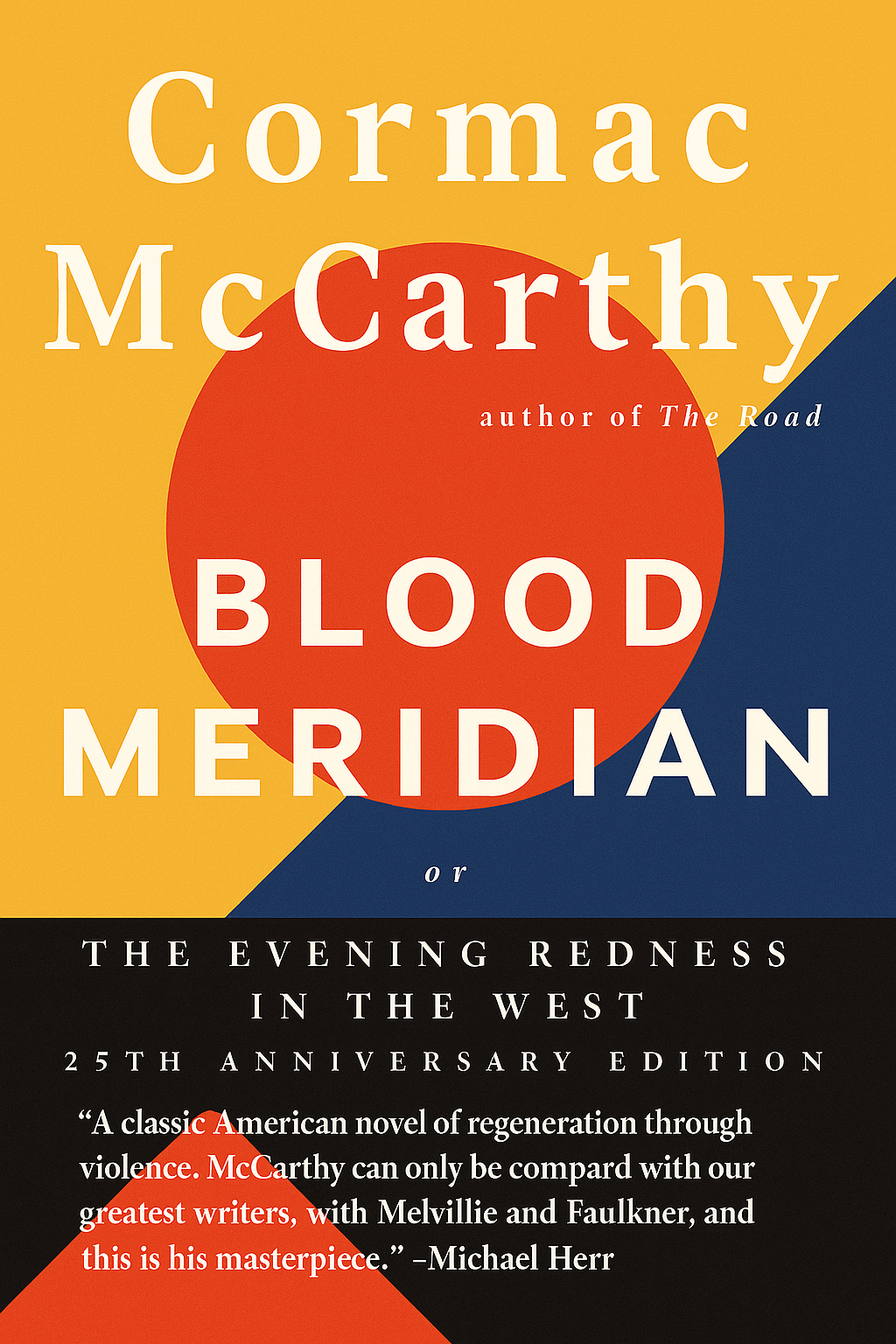
Blood Meridian
Or the Evening Redness in the West
Book Edition Details
Summary
In the sun-scorched expanse of the 1850s Texas-Mexico border, brutality and ambition collide in "Blood Meridian." Here, a nameless youth, known only as the Kid, is thrust into a savage world where moral compasses are skewed, and the value of life is measured by the weight of a scalp. This harrowing tale, drawn from grim historical events, paints a vivid tableau of the West, unmasking the myth of cowboy heroics to reveal the raw, untamed darkness beneath. As the Kid joins a band of merciless outlaws, the desert becomes a stage for unspeakable acts, challenging the very essence of humanity and survival. With stark prose and unflinching realism, this novel redefines the Western genre, inviting readers to ponder the true cost of conquest.
Introduction
In the scorching borderlands of 1840s Texas and Mexico, a teenage runaway from Tennessee found himself swept into one of history's most savage enterprises. The kid, as he becomes known, joined bands of scalp hunters and filibusters, witnessing firsthand how violence transformed from desperate survival into systematic extermination. His journey through the desert Southwest reveals the dark machinery that drove American expansion, where government contracts turned genocide into profitable business and philosophical justifications masked the raw pursuit of land and power. This harrowing chronicle illuminates three crucial aspects of American empire-building that official histories often obscure. First, it demonstrates how the frontier didn't civilize savage lands but rather unleashed the savage potential within civilized men, creating cycles of brutality that consumed perpetrators and victims alike. Second, it reveals how economic incentives and institutional structures transformed individual acts of violence into systematic campaigns of extermination, showing us the bureaucratic face of atrocity. Finally, it exposes the intellectual frameworks that societies construct to justify mass violence, from manifest destiny to racial superiority, and how these ideas take root in desperate minds seeking meaning in chaos. This exploration speaks directly to historians grappling with uncomfortable truths about American expansion, policymakers confronting the legacy of institutional violence, and anyone seeking to understand how ordinary people become complicit in extraordinary evil. The story offers no redemptive arc or moral clarity, but it provides essential insights into the psychological and social mechanisms that enable mass atrocity, lessons that remain disturbingly relevant in our contemporary world of border conflicts and imperial interventions.
Frontier Initiation: The Kid's Entry into Systematic Violence (1840s)
The transformation began in the rough river towns and frontier settlements of the 1840s, where a fourteen-year-old runaway from Tennessee first encountered the casual brutality that defined life beyond civilization's reach. Born under a meteor shower that his drunken father claimed as an omen, the kid possessed neither education nor prospects, only the restless energy that drove thousands of young Americans westward in search of fortune and purpose. His early experiences in places like Nacogdoches and New Orleans revealed how quickly the veneer of civilized behavior dissolved when law and social restraint were absent. The frontier operated as a vast laboratory for violence, where desperate men discovered that brutality offered the most reliable currency for survival and advancement. The kid witnessed men killed over card games, women brutalized without consequence, and indigenous peoples treated as obstacles to be removed rather than human beings deserving of moral consideration. What proved most disturbing was not the existence of such violence, but how rapidly he adapted to it, suggesting that the capacity for extreme brutality lies dormant in ordinary people, waiting for the right circumstances to emerge. This period of initiation established the psychological patterns that would define both the kid's trajectory and the broader American experience of westward expansion. Violence became normalized through repetition and necessity, while the absence of established authority created a moral vacuum filled not by noble self-reliance but by the rawest expressions of human nature. The frontier didn't corrupt good men so much as it revealed what they had always been capable of becoming when freed from social constraints. The economic and social structures of frontier life actively rewarded violence while punishing restraint, creating a Darwinian environment where moral scruples became dangerous luxuries. This systematic cultivation of brutality prepared men like the kid for the even more organized forms of violence that would characterize the next phase of American expansion, when individual acts of cruelty would evolve into institutionally sanctioned campaigns of extermination.
The Scalp Wars: Institutionalized Genocide in the Borderlands (1849-1850)
By 1849, the kid had joined Captain John Joel Glanton's gang of scalp hunters, operating under contract with Mexican authorities to eliminate Apache raiders along the Sonoran Desert frontier. This arrangement represented the institutionalization of violence, where governments legitimized and financially incentivized the systematic extermination of indigenous peoples. The scalp bounty system created a grotesque economy where human hair became currency and killing became routine work, revealing how quickly bureaucratic structures could transform individual brutality into systematic genocide. The gang's operations across the desert borderlands demonstrated the perverse logic of commodified violence. Mexican authorities paid bounties for Apache scalps without verifying their origin, creating incentives that made any dark-haired person a potential target. The hunters massacred not only Apache warriors but entire villages, including women and children, driven by the simple mathematics of payment per scalp. This commodification of human life stripped away any remaining moral restraints, transforming murder into a business enterprise that operated with the efficiency and ruthlessness of any other commercial venture. The desert environment itself became complicit in this systematic violence, its vast emptiness seeming to absorb atrocity without witness or judgment. The gang moved through this harsh landscape like a force of nature, leaving behind trails of destruction that the wind quickly erased, as if their crimes had never occurred. The isolation and beauty of the terrain created a sense that normal moral laws had been suspended, that the usual rules of civilization simply didn't apply in such remote and unforgiving places. What emerged from this period was a clear demonstration of how economic incentives and institutional structures could transform ordinary men into instruments of genocide. The scalp hunting enterprise revealed the dark logic underlying much of American expansion: the systematic dehumanization of indigenous peoples to justify their elimination and the seizure of their lands. This institutionalized violence would establish patterns that would persist long after the frontier officially closed, embedding brutality into the very foundations of American territorial expansion.
Judge Holden's Philosophy: War as Sacred Truth and Imperial Logic
At the center of the gang's operations stood Judge Holden, a massive, hairless albino whose intellectual sophistication masked a profound commitment to violence as the organizing principle of existence. The Judge represented more than just another frontier killer; he embodied the philosophical justification for systematic brutality, articulating a worldview in which war served as the ultimate arbiter of truth and the only honest expression of human nature. His presence transformed the scalp hunters from simple criminals into something approaching a religious cult devoted to destruction. The Judge's philosophy emerged through his eloquent speeches around desert campfires, where he argued that moral systems were elaborate deceptions designed to mask humanity's essential violent nature. He saw war not as a regrettable necessity but as a sacred activity that revealed fundamental truths about power, dominance, and human destiny. In his famous declaration that "war is god," he provided an intellectual framework that allowed ordinary men to participate in genocide without losing their sanity, transforming mass murder into a form of religious observance. His scholarly pursuits served to catalog and ultimately possess the world around him, reflecting a broader imperial impulse to dominate through knowledge. The Judge collected specimens, sketched landscapes, and recorded observations in his ledger, but always with the ultimate goal of control and destruction. He believed that true knowledge came only through domination, that one could not simply observe a thing but must own it, control it, and ultimately destroy it to prove mastery over it. This philosophy extended to his relationship with other human beings, whom he saw as either useful tools or obstacles to be eliminated. The Judge's influence over younger gang members like the kid revealed the seductive power of nihilistic philosophy in environments where traditional moral frameworks had collapsed. His arguments appealed particularly to those who had witnessed enough violence to doubt the existence of any meaningful moral order, offering intellectual justification for abandoning restraint. This dynamic would prove crucial to understanding how imperial enterprises sustain themselves, requiring not just brute force but sophisticated ideological frameworks that make brutality seem not only necessary but noble.
The Reckoning: Violence's Legacy in the Closing of the Frontier
The gang's reign of terror eventually collapsed under the weight of its own excess, culminating in betrayals and massacres that destroyed most of the scalp hunters and scattered the survivors into the desert. This violent dissolution marked not just the end of one criminal enterprise but the closing of an entire historical epoch, as the frontier that had created such men began disappearing under the advance of railroads, towns, and the apparatus of modern civilization. The kid, now a young man hardened by years of systematic brutality, found himself adrift in a world that no longer had use for his particular skills. The final confrontation between the kid and Judge Holden occurred decades later, when both had become anachronisms in a rapidly changing West. Their encounter in a frontier saloon represented a reckoning not just between two individuals but between different responses to the frontier experience. Where the kid retained some vestige of human conscience and struggled with the weight of his past actions, the Judge had transcended such limitations entirely, becoming a pure embodiment of will-to-power who thrived in any environment by adapting his philosophy of violence to new circumstances. The kid's attempts to live a normal life in the emerging modern West were haunted by his participation in systematic violence, suggesting that some experiences leave permanent damage that cannot be healed by time or good intentions. His fate served as a meditation on whether redemption was possible for those who had crossed certain moral boundaries, and whether American society could successfully integrate the veterans of its imperial violence into peaceful civilian life. The answer appeared to be a troubling negative. The story's conclusion offered no easy resolution or moral clarity, instead presenting violence as an inescapable part of human nature that civilization could contain but never eliminate. The end of the frontier didn't represent the triumph of good over evil but simply the evolution of violence into new forms more suited to modern conditions. The Judge's survival and continued influence suggested that the forces he represented—the intellectual justification for brutality, the celebration of power over compassion—remained as relevant in civilized society as they had been in the lawless desert, waiting for new opportunities to emerge and new disciples to corrupt.
Summary
The central tragedy revealed through this borderland chronicle lies in its demonstration that American expansion was built not on the triumph of civilization over savagery, but on the systematic cultivation of savagery within civilization itself. The violence that characterized westward expansion wasn't an unfortunate byproduct of progress but the essential engine that drove the entire enterprise, creating cycles of brutality that consumed both perpetrators and victims while leaving permanent scars on the national psyche. The frontier experience didn't represent a temporary departure from American values but rather their most honest and unrestrained expression. These historical insights offer crucial lessons for understanding contemporary America and its ongoing struggles with institutional violence. First, we must recognize that violence remains deeply embedded in American culture and institutions, manifesting in everything from foreign military interventions to domestic policies that systematically harm vulnerable populations. The scalp bounty system that incentivized genocide finds modern echoes in immigration enforcement, criminal justice policies, and military contractor arrangements that profit from human suffering. Second, we must remain vigilant against philosophical systems that justify cruelty in the name of higher purposes, whether they come wrapped in appeals to national security, economic necessity, or cultural superiority. The Judge's seductive intellectualism reminds us that the most dangerous violence often comes dressed in sophisticated arguments that make atrocity seem reasonable or even noble. Finally, this dark chronicle suggests that genuine redemption—both individual and collective—requires confronting rather than mythologizing our capacity for brutality. The kid's struggle with his violent past mirrors America's ongoing struggle to reconcile its ideals with its history, while the Judge's persistence represents the ever-present temptation to embrace power over principle. True progress demands not the erasure of difficult truths but their integration into a more complete understanding of who we are and who we might become, acknowledging that the line between civilization and savagery runs not between different peoples but through every human heart.
Related Books
Download PDF & EPUB
To save this Black List summary for later, download the free PDF and EPUB. You can print it out, or read offline at your convenience.
By Cormac McCarthy
