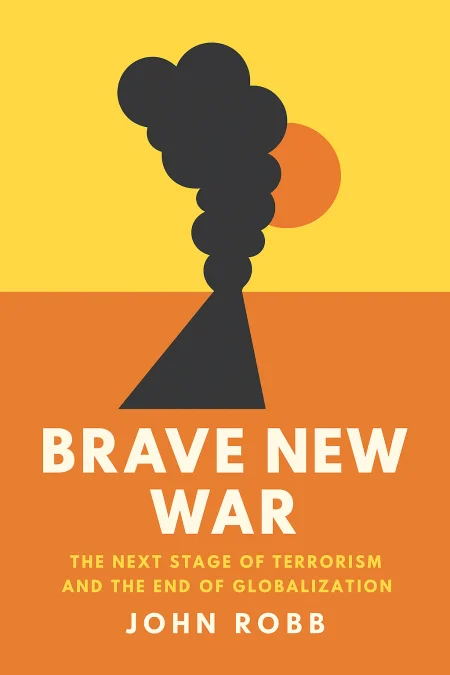
Brave New War
The Next Stage of Terrorism and the End of Globalization
Book Edition Details
Summary
In an era where the digital web binds the world in seamless unity, John Robb exposes a darker reality lurking beneath the surface. The very technologies that shrink distances and knit cultures together are the same tools wielded by cunning terrorists and shadowy criminals to launch precise, devastating attacks on a global scale. These small yet powerful strikes can cripple vital infrastructures, sending shockwaves through economies and societies dependent on the flow of oil, tech, and finance. Robb delves into the paradox of our age: how do we defend the interconnected systems we cherish without unraveling the global tapestry? Through gripping analysis, this book challenges us to rethink security in a world where a lone individual can tilt the scales of power.
Introduction
In the summer of 2004, a small team of guerrillas attacked a pipeline in southeastern Iraq with materials costing roughly $2,000. The resulting damage cost the Iraqi government over $500 million in lost oil revenues—a return on investment of 25 million percent. This wasn't an isolated incident, but rather a glimpse into a new form of warfare that would reshape global security in the 21st century. Traditional military thinking assumes enemies wear uniforms, hold territory, and fight according to recognizable rules. Yet across Iraq, Nigeria, Pakistan, and beyond, a different kind of adversary was emerging—one that operated more like a successful technology startup than a conventional army. This transformation reveals how globalization and internet connectivity have democratized the tools of warfare, allowing small, networked groups to challenge the world's most powerful nation-states. The story unfolding is not simply about terrorism or insurgency, but about a fundamental shift in how power operates in an interconnected world. For military strategists, policy makers, and anyone seeking to understand modern conflict, these developments offer crucial insights into how technology amplifies the capabilities of non-state actors. The patterns emerging from these conflicts suggest we are witnessing the early stages of a new kind of warfare—one where the traditional advantages of nation-states may no longer guarantee victory.
The Decline of State Warfare and Network Emergence
The transformation of modern warfare began not in the mountains of Afghanistan or the streets of Baghdad, but in the structural changes that reshaped global power in the late 20th century. Nuclear weapons had effectively ended large-scale wars between major powers, creating what strategists called "mutual assured destruction." Simultaneously, economic globalization was binding nations together through trade relationships so complex that conventional war became economically ruinous for all participants. Into this vacuum stepped a new kind of adversary. The September 11 attacks demonstrated that nineteen men with box cutters and basic flight training could inflict damage previously requiring entire armies. The attackers didn't factor the opposition of the U.S. military into their planning because they operated outside the traditional framework of state-versus-state conflict. This wasn't an anomaly but a harbinger of warfare's future direction. The invasion of Iraq in 2003 inadvertently became a laboratory for this new form of conflict. Rather than facing a hierarchical insurgency with clear leadership, American forces confronted a bewildering array of autonomous groups—former Baathists, Sunni nationalists, Shiite militias, foreign jihadists, and criminal gangs. These groups shared no common ideology beyond opposition to occupation, yet they began operating with surprising coordination. What made this insurgency different was its organizational structure. Like successful technology companies, these groups operated as networked communities rather than traditional hierarchies. They shared information, techniques, and resources through what resembled an open-source development model. When one group discovered an effective improvised explosive device design or attack method, the innovation spread rapidly across the entire network. The result was an insurgency that learned and adapted faster than the conventional military forces arrayed against it, setting the stage for a new era of asymmetric conflict.
Iraq as Laboratory: Systems Disruption and Open-Source War
Iraq became the testing ground where traditional military superiority met networked resistance, and the results fundamentally challenged conventional wisdom about warfare. The insurgency that emerged wasn't trying to seize territory or capture the capital—instead, it focused on disrupting the systems that modern societies depend upon. This approach, known as systems disruption, targeted Iraq's electrical grid, oil pipelines, and transportation networks with devastating effectiveness. The strategy proved remarkably efficient. Small teams could attack a pipeline junction or electrical substation, causing cascading failures that shut down services for millions of people. These attacks cost thousands of dollars to execute but caused hundreds of millions in damage and lost revenue. More importantly, they delegitimized the new Iraqi government by demonstrating its inability to provide basic services to its citizens. The insurgency's organizational model was equally revolutionary. Rather than operating as a traditional hierarchy with centralized command, it functioned like an open-source software project. Different groups contributed expertise and resources while maintaining their autonomy. Bomb-makers became freelance contractors, selling their services to various factions. Former military officers provided tactical knowledge. Criminal networks supplied financing and logistics. This bazaar-like atmosphere fostered rapid innovation and made the insurgency virtually immune to decapitation strikes against its leadership. The implications extended far beyond Iraq's borders. The techniques developed there began appearing in conflicts worldwide, from Nigerian oil platforms to Pakistani gas pipelines. The insurgency had created a new template for asymmetric warfare—one that any group with modest resources and basic technical knowledge could adopt. The age of the superempowered small group had begun, and the nation-state system would never be the same.
Global Spread: From Oil Fields to Urban Networks
The Iraqi model of networked insurgency quickly metastasized across the globe, adapted by groups with diverse motivations but similar methods. In Nigeria's Niger Delta, the Movement for the Emancipation of the Niger Delta began targeting oil infrastructure with techniques clearly borrowed from Iraq. Using speedboats to attack offshore platforms and pipelines, they reduced Nigeria's oil production by hundreds of thousands of barrels per day, generating billions in lost revenue while achieving their political objectives. Pakistan witnessed similar developments as Baloch separatists launched a systematic campaign against the country's energy infrastructure. Their attacks on natural gas pipelines and electrical grids demonstrated the same principles of systems disruption, causing economic damage far exceeding the cost of the operations. In Thailand's southern provinces, Islamic separatists coordinated attacks on power stations and security posts using cell phones, temporarily blacking out entire cities. These conflicts shared several characteristics that distinguished them from traditional insurgencies. The groups involved were small, autonomous, and networked rather than hierarchically organized. They focused on economic disruption rather than territorial control. Most significantly, they operated as part of a global community of practice, sharing techniques and innovations through internet forums and direct communication. The rise of transnational criminal networks provided additional resources and capabilities. Drug trafficking, human smuggling, and arms dealing created revenue streams that freed these groups from dependence on state sponsors. The Madrid bombers funded their attack by selling drugs. Nigerian militants financed operations through oil theft. This fusion of political violence and criminal enterprise created self-sustaining networks that could operate indefinitely without external support, fundamentally altering the landscape of global security and pointing toward an even more challenging future for traditional state power.
Future Security: Decentralized Resilience vs Brittle Systems
The emergence of global guerrilla networks has exposed the fundamental brittleness of centralized security systems. Traditional approaches—from airport screening to border fences—assume threats will emerge in predictable patterns and can be countered through centralized responses. Yet the new adversaries operate more like computer viruses, constantly evolving and finding new vulnerabilities in complex systems. Each defensive measure prompts innovation by attackers, creating an endless cycle where the advantage lies with those who can adapt most quickly. The implications extend beyond military conflict to natural disasters, economic crises, and technological failures. Hurricane Katrina demonstrated how centralized emergency response systems can collapse when faced with unexpected challenges, leaving communities to organize their own survival. Similarly, the 2003 Northeast blackout showed how complex infrastructure networks can fail catastrophically when a few critical nodes are disrupted. These vulnerabilities will only increase as societies become more interconnected and dependent on just-in-time systems. The solution lies not in building higher walls but in developing decentralized resilience. This approach recognizes that security cannot be provided by governments alone but must emerge from the collective actions of individuals, communities, and organizations. Like the internet itself, resilient systems distribute critical functions across many nodes, ensuring that no single point of failure can bring down the entire network. This transformation is already underway in many areas. Cities are developing their own intelligence capabilities rather than relying solely on federal agencies. Private security companies provide services once monopolized by police and military forces. Communities are installing backup power systems and communication networks. While this shift may seem to weaken central authority, it actually strengthens overall societal resilience by creating multiple layers of protection and response. The future of security will be distributed, adaptive, and participatory—a fundamental departure from the centralized models that dominated the 20th century but the only viable approach for managing the complex threats of the 21st century.
Summary
The central tension explored throughout this analysis is the conflict between centralized, hierarchical systems of power and decentralized, networked forms of organization. This struggle represents more than a shift in military tactics—it reflects a fundamental transformation in how power operates in a globally connected world. Nation-states, designed for an era of clear borders and identifiable enemies, find themselves increasingly outmaneuvered by fluid networks that transcend traditional boundaries and operate according to different rules. The historical pattern reveals that technological revolutions consistently redistribute power, often in unexpected directions. Just as the printing press undermined medieval authority structures and industrialization enabled modern nation-states, today's information technologies are empowering new forms of organization that challenge established hierarchies. The groups emerging from this transformation—whether motivated by politics, profit, or ideology—share common advantages: speed, adaptability, and the ability to harness collective intelligence through networked cooperation. For those navigating this transformed landscape, three principles emerge as essential. First, embrace decentralized approaches to security and resilience rather than relying solely on centralized protection. Second, develop systems that can adapt and evolve rather than rigid structures that break under unexpected stress. Third, recognize that sustainable security requires broad participation and cannot be achieved through control alone. The future belongs not to those who can build the highest walls, but to those who can create the most resilient and adaptive networks. This shift demands new ways of thinking about security, governance, and collective action—changes that may prove as significant as any in human history.
Related Books
Download PDF & EPUB
To save this Black List summary for later, download the free PDF and EPUB. You can print it out, or read offline at your convenience.
By John Robb
