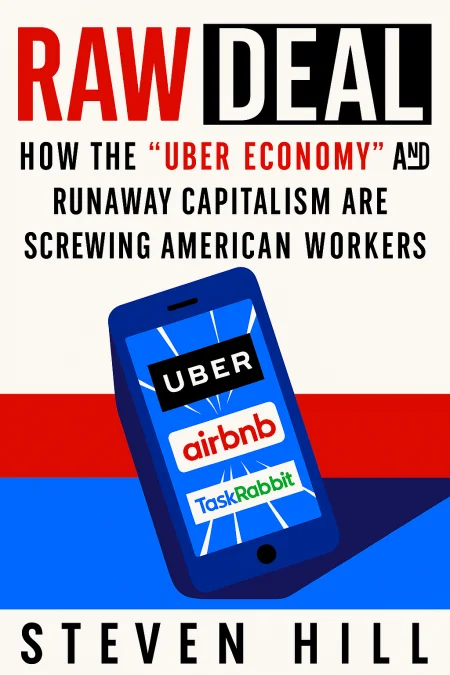
Raw Deal
How the “Uber Economy” and Runaway Capitalism are Screwing American Workers
Book Edition Details
Summary
Amidst the shimmering allure of Silicon Valley's promises, a darker tale unfolds in Steven Hill's "Raw Deal." Beneath the veneer of the so-called "sharing economy," where tech giants boast of turning everyday folks into self-made entrepreneurs, lies a stark reality: a workforce teetering on the brink of precarity. Freelancers, temps, and gig workers navigate an economic landscape reshaped by cunning tech moguls and Wall Street's relentless greed. As traditional job security crumbles, Hill unravels the myths fueling this economic upheaval, exposing the dangerous trajectory that threatens not just workers but the very fabric of society. In this incisive exposé, Hill challenges us to rethink the seductive narratives of independence and innovation, urging a bold reimagining of policies to safeguard the American workforce from a looming crisis.
Introduction
The modern American economy faces a profound transformation disguised as technological progress. Beneath the glossy marketing of "sharing economy" platforms lies a systematic dismantling of worker protections that took generations to establish. This transformation represents more than business innovation—it constitutes a deliberate restructuring of capitalism itself, transferring economic risk from corporations to individual workers while concentrating wealth among platform owners and venture capitalists. The analysis employs rigorous economic examination combined with detailed case studies to expose the gap between Silicon Valley rhetoric and worker reality. Through careful investigation of companies like Uber, Airbnb, and TaskRabbit, the evidence reveals how these platforms exploit regulatory gaps and worker desperation to create competitive advantages based on law evasion rather than genuine efficiency. The methodology traces connections between platform capitalism, automation trends, and broader patterns of wealth concentration to demonstrate how seemingly isolated business practices threaten the foundations of democratic capitalism. Understanding this crisis requires recognizing how current developments connect to historical patterns of labor exploitation while taking new forms enabled by digital technology. The examination reveals that technological capability alone cannot determine social outcomes—the benefits of innovation can be shared broadly or concentrated narrowly depending on the political and economic structures society chooses to create and maintain.
The 1099 Economy: Systematic Worker Misclassification and Its Human Costs
The fundamental shift from traditional employment to independent contractor status represents one of the most significant transformations in American labor relations since the New Deal era. Companies across industries have discovered they can reduce labor costs by approximately thirty percent simply by reclassifying employees as independent contractors, eliminating obligations for health insurance, unemployment benefits, workers' compensation, and Social Security contributions. This practice extends far beyond Silicon Valley startups into traditional sectors including construction, trucking, home healthcare, and professional services. The human cost of this transformation manifests in devastating individual stories that reveal systemic problems. Maria Fernandes died from carbon monoxide poisoning while sleeping in her car between shifts at three different Dunkin' Donuts locations, symbolizing the impossible pressures facing workers who must cobble together multiple part-time jobs to survive. Her death represents not an isolated tragedy but the predictable consequence of employment practices that treat human labor as a disposable commodity while demanding constant availability without providing living wages or adequate hours. Major corporations including FedEx, Microsoft, and various auto manufacturers have perfected sophisticated strategies to distance themselves from direct employment relationships while maintaining operational control over workers. These arrangements involve complex subcontracting chains, temporary staffing agencies, and franchise models specifically designed to circumvent traditional employer responsibilities. Workers perform identical tasks to regular employees but receive significantly lower wages and no benefits, creating a two-tiered system that undermines labor standards across entire industries. The legal framework struggles to address increasingly sophisticated avoidance strategies while enforcement remains sporadic and penalties insufficient to deter violations. When employers can avoid contributing to unemployment insurance, Social Security, and other safety net programs, the burden shifts to taxpayers and remaining traditional employers, creating competitive pressure for all businesses to adopt similar practices in a destructive race to the bottom.
Platform Giants' Deception: How Sharing Economy Companies Exploit Labor
The sharing economy's most prominent companies have built their success on systematic law-breaking, regulatory arbitrage, and the exploitation of desperate workers willing to accept substandard conditions. Uber exemplifies this approach through its aggressive expansion strategy of launching operations in cities without permits, fighting regulations through expensive lobbying campaigns, and treating legal compliance as optional while extracting maximum value from drivers' labor and vehicle depreciation. The company's business model depends entirely on avoiding the costs and responsibilities that govern traditional transportation companies while exercising unprecedented control over drivers through algorithmic management, pricing decisions, and performance monitoring. Despite setting fares, determining work assignments, and maintaining the power to terminate drivers instantly, Uber claims these individuals are independent business owners rather than employees, creating a legal fiction that allows the company to capture all benefits of employment relationships while avoiding corresponding obligations. Airbnb has similarly transformed housing markets by facilitating the conversion of thousands of residential units into illegal hotels, driving up rents and forcing longtime residents from their homes in major cities. Despite company rhetoric about regular people sharing spare rooms, data analysis reveals that substantial revenue comes from commercial operators managing multiple properties who use the platform to circumvent rent control laws and housing regulations, often evicting elderly and disabled tenants to maximize tourist rental income. Both companies exemplify a broader pattern where venture capital-funded platforms use their financial resources to overwhelm local governments and reshape regulatory environments to their advantage. Their success depends not on genuine innovation but on maintaining competitive advantages through legal and political pressure while externalizing costs to workers, communities, and public infrastructure that bears the burden of their operations without receiving corresponding compensation.
Automation and Economic Singularity: Technology's Threat to Democratic Capitalism
The convergence of artificial intelligence, robotics, and algorithmic management threatens to eliminate human jobs across vast sectors of the economy while concentrating the benefits of increased productivity among a small class of technology owners. Current automation extends beyond manufacturing into knowledge work, creative industries, and service sectors previously considered immune to technological displacement, with sophisticated algorithms now performing complex tasks from pharmaceutical dispensing to financial trading with greater speed and accuracy than human workers. The Oxford University study predicting that forty-seven percent of existing jobs face computerization over the next two decades may underestimate the scope of disruption as artificial intelligence capabilities expand rapidly. Unlike previous technological revolutions that created new categories of employment to replace displaced workers, current automation threatens to eliminate more jobs than it creates while the sharing economy simultaneously degrades the quality of remaining work through systematic removal of benefits and protections. Platform companies accelerate this process by reducing human workers to algorithmic inputs while capturing the value of technological efficiency for shareholders and executives. Uber's ultimate goal of replacing drivers with autonomous vehicles exemplifies how these companies view workers as temporary inconveniences rather than stakeholders deserving consideration, using human labor only until technological alternatives become viable while providing no transition support or compensation for displaced workers. The trajectory toward what might be called an Economic Singularity—where technological unemployment combines with extreme wealth concentration to create mass economic displacement—represents an existential threat to democratic capitalism itself. If technological productivity gains accrue primarily to capital owners while workers face declining prospects and purchasing power, the result could be social instability and the collapse of consumer demand that drives economic growth, undermining the market system's fundamental assumptions about wealth circulation.
Rebuilding the Social Contract: Portable Benefits and Worker Power
The solution requires fundamentally restructuring the relationship between work, benefits, and economic security through portable Individual Security Accounts that follow workers across jobs and employers regardless of their classification status. This system would require all employers to contribute to each worker's safety net based on hours worked or wages paid, eliminating the incentive to misclassify workers while ensuring comprehensive coverage for all forms of employment including traditional jobs, gig work, and independent contracting. The model draws from existing multiemployer plans in construction and other industries where workers maintain benefits despite changing employers frequently, but extends this approach universally to create a social insurance system adapted to modern work realities. Such accounts would fund health insurance, unemployment benefits, disability coverage, and retirement savings while preserving legitimate needs for employment flexibility without sacrificing worker security or shifting costs to taxpayers. Collective bargaining rights must expand to cover independent contractors and gig workers who currently lack legal protections for organizing against algorithmic management systems and exploitative contract terms. New forms of worker organization adapted to platform-mediated work could include sector-wide bargaining, portable union membership, and worker cooperatives that own and operate their own platforms, providing countervailing power against corporate concentration while ensuring that technological benefits reach workers rather than flowing exclusively to shareholders. Political reform becomes essential as economic elites capture regulatory and legislative processes to preserve their advantages through campaign contributions, lobbying expenditures, and revolving door relationships that undermine democratic accountability. Campaign finance reform, voting rights expansion, and antitrust enforcement could restore government responsiveness to broader public interests rather than narrow corporate concerns, enabling policies that harness technological capabilities for shared prosperity rather than concentrated extraction.
Summary
The transformation of American work through platform capitalism represents a deliberate policy choice rather than inevitable technological progress, revealing how digital innovation has become a sophisticated tool for transferring economic risk from employers to workers while concentrating profits among a technological elite. The evidence demonstrates that current trends toward gig work, systematic misclassification, and automation-driven displacement threaten not only individual economic security but the stability of democratic institutions and market economies that depend on broad-based prosperity and consumer purchasing power. Only through conscious political action to restructure the social contract—establishing portable benefits, expanding collective bargaining rights, and regulating platform monopolies—can society ensure that technological advancement serves human flourishing rather than replacing it with algorithmic efficiency and concentrated wealth that ultimately undermines the economic foundations of democratic capitalism itself.
Related Books
Download PDF & EPUB
To save this Black List summary for later, download the free PDF and EPUB. You can print it out, or read offline at your convenience.
By Steven Hill
