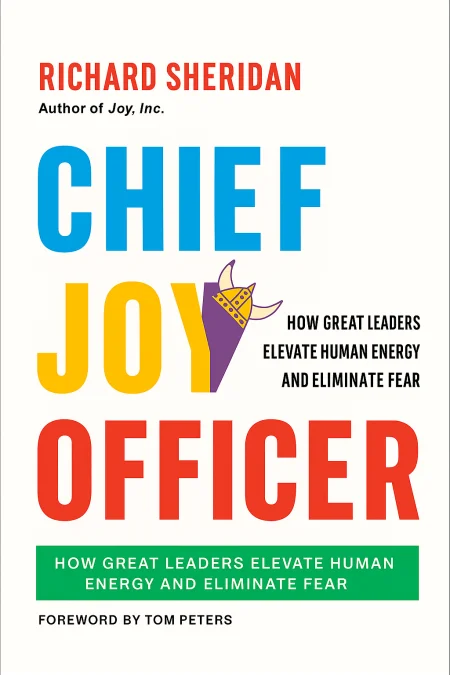
Chief Joy Officer
How Great Leaders Elevate Human Energy and Eliminate Fear
byRichard Sheridan, Tom Peters
Book Edition Details
Summary
In the fast-paced world of business, where spreadsheets often overshadow smiles, Richard Sheridan emerges as a beacon of hope with "Chief Joy Officer." Sheridan, the visionary behind Menlo Innovations, weaves a tapestry of wisdom, drawing from his transformative journey in leadership. This book is not just about achieving success; it's about reimagining it through the lens of joy. Sheridan challenges leaders to foster environments where authenticity, trust, and humility thrive, and where leadership is about nurturing potential rather than dictating tasks. Packed with vibrant stories and profound insights, "Chief Joy Officer" is a rallying cry for managers seeking to reignite their passion and purpose, and for anyone daring enough to lead with joy at the helm.
Introduction
Sarah was eight years old when she changed her father's understanding of leadership forever. During a "take your child to work" day, she sat quietly in his corporate office, coloring with crayons while he answered phones, wrote reports, and held meetings. At day's end, when asked what she learned about daddy's job, her innocent observation cut straight to the heart: "You're really important because no one here can make a decision without asking you first." Her father felt mortified rather than proud, suddenly seeing how his leadership style was actually slowing down his entire team. This moment of clarity sparked a transformation that would reshape not just one leader's approach, but an entire organization's culture. The traditional model of fear-based, hierarchical leadership was failing everyone involved—the leader felt trapped by endless demands, the team felt disempowered and unable to grow, and the company suffered from bottlenecked decision-making. What emerged from this realization was a revolutionary approach to leadership rooted in joy, authenticity, and genuine service to others. The pages ahead reveal how leaders can break free from the exhausting cycle of heroic management and instead create environments where leadership flourishes at every level. Through real stories and practical insights, you'll discover how authentic vulnerability, humble service, and optimistic courage can transform workplace cultures from fear-driven hierarchies into joyful communities of empowered contributors. This transformation isn't just about business success—it's about reclaiming the deeper purpose and personal fulfillment that drew you to leadership in the first place.
Breaking Free from Hero-Based Leadership
The conference room fell silent as the CEO announced the devastating news: half the development team would be eliminated by Christmas. Rich had just two hours to decide who stayed and who went. As he closed his office door and began making his list, the weight of these decisions pressed down on him—each name represented not just an employee, but someone's livelihood, dreams, and family security. This was the loneliest moment of his professional life, embodying everything wrong with traditional hierarchical leadership. When the layoffs were executed, something remarkable happened that revealed the true spirit of teamwork his organization had cultivated despite the circumstances. David, one of the employees being terminated, pulled out a notepad and created columns for names and contact information. In front of the HR representatives, he told the group of departing colleagues, "Sign your name here and put down your home email address. I'll make an email group and we'll support each other in finding our next jobs." This selfless act of leadership emerged not from authority or title, but from genuine care for others—exactly the kind of leadership the company had been trying to foster. The contrast was stark and educational. While traditional boss-driven leadership relied on position and power to make difficult decisions in isolation, true leadership manifested in David's instinctive move to serve others even in his darkest professional moment. That email group stayed active for nearly a decade, supporting members through career transitions and celebrating new opportunities together. This experience illuminated a fundamental truth: sustainable leadership isn't about being the indispensable hero at the center of every decision, but about creating conditions where leadership can emerge naturally from anyone, anywhere, anytime the organization needs it most.
Building Authentic Teams Through Vulnerability
The morning conversation between Rich and Tracy began with a simple question that cut through all pretense: "Are you okay?" Tracy had noticed something was off after Rich's interaction with team members the previous day, and she was doing exactly what the culture encouraged—speaking truth to power with compassion and care. This wasn't insubordination; it was authentic leadership in action, showing how vulnerability creates space for growth and connection. The incident in question had occurred when Rich asked Matt about a technical system's architecture. When Matt honestly replied "I don't know," Rich responded with disappointment and criticism—directly beneath a company poster that read "It's OK to Say I Don't Know." The irony wasn't lost on anyone present, and Rich knew immediately he'd failed to model the values he espoused. That evening, he tossed and turned, knowing he needed to make things right. The next morning's conversation became a masterclass in authentic leadership repair. Rich immediately apologized to both Tracy and Matt, owning his mistake without excuse or defensiveness. Matt's response was equally remarkable in its simplicity and grace: "I forgive you." This exchange revealed the power of bringing one's whole, imperfect self to work. When leaders model vulnerability and accountability, they create psychological safety that allows authentic relationships to flourish. The masks come off, trust deepens, and the entire team becomes stronger through shared humanity rather than pretended perfection.
Creating Systems That Serve People
The empty waiting room puzzled Rich throughout his daughters' childhood visits to their pediatrician. While every other medical office he'd experienced was chaotic with overbooked schedules and frustrated patients, Dr. John Gall's practice ran with clockwork precision. Appointments started on time, urgent needs were accommodated the same day, and the atmosphere was calm and professional. Rich assumed this doctor was simply struggling to build his patient base, never imagining that this tranquility was entirely intentional. Decades later, Rich discovered that Dr. Gall was not just an excellent pediatrician but also one of the world's leading systems thinkers, author of "The Systems Bible." His quiet waiting room wasn't the result of failed marketing—it was the product of brilliant operational design. Dr. Gall had carefully calculated exactly how long different types of appointments required, allocated appropriate time slots for urgent visits each season, and built buffer capacity into his schedule. The result was a system that served both patients and staff beautifully, eliminating the stress and chaos that plagued most medical practices. This revelation illuminated a crucial leadership principle: the difference between systems that serve people and bureaucracy that constrains them. Great leaders don't create more rules and processes to control behavior; they design elegant systems that make good work easier and natural. When systems are thoughtfully constructed around human needs and organizational purpose, they eliminate friction, reduce errors, and free people to contribute their best work. The goal isn't more control but better outcomes through intelligent design that honors both individual dignity and collective success.
Leading with Purpose Beyond Profit
At six years old, Rich witnessed his father crying for the first and nearly last time in his life. The images flickering across their television screen showed President Kennedy's funeral procession moving through Washington, and his father sat silently with tears streaming down his face. Those powerful words from Kennedy's inaugural address—"Ask not what your country can do for you, ask what you can do for your country"—had shaped a generation's understanding of service and sacrifice. This early lesson in service-oriented leadership would eventually transform Rich's entire approach to business. When his software company faced the fundamental question of whom they truly served, the easy answers—customers, employees, shareholders—felt incomplete and self-serving. The breakthrough came when they looked beyond these obvious stakeholders to identify their deeper purpose: ending human suffering as it relates to technology. This meant serving the unknown end users who would never pay them directly but whose lives could be improved or complicated by the software they created. The insurance industry provided a perfect example of this principle in action. A life insurance company's real moment of service isn't when they sell a policy to earn a commission, but when they answer the phone to help a grieving beneficiary during one of the worst moments of their life. That caller has never paid the company a dime, may be struggling financially after losing their provider, and desperately needs compassion, understanding, and efficient service. When leaders can inspire their teams with this kind of noble purpose—serving people they'll never meet to make the world a little better—work transforms from mere employment into meaningful contribution to something far greater than quarterly profits.
Summary
The transformation from fear-based management to joyful leadership begins with a fundamental shift in perspective—from seeing people as resources to be controlled to recognizing them as whole human beings capable of remarkable contribution when given the right environment to flourish. This journey requires leaders to embrace their own vulnerability, model authenticity, and create systems that serve human flourishing rather than administrative convenience. True leadership emerges not from titles or authority but from genuine service to others, starting with those in our immediate sphere and extending outward to the broader community we're privileged to impact. When leaders focus on developing other leaders rather than maintaining their own indispensability, organizations become resilient, adaptive, and capable of sustained excellence that transcends any individual's presence. The choice between fear and joy isn't just a business strategy—it's a fundamental decision about the kind of legacy we want to create and the kind of world we want to help build. Every interaction, every decision, and every moment of leadership either contributes to human flourishing or detracts from it. By choosing the path of joyful service, leaders don't just improve their organizations; they participate in the larger work of healing our shared humanity and creating communities where everyone can contribute their gifts to something meaningful and lasting.
Related Books
Download PDF & EPUB
To save this Black List summary for later, download the free PDF and EPUB. You can print it out, or read offline at your convenience.
By Richard Sheridan
