
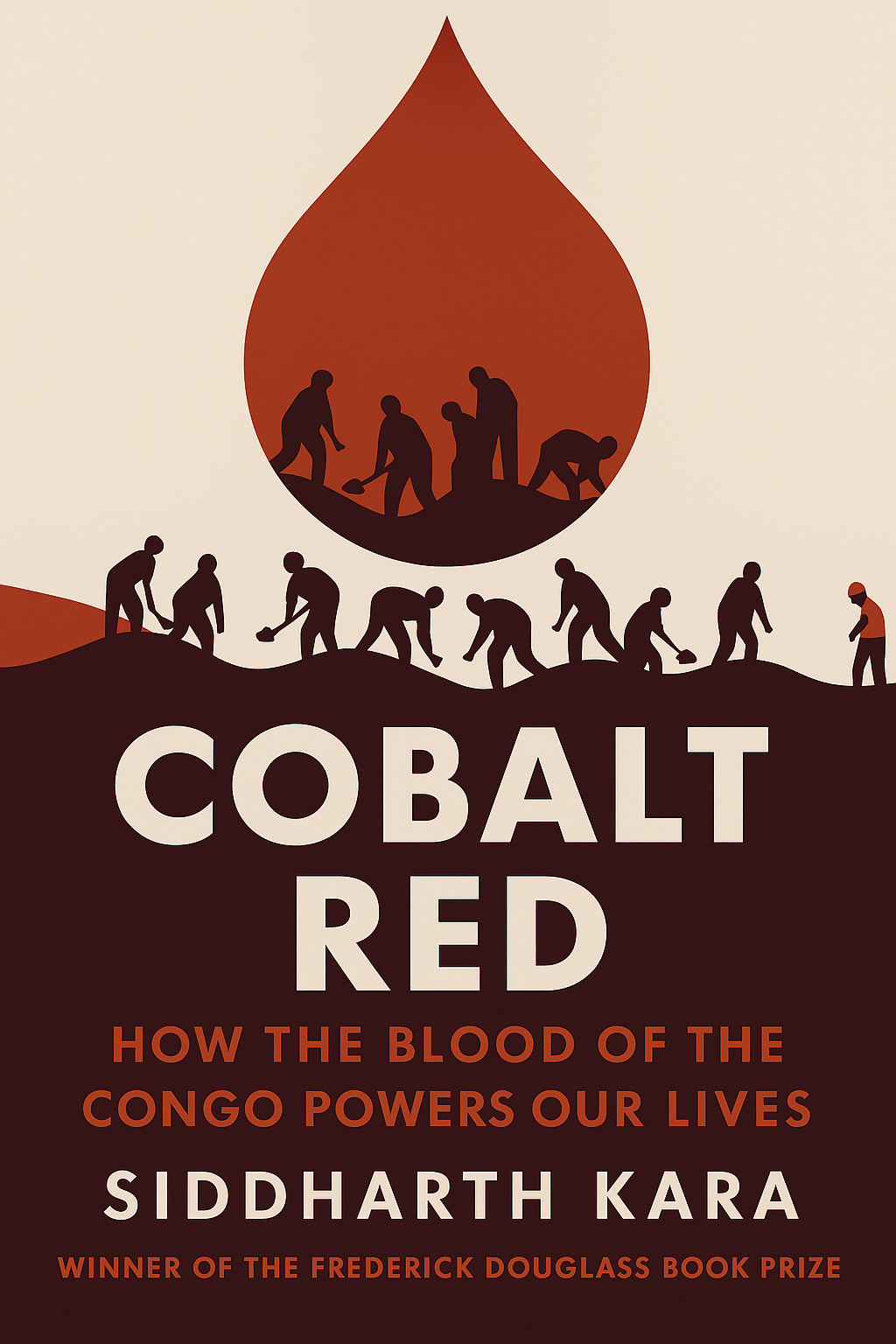
Cobalt Red
How the Blood of the Congo Powers Our Lives
Book Edition Details
Summary
In the depths of the Democratic Republic of the Congo, a haunting truth lies buried beneath layers of earth and corporate facades. "Cobalt Red" is an unyielding chronicle that lays bare the harrowing human rights violations entwined with the extraction of cobalt, a mineral indispensable to the tech we cannot live without. Siddharth Kara, an activist with an unflinching gaze, navigates militia-held territories and toxic pits to bring forth the voices of those who toil and perish in this bleak shadow of progress. As cobalt fuels our modern conveniences, this gripping exposé compels us to confront the profound ethical entanglements of our digital age. Prepare to be awakened to a silent crisis that implicates us all, as Kara argues with passion and precision that awareness is no longer optional, but essential.
Introduction
In the palm of your hand lies a device that connects you to the world, yet hidden within its sleek design is a story of unimaginable human suffering. The cobalt that powers your smartphone's battery comes from the Democratic Republic of Congo, where children as young as six years old descend into hand-dug tunnels, risking their lives for pennies a day. This modern tragedy reveals how our technological revolution rests upon foundations of exploitation that echo the darkest chapters of colonial history. This investigation exposes the uncomfortable truth that our clean energy future may be built upon the suffering of some of the world's most vulnerable people. From King Leopold's brutal rubber extraction to today's cobalt mining, the same patterns of violence and dehumanization persist, hidden behind complex supply chains and corporate assurances of ethical sourcing. The story reveals how multinational corporations, despite their public commitments to human rights, continue to profit from a system that treats Congolese lives as expendable. This examination is essential reading for anyone who uses modern technology, drives an electric vehicle, or cares about global justice. It challenges us to confront whether we can truly call progress ethical when it comes at such a devastating human cost, and demands accountability from the companies that shape our technological future.
Colonial Foundations: From Leopold's Terror to Mining Empire (1885-1960)
The roots of today's cobalt crisis stretch back to 1885, when King Leopold II of Belgium declared himself the personal owner of the Congo Free State, a territory seventy-six times the size of Belgium. What followed was one of history's most brutal colonial regimes, designed to extract maximum wealth from Congo's abundant natural resources through the systematic enslavement of its people. Leopold's Force Publique mercenaries coerced the native population into meeting impossible rubber quotas, using the chicotte whip and severing hands of those who failed to deliver. The human cost was staggering, with an estimated ten million Congolese deaths during Leopold's reign. British diplomat Roger Casement documented these atrocities, describing "a veritable hell on earth" where human life held no value compared to profit margins. The international outcry eventually forced Leopold to transfer control to the Belgian state, but the extractive system remained unchanged. The same infrastructure and legal frameworks designed to funnel wealth to European powers would persist long after independence. The discovery of Katanga's mineral wealth in the early 1900s transformed the colonial economy once again. Union Minière du Haut-Katanga established massive copper mining operations using forced labor, creating the foundation for today's mining industry. The same copper deposits that powered World War II ammunition contained the cobalt that would later become essential for rechargeable batteries. Even the uranium that powered the atomic bombs dropped on Japan came from Congolese mines, yet the Congolese people saw none of the benefits. This colonial legacy established patterns that persist today: foreign powers extracting wealth while local populations suffer in poverty, complex supply chains obscuring responsibility, and international markets driving demand regardless of human cost. The infrastructure and economic relationships forged during this period created the foundation upon which modern cobalt extraction operates, ensuring that the benefits flow away from Congo while the suffering remains.
Independence Betrayed: Lumumba's Vision and Foreign Intervention (1960-1997)
Congo's independence in 1960 offered a brief moment of hope when Patrice Lumumba became the nation's first democratically elected prime minister. Lumumba envisioned a truly independent Congo where the country's vast mineral wealth would benefit its own people rather than foreign powers. His famous declaration that Congolese independence was not "a gift from Belgium" but something "we have won for ourselves" captured the aspirations of millions of Africans emerging from colonial oppression. However, this vision threatened the economic interests of Belgium, the United States, and other Western powers who depended on Congo's strategic minerals. When Lumumba turned to the Soviet Union for assistance in reunifying the country after Belgian-backed Katanga seceded, President Eisenhower ordered the CIA to eliminate him. The conspiracy involved recruiting Lumumba's friend Joseph Mobutu to overthrow him, with full backing from the UN, Belgium, and the United States. Lumumba was captured, tortured, and executed in January 1961, his body dissolved in acid to eliminate all traces. The assassination represented more than the death of one leader; it was the murder of Congo's democratic aspirations and the installation of a kleptocratic system that would persist for decades. Mobutu ruled for thirty-two years, siphoning billions from mineral exports into personal accounts while maintaining Western support through his anti-communist stance. The betrayal of Lumumba's vision established the template for post-independence Congo: a facade of sovereignty masking continued foreign exploitation. Each subsequent leader perpetuated the same system of personal enrichment through mineral deals while the Congolese people remained impoverished. This period demonstrates how genuine independence was systematically prevented, ensuring that Congo's resources would continue flowing to foreign markets while its people paid the ultimate price.
The Cobalt Rush: Child Labor in the Digital Age (1997-Present)
The collapse of the Soviet Union ended Mobutu's usefulness to the West, paving the way for Laurent Kabila's invasion in 1997. Kabila's victory marked the beginning of a new phase in Congo's exploitation, as he immediately began auctioning mining concessions to the highest bidders. The pivotal moment came with Chinese investment following the 2002 Mining Code, designed to attract foreign capital. By 2021, Chinese firms controlled roughly 75 percent of global cobalt refining capacity. This Chinese dominance coincided perfectly with the smartphone revolution and the push for electric vehicles following the 2015 Paris Climate Agreement. As demand for cobalt exploded, Chinese companies established sophisticated supply chains that could absorb massive quantities of artisanally mined cobalt while maintaining plausible deniability about working conditions. The system allowed tech giants and automakers to source cobalt through multiple intermediaries, obscuring the connection to child labor and hazardous conditions. The human reality behind this supply chain is most visible in places like Kasulo, where thousands of children dig in tunnels up to sixty meters deep to extract cobalt-rich ore. These children, some as young as six years old, work with their bare hands using primitive tools, earning between one and two dollars per day while risking their lives in collapsing tunnels and toxic exposure to heavy metals. According to estimates, up to 70 percent of Congo's cobalt production involves child labor at some point in the supply chain. The health consequences are devastating and long-lasting. Research shows that artisanal miners have forty times the normal levels of cobalt in their urine, along with dangerous concentrations of lead and uranium. Children suffer disproportionately, with high rates of birth defects, respiratory diseases, and developmental damage. Despite corporate pledges and international monitoring initiatives, the situation continues to worsen as demand for cobalt grows, representing the ultimate expression of global capitalism's capacity to externalize human costs while maximizing profits.
Global Supply Chains: Engineering Opacity and Corporate Denial
The cobalt that powers our devices travels through a deliberately opaque supply chain designed to obscure its origins and absolve companies of responsibility for the conditions under which it is extracted. From the moment a child fills a sack with cobalt ore, that mineral begins a journey through multiple intermediaries, processing facilities, and trading companies that systematically erase any trace of its human cost. This opacity is not accidental but engineered to provide plausible deniability for the multinational corporations that ultimately profit from Congolese suffering. Chinese companies dominate the middle of this supply chain, operating processing facilities and trading networks that transform raw cobalt ore into refined materials ready for battery production. These companies purchase cobalt from both industrial mines and artisanal sources, mixing them together in processing facilities where their origins become impossible to distinguish. The refined cobalt is then sold to battery manufacturers and technology companies who can truthfully claim they do not know the specific source of their materials. The human cost extends far beyond the mines themselves. Entire communities in Congo's mining provinces suffer from environmental contamination, social disruption, and economic displacement caused by the cobalt boom. Water sources are polluted with toxic runoff, agricultural land is destroyed by mining operations, and traditional social structures collapse under the pressure of rapid industrialization. The profits from this destruction flow to shareholders in Beijing, London, and Silicon Valley, while the costs are borne entirely by the Congolese people. Companies like Apple, Tesla, and Samsung publicly commit to zero-tolerance policies on child labor while their supply chains remain inextricably linked to artisanal mining. The complex web of intermediaries serves to launder cobalt from child miners into formal supply chains, making it virtually impossible to source clean cobalt from Congo. This system demonstrates how global capitalism has perfected the art of extracting value while externalizing harm, ensuring that the benefits of technological progress flow upward while the costs are borne by the world's most vulnerable populations.
Summary
The story of Congo's cobalt reveals a fundamental contradiction at the heart of our modern economy: our most advanced technologies depend on some of the world's most primitive and exploitative labor conditions. From Leopold's rubber terror to today's cobalt rush, the same patterns persist across more than a century. Foreign powers extract wealth while Congolese people suffer, complex supply chains obscure responsibility, and international demand drives exploitation regardless of human cost. This historical continuity demonstrates that the current crisis is not an unfortunate accident but the inevitable result of economic systems that treat African lives as expendable. The assassination of Patrice Lumumba eliminated the possibility of genuine independence, ensuring that Congo would remain what it has always been: a source of wealth for the world while its people remain impoverished. Today's tech executives and automaker CEOs perpetuate this colonial relationship, profiting from Congolese suffering while maintaining plausible deniability through layers of intermediaries. The path forward requires acknowledging that our clean energy transition cannot be built on the backs of exploited children. Consumers must demand true transparency in supply chains and support companies that invest in fair wages and safe working conditions rather than empty promises. Governments must enforce regulations that hold corporations accountable for human rights abuses throughout their supply chains. Most importantly, we must recognize that technological progress without social justice is not progress at all, but merely the latest chapter in a long history of exploitation that diminishes our shared humanity.
Related Books
Download PDF & EPUB
To save this Black List summary for later, download the free PDF and EPUB. You can print it out, or read offline at your convenience.
By Siddharth Kara
