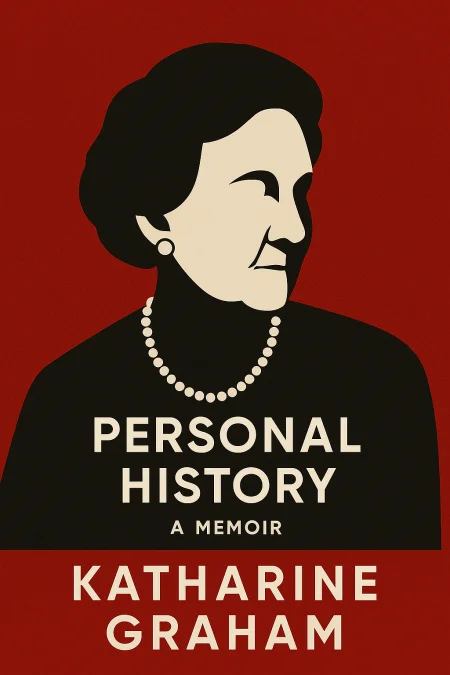
Personal History
Uncover the remarkable story of America’s leading lady of letters
Book Edition Details
Summary
From the gilded corridors of American media power comes the riveting life story of Katharine Graham, a woman who shaped the landscape of journalism with grace and grit. In "Personal History," this Pulitzer Prize-winning memoir invites readers into Graham’s world, one where brilliance and adversity danced a delicate waltz throughout her formative years. Her journey, sculpted by a formidable mother and her own relentless drive, unveils the triumphs and tribulations that accompanied her ascent to the helm of the Washington Post. This is not just an autobiography; it's an exploration of resilience, ambition, and the indomitable spirit of a media trailblazer who defied the norms and left an indelible mark on the industry.
Introduction
In the summer of 1963, a grieving widow stood at the crossroads of American journalism history, clutching the keys to one of the nation's most influential newspapers while battling profound self-doubt about her ability to lead. Katharine Graham had never imagined herself as a media mogul, yet the tragic suicide of her husband Philip thrust her into the publisher's chair at The Washington Post during one of the most turbulent decades in American history. Her transformation from a traditional housewife into one of the most powerful women in corporate America would unfold against the backdrop of Vietnam, civil rights upheaval, and ultimately the constitutional crisis that would topple a presidency. Graham's journey reveals the extraordinary evolution of a woman who learned to wield immense power with wisdom and courage, defending press freedom against government intimidation while building a media empire that would influence American democracy for generations. Through her experiences navigating the Pentagon Papers crisis and the Watergate investigation, readers will discover how personal tragedy can forge unexpected strength, how institutional responsibility can overcome individual insecurity, and how the pursuit of journalistic truth can become both a calling and a crusade. Her story illuminates the delicate balance between business acumen and editorial integrity, showing how one woman's determination to honor her family's legacy helped redefine the relationship between government and the press in ways that continue to shape American journalism today.
From Privilege to Partnership: Early Life and Marriage
Katharine Meyer's formative years unfolded within the rarefied atmosphere of Washington's intellectual elite, where dinner conversations included Supreme Court justices and cabinet members who frequented her family's Georgetown home. Her father, Eugene Meyer, had purchased The Washington Post at a bankruptcy auction in 1933, transforming it from a failing publication into a respectable voice in the nation's capital. Despite this privileged upbringing, young Katharine struggled with profound feelings of inadequacy, particularly when compared to her brilliant older brother Bill, who seemed destined to inherit the family's media empire. Her education at Vassar College and the University of Chicago exposed her to progressive ideas and social causes, yet she remained uncertain about her own path forward. After a brief stint as a reporter at the San Francisco News, she returned to Washington where fate introduced her to Philip Graham, a charismatic Harvard Law School graduate who had clerked for Supreme Court Justice Felix Frankfurter. Their courtship blossomed against the backdrop of New Deal optimism and the looming threat of world war, with Phil representing everything Katharine admired: intellectual brilliance, political passion, and the confidence she felt she lacked. Their 1940 marriage solved multiple dilemmas simultaneously, providing Katharine with a defined role while giving Eugene Meyer the dynamic successor he had hoped to find in his son. Phil Graham quickly ascended to publisher of the Post, bringing boundless energy and ambitious vision to transform the struggling newspaper into a national voice. Katharine embraced her supporting role with dedication, raising their four children while managing the complex social obligations that came with their position in Washington society. For over two decades, she remained content to be known as "Phil Graham's wife," hosting dinner parties that brought together the political and journalistic elite while providing the stable foundation that allowed her husband to pursue his grand ambitions for the newspaper. This comfortable arrangement seemed to suit everyone involved, yet it also left Katharine unprepared for the devastating crisis that would soon shatter their carefully constructed world and thrust her into a role she had never imagined occupying.
Thrust into Leadership: The Unexpected Publisher
The phone call that changed everything came on that terrible August afternoon in 1963, when Phil Graham's suicide at their Virginia farm left Katharine widowed at forty-six and suddenly responsible for one of America's most influential media companies. The transition was neither smooth nor certain, as she faced a board of directors composed entirely of men who questioned whether someone with no business experience could successfully navigate the complex challenges of running a major newspaper. Her first instinct was to find a male successor, but gradually she began to understand that the company's future depended on her willingness to step forward and master the business that had been her husband's consuming passion. The early years tested every aspect of her resolve as she struggled to overcome profound self-doubt while learning everything from circulation figures to union negotiations. She attended editorial meetings with trepidation, asked probing questions despite her fear of appearing ignorant, and slowly began asserting her authority over an organization that had never been led by a woman. The skepticism she encountered from industry peers and even some employees only strengthened her determination to prove that competence mattered more than gender in the leadership of a great newspaper. Her hiring of Ben Bradlee as executive editor in 1965 proved to be one of her most consequential decisions, bringing to the Post the energy and investigative instincts that would define its character for decades to come. Together, they began transforming the newspaper from a respectable but provincial publication into a force that could compete with The New York Times for national influence and prestige. Graham invested heavily in foreign bureaus, expanded the paper's investigative capacity, and created an environment where journalists felt empowered to pursue the most challenging stories of their time. The Pentagon Papers crisis in 1971 became her first major test as a publisher, when The New York Times was enjoined from continuing publication of the classified Vietnam War documents. Standing in her library during a retirement party, Graham faced the momentous decision of whether to risk everything by publishing the Post's own excerpts, knowing they would face government prosecution and potentially lose their television licenses. Her authorization to proceed with publication, despite warnings from lawyers about potential criminal charges, established both the Post's national credibility and her own reputation as a publisher willing to sacrifice everything for the principle of press freedom.
Defining Moments: Pentagon Papers and Watergate
The Watergate story began with what White House officials dismissed as "a third-rate burglary attempt," yet for Katharine Graham and The Washington Post, it would become both their greatest triumph and most perilous challenge. When five men were caught breaking into Democratic National Committee headquarters in June 1972, reporters Bob Woodward and Carl Bernstein began following a money trail that would ultimately lead to the highest levels of government. As their investigation deepened, the Post found itself increasingly isolated, facing relentless attacks from the Nixon administration while other news organizations remained skeptical of the story's significance. Graham endured months of unprecedented pressure as the White House launched a coordinated campaign to destroy the newspaper's credibility and threaten its financial foundation. Attorney General John Mitchell personally warned her that she would "get her tit caught in a big fat wringer" if the Post continued its coverage, while administration officials challenged the company's television station licenses in Florida and orchestrated systematic efforts to isolate the newspaper from sources and advertisers. The president himself was recorded discussing economic retaliation against the Post, treating the newspaper as an enemy of the state rather than a legitimate voice of democratic oversight. Throughout this ordeal, Graham provided crucial support to her editors and reporters while managing business pressures that threatened the company's survival. She defended the Post's coverage in speeches around the country, even as circulation and advertising revenue suffered from the administration's attacks. The isolation was profound, with the Post standing virtually alone in pursuing a story that seemed to implicate the president himself in criminal activity, yet Graham never wavered in her commitment to seeing the investigation through to its conclusion. The vindication came slowly, beginning with James McCord's letter to Judge John Sirica revealing the cover-up and culminating in Nixon's resignation in August 1974. The Post's Watergate coverage earned a Pulitzer Prize and established the newspaper as one of the most influential voices in American journalism, while Graham emerged as a symbol of editorial courage and independence. Her willingness to risk everything for the truth had not only preserved democratic institutions but also demonstrated that principled journalism could triumph over even the most powerful attempts at intimidation and suppression.
Building a Legacy: Media Empire and Press Freedom
The success of Watergate coverage transformed The Washington Post Company from a regional media business into a national powerhouse, but Graham's greatest test as a business leader came during the violent pressmen's strike of 1975. When union workers destroyed printing presses and engaged in systematic sabotage to protest modernization efforts, she faced a choice between capitulating to demands or risking the newspaper's destruction through a prolonged work stoppage. The strike lasted four and a half months, during which Graham worked alongside other executives to produce the newspaper using helicopters and suburban printing plants while enduring threats and violence that tested her resolve to its limits. Her successful resolution of the strike, achieved through hiring replacement workers while maintaining relationships with other unions, gave the Post the operational flexibility needed to compete in a rapidly changing media landscape. Beyond crisis management, Graham proved herself an astute business leader who understood that editorial excellence and financial success were inextricably linked. She oversaw the company's expansion into cable television, acquired full ownership of Newsweek magazine, and built Post-Newsweek Stations into a profitable broadcast division that provided the financial foundation for continued editorial independence. Graham's influence extended far beyond her own company as she became a prominent voice in industry organizations and a mentor to other media executives. She was the first woman to serve as chairman of the American Newspaper Publishers Association and used her platform to advocate for press freedom and professional standards throughout the industry. Her philosophy that journalistic integrity and profitability could coexist guided strategic decisions that consistently prioritized quality content while maintaining strong financial performance, proving that principled leadership could yield both moral and economic rewards. When she stepped down as CEO in 1991, Graham left behind a media empire worth billions of dollars and a legacy of editorial independence that continues to influence journalism today. Her transformation from reluctant widow to media mogul had demonstrated that leadership could emerge from the most unexpected circumstances, and that courage in defense of democratic principles could strengthen both institutions and individuals. The precedents she established during the Pentagon Papers and Watergate crises continue to guide news organizations facing government pressure, while her example as a female executive breaking barriers in corporate America inspired countless others to pursue leadership roles in traditionally male-dominated industries.
Summary
Katharine Graham's extraordinary journey from grieving widow to media titan demonstrates that true leadership often emerges not from ambition but from necessity, and that the courage to defend fundamental principles can transform both individuals and institutions in ways that resonate across generations. Her willingness to risk everything for editorial independence during the Pentagon Papers and Watergate crises established new standards for press freedom while proving that moral courage and business success need not be mutually exclusive, but can instead reinforce each other in powerful ways. From Graham's experience, we learn that self-doubt need not prevent decisive action when guided by clear principles, that seeking wise counsel while maintaining personal responsibility can navigate the most difficult decisions, and that institutions are ultimately strengthened when their leaders choose long-term integrity over short-term convenience. Her legacy serves as a powerful reminder that democracy depends not just on formal governmental structures, but on the courage of individuals willing to hold power accountable regardless of personal cost, making her story particularly relevant for anyone interested in journalism, leadership under pressure, or the ongoing struggle to maintain democratic institutions in an increasingly complex world.
Related Books
Download PDF & EPUB
To save this Black List summary for later, download the free PDF and EPUB. You can print it out, or read offline at your convenience.
By Katharine Graham
