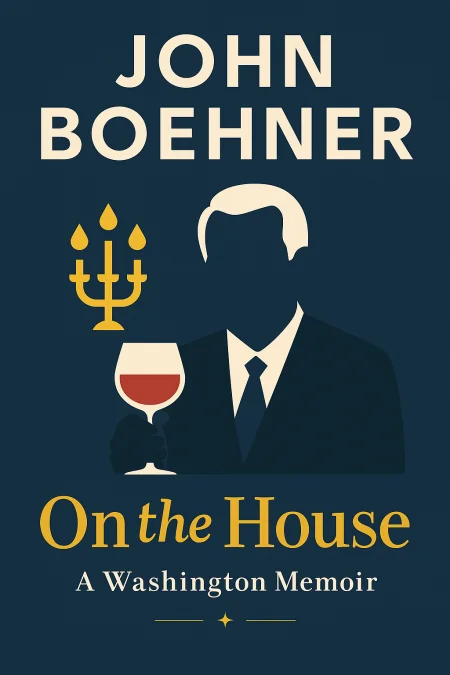
On the House
A Washington Memoir
Book Edition Details
Summary
Amidst the smoke and mirrors of Capitol Hill, John Boehner, with his characteristic candor and humor, invites you behind the scenes of his storied political life in "On the House." Here lies a vivid chronicle of power plays and political prowess, where Boehner, the straight-talking Speaker with a penchant for wine and golf, navigates the tempestuous waters of Washington. As he recounts tales of camaraderie and conflict with everyone from presidents to pundits, Boehner pulls back the curtain on a bygone era when integrity guided leadership. With a sharp wit and no-nonsense style, he paints an unfiltered portrait of politics, offering insights into the shifting sands of the Republican Party and the enduring complexities of American governance. This memoir is not just a recollection but a revelatory experience, showcasing Boehner's unique perspective on the figures who shaped, and sometimes shook, the nation.
Introduction
In the mahogany-paneled chambers of power, where deals are struck and destinies shaped, few ascents are as remarkable as that of John Boehner. From sweeping floors in his grandfather's Cincinnati bar to wielding the Speaker's gavel as second in line to the presidency, his journey embodies the quintessential American dream. Born into a family of twelve children in a modest Ohio home, Boehner learned early that success demanded relentless effort, unwavering integrity, and the courage to challenge entrenched systems when they failed the people they were meant to serve. His political career spanned nearly three decades of American transformation, witnessing the rise of conservative movements, the bitter polarization of Washington, and the emergence of what he colorfully termed "Crazytown" politics. As Speaker during the Obama years, Boehner found himself caught between an uncompromising Democratic administration and an increasingly radical faction within his own Republican Party. His tenure became a masterclass in the art of political survival and the delicate balance between principle and pragmatism. Through his remarkable story, readers will discover how authentic leadership emerges from humble beginnings, how one maintains personal integrity while navigating treacherous political waters, and how the lessons learned in a working-class bar can guide decisions affecting the fate of nations. Boehner's tale reveals not just the machinery of American government, but the human heart that must beat within it to make democracy work.
From Andy's Café to Capitol Hill
John Boehner's political education began long before he ever set foot in a campaign headquarters or legislative chamber. It started at 5:30 each Saturday morning, when his father would quietly wake him and his older brother Bob to help open Andy's Café, the family bar in Cincinnati's blue-collar Carthage neighborhood. There, among factory workers grabbing breakfast shots and beers before their shifts, young Boehner learned lessons that would serve him throughout his rise to the highest echelons of American power. The bar, owned by his grandfather Andrew Boehner since the 1930s, was more than just a business—it was a classroom in human nature and democratic values. Every customer, regardless of their station in life, received the same respectful treatment. Whether they were plant managers or line workers, everyone's voice mattered equally at Andy's. This early exposure to the dignity of working people would later inform Boehner's approach to governance, where he consistently advocated for policies that supported small businesses and honored the value of honest labor. His childhood in a household of twelve children taught him additional crucial skills: the ability to find consensus among competing voices, the importance of personal responsibility, and the art of making limited resources stretch to meet everyone's needs. When you share a single bathroom with eleven siblings, you learn patience and compromise out of necessity. These weren't abstract political concepts to Boehner; they were daily survival skills that prepared him for the chaos and competing demands of congressional leadership. The transition from Andy's Café to the halls of Congress wasn't direct or easy. After military service cut short by a back injury, marriage, college, and building a successful plastics business, Boehner entered local politics almost by accident. His first involvement came through a simple homeowners association meeting, but his natural leadership abilities and genuine concern for his community quickly propelled him from township trustee to state legislator to Congress. Each step built upon the foundational values learned in that Cincinnati bar: treat everyone with respect, work hard for what you earn, and never forget where you came from.
Rising Through the Republican Ranks
Boehner arrived in Washington in 1991 as part of a new generation of conservative reformers, but he quickly distinguished himself from the typical freshman by his willingness to take on his own party's entrenched power structure. His first major battle came with the House banking scandal, where he exposed a corrupt system allowing members of Congress to bounce checks without penalty at taxpayer expense. This wasn't partisan politics—it was principle over party, even when that meant targeting fellow Republicans who had grown comfortable with the perks of power. His reputation as a reformer made him enemies among the establishment but earned him respect among colleagues who shared his vision of accountable government. Boehner understood that real leadership meant being willing to clean house, even when it made your own life more difficult. His role in eliminating earmarks—those special spending projects that members used to funnel taxpayer dollars to their districts—exemplified this philosophy. While other politicians built their careers on bringing home bacon, Boehner built his on ensuring that bacon was earned rather than simply grabbed. The path to leadership required more than just taking principled stands; it demanded the political skills to build coalitions and advance conservative policies. Boehner mastered the art of fundraising for his colleagues, understanding that in politics, loyalty is often built through mutual benefit rather than ideology alone. He traveled countless miles on behalf of fellow Republicans, raising money and offering support that would later translate into votes when leadership positions opened up. This wasn't cynical transactional politics—it was recognition that getting things done requires building relationships and trust over time. His rise through the leadership ranks—from Conference Chairman to Majority Leader to Speaker—reflected his unique combination of conservative principles and pragmatic governing skills. Unlike some of his more ideological colleagues, Boehner understood that being in the minority meant accepting incremental progress rather than demanding perfect solutions. He learned to count votes, not just make arguments, and to find the narrow path between compromising your values and compromising your effectiveness. This balance would be tested to its limits during his tenure as Speaker, when the art of governing collided with the politics of outrage that increasingly defined Washington.
Speaker in the Age of Extremism
When Boehner assumed the Speaker's gavel in 2011, he inherited not just the second most powerful position in American government, but also stewardship of a Republican Party increasingly influenced by what he termed the "chaos caucus." The Tea Party wave that brought Republicans back to power also delivered a cohort of members more interested in television appearances than legislative achievement, more committed to ideological purity than practical governance. Boehner found himself serving as both their leader and, increasingly, their target. The defining challenge of his Speakership came with the rise of figures like Senator Ted Cruz, who convinced House Republicans that shutting down the government would force President Obama to abandon his signature healthcare law. Boehner knew this strategy was doomed to failure, but he also understood that a leader without followers is just a man taking a walk. Despite his private reservations, he led the charge, demonstrating the complex calculations that define effective leadership in a democratic system where your authority derives from consensus rather than command. His relationship with President Obama revealed another dimension of his leadership philosophy: the belief that governing requires working with your opponents, even when your base demands perpetual warfare. Their golf outings and private negotiations over fiscal issues showed Boehner's commitment to finding common ground, even as both men faced criticism from their respective parties for these efforts. The near-miss of their "grand bargain" on deficit reduction represented both the potential and the limitations of traditional legislative deal-making in an era of increasing polarization. Perhaps most tellingly, Boehner's decision to invite Pope Francis to address Congress reflected his understanding that leadership sometimes means rising above partisan politics to moments of genuine national significance. The Pope's visit represented everything Boehner believed government service should embody: dignity, service to others, and recognition of higher purposes beyond political advancement. That this achievement came near the end of his tenure was fitting—it represented the culmination of a career spent trying to make government work for the people it serves, rather than the politicians who temporarily inhabit it.
Legacy of Leadership and Compromise
John Boehner's resignation from the Speakership in 2015 was both an ending and a vindication of his governing philosophy. Faced with another potential government shutdown orchestrated by the same forces that had made his tenure increasingly difficult, he chose to step aside rather than continue enabling what he saw as legislative terrorism. His decision protected both his party and his country from another self-inflicted crisis, demonstrating that sometimes the most powerful act a leader can perform is knowing when to relinquish power. The years since his departure have only reinforced the prescience of his warnings about the dangers of governing by outrage rather than reason. The same members who criticized him for being insufficiently conservative remained silent as subsequent Republican administrations added trillions to the national debt they had claimed was their primary concern. Their silence revealed what Boehner had long suspected: for many, the issue was never really fiscal responsibility but rather the pursuit of chaos that generated media attention and fundraising opportunities. His post-congressional career has been marked by the same authentic voice that characterized his time in office. Whether criticizing Donald Trump's refusal to accept election results or calling out former colleagues for abandoning their stated principles when politically convenient, Boehner has continued to demonstrate that integrity doesn't end when your political career does. His willingness to speak uncomfortable truths about his own party reflects the same courage that drove him to expose congressional corruption as a freshman member thirty years earlier. The institutions Boehner championed—bipartisan cooperation, legislative compromise, respect for democratic norms—may seem antiquated in our current political moment, but they remain essential for functional democracy. His career serves as both a reminder of what effective governance can accomplish and a warning about what happens when the pursuit of power overwhelms the purpose of service. The bartender's son who rose to second in line for the presidency ultimately proved that in American democracy, character matters more than charisma, and substance more than sensation.
Summary
John Boehner's extraordinary journey from a Cincinnati bar to the Speaker's chair embodies the fundamental American belief that merit and integrity can triumph over circumstance and opposition. His life's work demonstrates that authentic leadership emerges not from the pursuit of power but from the commitment to serve others, even when that service demands personal sacrifice and political courage. Through decades of public service, he proved that the values learned in a working-class family—respect for others, honest dealing, and accountability—remain relevant guides for governing in the world's most powerful democracy. For anyone seeking to understand how democracy actually works beyond the theatrical performances that dominate modern media, Boehner's story offers invaluable insights into the art of building consensus, the necessity of compromise, and the importance of maintaining personal integrity while navigating institutional power. His experience reveals that effective governance requires not just strong convictions but also the wisdom to know when those convictions must bend to serve the greater good. In an era when political discourse often resembles ideological warfare, his example reminds us that democracy's strength lies not in the purity of its positions but in its capacity to forge unity from diversity.
Related Books
Download PDF & EPUB
To save this Black List summary for later, download the free PDF and EPUB. You can print it out, or read offline at your convenience.
By John Boehner
