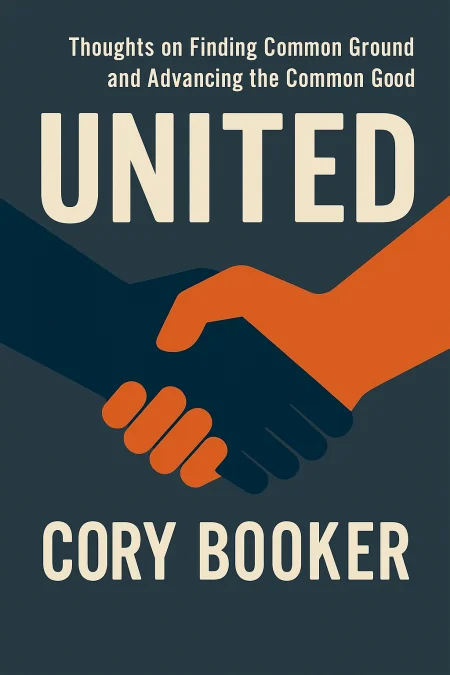
United
Thoughts on finding common ground and advancing the common good
Book Edition Details
Summary
Cory Booker’s "United" is a riveting tapestry of personal narrative and national call-to-action, where ideals of empathy, responsibility, and unity are the guiding stars. From the football fields of Stanford to the gritty streets of Newark, Booker’s journey is one of relentless commitment to public service. This chronicle unveils the defining moments that have sculpted his political soul, introducing us to the unsung heroes who fueled his aspirations. As the first African American senator from New Jersey, Booker passionately advocates for a society where love transcends mere tolerance and shared destinies forge a hopeful future. His compelling insights on race, justice, and communal upliftment make "United" not just a memoir but a manifesto for a compassionate America.
Introduction
In 2006, a young Rhodes Scholar and Yale Law graduate walked through the crime-ridden streets of Newark, New Jersey, not as a visitor, but as its newly elected mayor. Cory Booker's journey from the comfortable suburbs of northern New Jersey to the urban battleground of one of America's most challenging cities represents more than a personal transformation—it embodies the profound realization that individual destiny and collective responsibility are inseparably intertwined. Born into privilege yet choosing service, Booker discovered that true leadership requires not just personal excellence, but a deep understanding of how our fates are connected across lines of race, class, and geography. His story illuminates three essential truths about American civic life: how privilege carries with it the obligation to serve others, how authentic leadership emerges from genuine relationships within communities rather than above them, and how the most pressing challenges of our time demand that we move beyond the illusion of separation to embrace our fundamental interdependence. Through his experiences as a tenant organizer, city councilman, mayor, and senator, Booker learned that the work of democracy is not about individual heroics, but about building the bridges that connect us to one another in common cause.
Roots of Connection: Family Legacy and Early Awakening
Cory Booker's awakening to his place in America's interconnected story began with a phone call from Harvard professor Henry Louis Gates Jr., inviting him to appear on "Finding Your Roots." What Booker discovered through DNA analysis and genealogical research shattered any illusions about racial separation in American history. He learned he was 47 percent African, 45 percent European, and 7 percent Native American—a living embodiment of the complex, often painful ways American bloodlines have intertwined across centuries. The research revealed ancestors on both sides of America's great moral divides: slaves and slave owners, Confederate soldiers and their victims, Native Americans and those who displaced them. Most poignantly, Booker discovered his great-great-great-grandmother, known in the records only as "Slave Mother," who was owned and impregnated by James Stamper. Her daughter Henrietta was born both as Stamper's child and his property, later transitioning from slavery to freedom as documented in the 1870 census. This nameless ancestor, whose story had been nearly erased from history, became a powerful symbol for Booker of the countless invisible hands that had shaped his existence. The privilege that allowed Booker's parents to move to suburban Harrington Park was itself the product of struggle and sacrifice. When IBM executive Cary Booker and his wife Carolyn sought to buy a home in Bergen County in 1969, they encountered systematic housing discrimination. Real estate agents steered them only toward neighborhoods with significant black populations, refusing to show homes elsewhere. It took a legal battle, complete with undercover "test couples" and a physical altercation in a real estate office, to secure their right to live where they chose. This history taught Booker that he was the beneficiary of what he came to call a "conspiracy of love"—countless acts of courage, both large and small, by people who fought to expand opportunity for others. From civil rights marchers who bled on the Edmund Pettus Bridge to Fair Housing Council volunteers who spent weekends helping families fight discrimination, Booker learned that his suburban childhood was made possible by networks of activists who understood that individual freedom required collective action. This understanding would become the foundation of his approach to public service: that privilege creates obligation, and that true security comes only when it is shared.
Finding Purpose: From Law School to Newark's Streets
The transition from Yale Law School to Newark's Central Ward represented more than a geographical move for Booker—it was a journey from abstract idealism to the concrete work of community building. When he first knocked on doors in Brick Towers, a pair of deteriorating sixteen-story public housing buildings, he carried with him the confidence of elite education and good intentions. What he encountered was Ms. Virginia Jones, the 68-year-old president of the tenants association, who would become one of his most important teachers. Ms. Jones's first lesson came in the form of a test. After listening politely to Booker's earnest speeches about wanting to help, she walked him outside and asked him to describe what he saw in the neighborhood. When Booker began listing problems—crime, deterioration, drugs—she cut him off with words that would reshape his understanding of service: "You can't help me. The world you see outside of you is a reflection of what you have inside of you. If all you see are problems, darkness, and despair, then that is all there is ever going to be." This confrontation forced Booker to examine his own assumptions and biases. Despite his good intentions, he was approaching the community as an outsider looking in, seeing deficits rather than assets, problems rather than people. Ms. Jones taught him that effective leadership requires what she called "loving eyes"—the ability to see potential and dignity even in difficult circumstances. She understood that communities are sustained not by outside saviors, but by the deep relationships and mutual care that exist within them. Under Ms. Jones's tutelage, Booker learned to listen more than he spoke, to follow more than he led, and to see his role as supporting existing community leadership rather than replacing it. He moved into Brick Towers itself, sharing in the daily realities of broken elevators, inadequate heat, and pervasive neglect by absentee landlords. Through tenant meetings, legal clinics, and countless conversations in lobbies and laundromats, he discovered that the residents possessed remarkable wisdom, resilience, and commitment to each other's welfare. The relationship with Ms. Jones also taught Booker about the true nature of power in communities. Despite having no formal title beyond tenant association president, Ms. Jones commanded respect from residents, local officials, and even drug dealers, who knew better than to cross her. Her authority came not from position but from her unwavering commitment to the people around her. She had chosen to love her community unconditionally, and that love had transformed her into a force that could protect, nurture, and guide others. This model of leadership—grounded in relationship rather than hierarchy—would shape Booker's approach throughout his career in public service.
Leading Through Crisis: Mayor, Senator, and Public Servant
When Booker took office as Newark's mayor in 2006, he inherited a city facing multiple crises: rising crime, massive budget deficits, and deep-seated cynicism about the possibility of change. His response revealed both the promise and limitations of individual leadership in addressing systemic challenges. From his first days in office, Booker threw himself into the work with characteristic intensity, spending nights riding with police, personally responding to shooting scenes, and maintaining an almost superhuman schedule of community meetings and public appearances. His hands-on approach yielded significant results. During his tenure, Newark experienced its longest stretch without a murder since 1961, built more parks than the city had created in over a century, and attracted billions of dollars in new investment to downtown. The population grew for the first time in sixty years, and the city's graduation rates improved dramatically. Yet Booker also learned painful lessons about the limits of individual heroism in the face of structural problems. The death of Hassan Washington, an eighteen-year-old Booker had known since childhood, crystallized these limitations. Hassan had grown up in Brick Towers while Booker lived there, and despite the mayor's proximity and good intentions, the teenager was drawn into drug dealing and ultimately killed in a shooting. Booker realized that his busy schedule of meetings, press conferences, and policy initiatives had distracted him from the simple acts of relationship that might have made a difference in Hassan's life. This tragedy taught Booker that systemic change requires more than charismatic leadership—it demands sustained investment in the unglamorous work of community building. During his mayoral years, he increasingly focused on programs that addressed root causes rather than symptoms: prisoner reentry services, job training, early childhood education, and environmental remediation. Many of these initiatives operated on shoestring budgets, funded through philanthropy rather than government appropriations, highlighting the inadequacy of existing systems to address complex social problems. Booker's transition to the U.S. Senate in 2013 represented both an opportunity and a challenge. The larger platform allowed him to address issues like criminal justice reform and environmental protection at a national scale, working with unlikely allies like Republican senators Rand Paul and Ted Cruz on bipartisan legislation. Yet he also recognized that federal policy, while important, could not substitute for the daily work of relationship-building that sustains communities. His Senate work on issues like the Superfund cleanup program and expungement of criminal records reflected his understanding that lasting change requires both policy reform and cultural transformation.
Vision of Unity: Building Bridges Across America's Divides
Booker's journey from suburban privilege to urban service ultimately led him to a philosophy of governance based on what he calls "radical interdependence." This vision emerged from his direct experience of how individual and collective fates are intertwined, even when systems of segregation and inequality create the illusion of separation. Whether addressing criminal justice reform, environmental restoration, or economic inequality, Booker consistently argues that these challenges cannot be solved by any single community or group acting alone. His approach to criminal justice exemplifies this philosophy. Having witnessed the devastating effects of mass incarceration in Newark, where 85 percent of murder victims had been previously arrested an average of ten times, Booker understood that public safety requires more than law enforcement. It demands investment in education, job training, mental health services, and community-based violence prevention. In the Senate, he has worked to reform mandatory minimum sentencing laws, expand expungement opportunities, and redirect resources from incarceration toward rehabilitation and prevention. Similarly, Booker's environmental work reflects his understanding that ecological and social justice are inseparable. Growing up near the contaminated Passaic River, where a former Agent Orange manufacturing plant created one of the nation's worst Superfund sites, he learned that environmental destruction disproportionately affects low-income communities and communities of color. His advocacy for Superfund cleanup and environmental justice legislation emerges from the recognition that healthy communities require both social and ecological restoration. The vision of unity that runs through Booker's work is not based on denying differences or conflicts, but on acknowledging the deeper connections that bind Americans together across lines of race, class, and geography. He frequently quotes the African proverb: "If you want to go fast, go alone, but if you want to go far, go together." This philosophy shaped his response to challenges ranging from Superstorm Sandy recovery to police-community relations, always emphasizing collaboration over confrontation and relationship-building over political point-scoring. Booker's call for unity extends beyond policy prescriptions to encompass a fundamental reimagining of American civic culture. He argues that true democracy requires not just periodic voting, but sustained engagement with the difficult work of listening to those who disagree with us, learning from those who challenge our assumptions, and taking responsibility for those whose suffering we might prefer to ignore. This vision, forged in the housing projects and community centers of Newark, offers a roadmap for addressing the complex challenges that will define America's future.
Summary
Cory Booker's journey from suburban comfort to urban service illuminates the fundamental truth that in America, individual flourishing and collective responsibility are not opposing forces but complementary necessities. His transformation from a well-meaning outsider to a community-grounded leader demonstrates that authentic public service requires not just good intentions, but the humility to be taught by those we seek to serve. Through his experiences organizing tenants, governing cities, and crafting national policy, Booker discovered that the most pressing challenges of our time—from criminal justice to environmental protection—cannot be solved by any single community acting alone, but only through the patient work of building bridges across the lines that divide us. His story offers two essential lessons for anyone seeking to make a meaningful difference: first, that privilege creates obligation, and those who have benefited from others' sacrifices must pay that debt forward through service; and second, that lasting change emerges not from heroic individual action, but from the sustained cultivation of relationships that help us see our fundamental interdependence. For readers seeking to understand how personal transformation and social change intersect, or how to translate idealism into effective action, Booker's journey provides both inspiration and practical wisdom for the challenging work of democracy in the twenty-first century.
Related Books
Download PDF & EPUB
To save this Black List summary for later, download the free PDF and EPUB. You can print it out, or read offline at your convenience.
By Cory Booker
