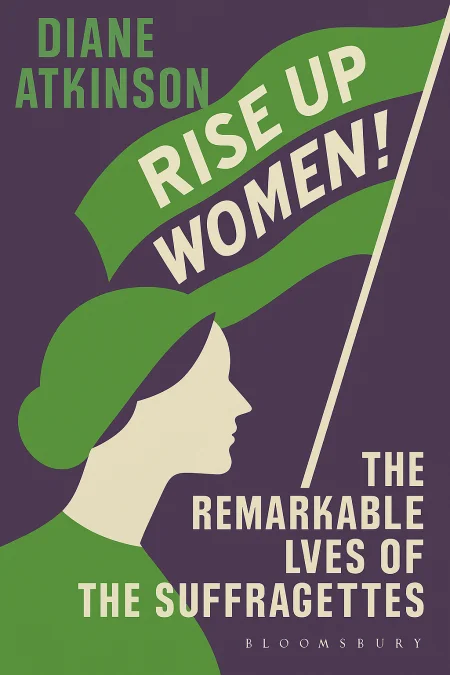
Rise Up, Women!
The Remarkable Lives of the Suffragettes
Book Edition Details
Summary
In the echo of shattering chains, "Rise Up Women!" offers a visceral plunge into the audacious saga of the British women's suffrage movement. From the stirring leadership of Millicent Garrett Fawcett's National Union of Women's Suffrage Societies to the fiery battles led by the Women's Social and Political Union under the banner of "Deeds Not Words," this narrative captures the grit and grace of trailblazing women. Enduring the sting of batons and the cruelty of force-feeding, these pioneers carved their voices into history, refusing to be silenced. With meticulous research and vibrant storytelling, this chronicle unveils the untold stories of the suffragettes' relentless struggle and profound impact, reminding us of the fierce courage required to forge a path toward equality—a journey that continues even now.
Introduction
On a crisp October morning in 1905, two women stood outside Manchester's Free Trade Hall, their hearts pounding as they prepared to shatter decades of political tradition. Christabel Pankhurst and Annie Kenney were about to ask a simple question that would ignite a revolutionary movement: "Will you give votes for women?" Their arrest that day marked the beginning of the most dramatic political campaign in British history, transforming the struggle for women's rights from polite drawing-room discussions into a fierce battle that would see thousands imprisoned, force-fed, and brutalized. This extraordinary story reveals how ordinary women became extraordinary revolutionaries, wielding everything from hammers and hunger strikes to arson and martyrdom in their war against a political system that treated them as second-class citizens. Through the experiences of mill workers and aristocrats, teachers and artists, we witness the birth of modern protest tactics that would inspire liberation movements worldwide. The suffragette campaign demonstrates three crucial insights: how sustained pressure can crack open seemingly immovable power structures, how marginalized groups can force change through strategic disruption, and how the willingness to sacrifice everything for a cause can generate moral authority more powerful than legal force. For anyone seeking to understand how social movements succeed, how individuals find courage to challenge entrenched authority, or how democracy itself sometimes requires militant defense, this story offers profound lessons about the mechanics of revolution and the true price of progress.
From Drawing Rooms to Prison Cells: The Birth of Militant Action (1903-1909)
The Women's Social and Political Union emerged from the ashes of forty years of failed petitions and ignored pleas. When Emmeline Pankhurst gathered women in her Manchester parlor in October 1903, she declared their new motto would be "Deeds Not Words," rejecting the polite constitutional approach that had yielded nothing but empty promises. The existing suffrage societies had achieved respectability but not results, leaving women as politically powerless as ever despite decades of reasoned argument. The movement's first militant act transformed both participants and observers. When Christabel Pankhurst and mill worker Annie Kenney disrupted that Liberal Party meeting, demanding answers about women's suffrage, their arrest and imprisonment created something unprecedented: martyrs for democracy. Their choice of prison over fines generated more publicity in a single day than years of drawing-room meetings, revealing a profound truth about political power. In a society obsessed with respectability, the spectacle of educated women being dragged through the streets like common criminals created an irresistible moral contradiction. The early suffragettes discovered that disruption commanded attention in ways that respectability never could. Their strategy of interrupting political meetings, chaining themselves to railings, and courting arrest exposed the brittleness of male political authority. Each imprisonment became a recruitment tool, as public sympathy grew for women willing to sacrifice their freedom for fundamental rights. The movement attracted supporters from every social class, creating an unprecedented sisterhood united by shared political exclusion. This period established the template for escalating confrontation that would define the next decade. The suffragettes had learned that in a democracy dependent on public opinion, visibility was everything, and controversy generated visibility more effectively than courtesy. Their willingness to violate the boundaries of acceptable feminine behavior demonstrated a new kind of political commitment that both inspired followers and terrified opponents, setting the stage for even more dramatic confrontations ahead.
Windows, Hunger Strikes, and Government Violence: Escalating Confrontation (1909-1912)
The introduction of hunger strikes in 1909 transformed the suffragette campaign from political protest into a battle over the most fundamental human right: control over one's own body. When Marion Wallace-Dunlop refused food in Holloway Prison, demanding treatment as a political prisoner, she created a weapon that put the government in an impossible position. Officials could either release hunger strikers and appear weak, or watch them die and face the political consequences of martyrdom. The government's decision to force-feed hunger strikers marked a moral watershed that shocked the nation. The brutal process, involving tubes forced down throats while women were held down by multiple wardresses, was condemned by medical professionals as torture. Yet this cruelty backfired spectacularly, creating a corps of battle-hardened veterans who wore their prison experiences as badges of honor. Lady Constance Lytton's disguise as working-class "Jane Warton" exposed the class bias in prison treatment, proving that justice in Britain depended on social status rather than legal principles. The systematic window-smashing campaigns of 1911 and 1912 represented a calculated escalation designed to hit the government where it hurt most: in the pockets of influential businessmen. The suffragettes had learned that property damage generated more political pressure than moral arguments, forcing the entire male establishment to confront the cost of denying women political rights. As Emmeline Pankhurst observed, "The argument of the broken pane is the most valuable argument in modern politics." The period culminated in "Black Friday," when 300 suffragettes attempting to reach Parliament were subjected to unprecedented police brutality for six hours. Women were punched, kicked, and sexually assaulted by officers instructed to avoid arrests while inflicting maximum humiliation. This state-sanctioned violence shattered any remaining faith in constitutional methods, convincing even moderate supporters that the government would use any means necessary to maintain male political monopoly. The day's brutality prepared the ground for the campaign of systematic destruction that would follow.
Fire and Martyrdom: The Final Campaign of Destruction (1912-1914)
The failure of the Conciliation Bill unleashed a wave of militancy that transformed suffragettes from political protesters into urban guerrillas. Beginning in 1912, they embarked on a systematic campaign of arson and bombing that targeted symbols of male power across Britain. Golf courses were vandalized, telegraph wires cut, and historic buildings consumed by flames as desperate women resorted to increasingly dramatic tactics to force recognition of their political rights. The government's response revealed its own desperation and moral bankruptcy. The Cat and Mouse Act of 1913 created a grotesque cycle of imprisonment, starvation, release, and re-arrest that turned suffragettes into fugitives constantly evading police surveillance. Women like Lilian Lenton became folk heroes as they escaped custody repeatedly while continuing their campaign of destruction. The breakdown of normal legal processes demonstrated that the suffragette challenge had destabilized the very foundations of Edwardian society. Emily Davison's death at the 1913 Derby provided the movement with its ultimate martyr and crystallized the price of political exclusion. Whether she intended to die or merely attach a suffragette banner to the King's horse, her sacrifice demonstrated that women were willing to pay the ultimate price for recognition as full citizens. Her funeral procession through London, attended by thousands in purple, white, and green, became a powerful demonstration of the movement's unbroken strength despite years of persecution. By 1914, the suffragette campaign had reached revolutionary intensity, with Mary Richardson's attack on the Rokeby Venus symbolizing their willingness to destroy cultural treasures in pursuit of political justice. The movement had evolved from seeking inclusion in the existing system to challenging its fundamental legitimacy. Only the outbreak of world war could resolve this escalating conflict between an immovable government and unstoppable force, but the suffragettes had already proven that determined minorities could shake even the most powerful states when willing to sacrifice everything for their beliefs.
War, Victory, and the Vote: Democratic Revolution Achieved (1914-1918)
The Great War transformed the political landscape in ways that made women's suffrage not just possible but inevitable. Emmeline and Christabel Pankhurst's strategic decision to suspend militancy and support the war effort demonstrated the pragmatic flexibility that had always characterized their leadership. Their transformation from enemies of the state to patriotic allies proved that their ultimate goal was inclusion, not destruction, while the memory of pre-war militancy ensured politicians took their demands seriously. Women's unprecedented wartime contributions demolished traditional arguments about their political incapacity. Nearly a million women entered munitions factories, while others became bus drivers, police officers, and farm workers, performing "men's work" with competence and dedication. The sight of women producing shells for the Western Front while being denied the vote became an embarrassment the government could no longer sustain. The war had created both practical necessity for franchise reform and moral justification for women's inclusion. The Representation of the People Act of 1918 granted the vote to women over thirty who met certain property qualifications, enfranchising 8.4 million women while maintaining male electoral dominance. Though limited and discriminatory, this breakthrough vindicated the suffragettes' central argument that only militant pressure could force political change. As Christabel Pankhurst observed, politicians granted women the vote precisely because they feared the resumption of militancy once peace returned. The final victory came in 1928 with the Equal Franchise Act, granting all women over twenty-one the same voting rights as men. Emmeline Pankhurst died just weeks before this legislation became law, having lived to see the cause for which she had sacrificed everything finally triumph. The suffragettes had not merely won the vote; they had fundamentally altered British society's understanding of women's capabilities and rights, creating the foundation for all subsequent advances in gender equality and proving that democracy sometimes requires militant defense.
Summary
The suffragette struggle reveals a fundamental truth about democratic progress: meaningful political change rarely comes through polite requests to those in power, but requires sustained pressure that makes the status quo more expensive to maintain than reform. The movement's evolution from constitutional campaigning to militant action demonstrates how marginalized groups must often escalate their tactics when traditional channels prove ineffective, forcing societies to confront uncomfortable truths about their own democratic credentials. The suffragettes' strategic genius lay in understanding that in a society priding itself on civilization and respectability, the spectacle of that same society using violence against its own women would create an unsustainable moral contradiction. They forced their opponents to choose between granting women political rights or revealing themselves as hypocrites willing to use brutality to maintain privilege. Their sophisticated use of media, symbolic action, and martyrdom created a template for modern protest movements that continues to inspire activists worldwide. Perhaps most importantly, the suffragettes proved that ordinary people possess extraordinary capacity for sacrifice when fighting for fundamental principles. Their willingness to endure imprisonment, force-feeding, and social ostracism reminds us that democracy is not a gift from benevolent rulers but a prize that must be won and defended by each generation. For contemporary movements seeking social change, their example suggests three crucial lessons: sustained pressure over years is often necessary to overcome institutional inertia, movements must be prepared to escalate when authorities refuse moderate approaches, and the willingness to sacrifice personal comfort for collective goals can generate moral authority more powerful than legal force.
Related Books
Download PDF & EPUB
To save this Black List summary for later, download the free PDF and EPUB. You can print it out, or read offline at your convenience.
By Diane Atkinson
