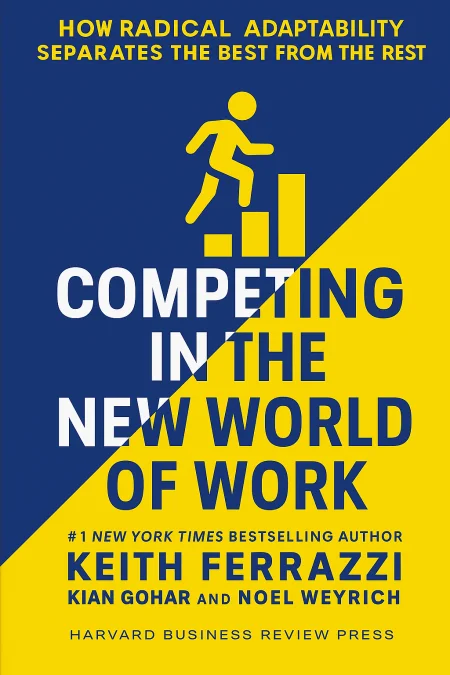
Competing in the New World of Work
How Radical Adaptability Separates the Best From the Rest
byKeith Ferrazzi, Kian Gohar, Noel Weyrich
Book Edition Details
Summary
In a world where rapid transformation is the norm, staying ahead demands more than just digital adaptation—it requires a radical rethinking of what it means to be agile and innovative. Keith Ferrazzi, together with Kian Gohar and Noel Weyrich, charts a course for leaders poised to redefine the very fabric of their organizations in "Competing in the New World of Work." Drawing from an extensive global research initiative, this compelling narrative dives deep into the minds of pioneering executives and change-makers who have mastered the art of anticipation and adaptability. The book challenges traditional models, advocating for human-centric strategies that not only respond to change but actively shape it. It's a strategic manifesto for those ready to seize opportunity from upheaval and foster resilience in a post-pandemic landscape, promising a future where bold leadership and visionary thinking are not just encouraged but essential.
Introduction
The rapid transformation of modern work environments has left many organizations struggling to adapt to unprecedented challenges. Traditional leadership models, designed for predictable hierarchical structures, often fail when faced with continuous disruption and accelerating change. How can leaders not merely survive but thrive in this new landscape? The authors present a comprehensive framework called radical adaptability, which fundamentally reimagines how teams collaborate, make decisions, and evolve in response to uncertainty. This systematic approach addresses the core challenges facing contemporary organizations: maintaining high performance while navigating constant change, building resilient teams across physical and virtual boundaries, and creating sustainable competitive advantages in volatile markets. The framework offers leaders practical methodologies to transform their organizations from reactive entities into proactive, continuously evolving systems. Rather than viewing disruption as a threat to be weathered, radical adaptability positions change as an opportunity for exponential growth and innovation.
Building Radically Adaptable Teams
Radically adaptable teams represent a fundamental shift from traditional collaborative structures to dynamic, self-organizing units capable of thriving amid uncertainty. Unlike conventional teams that rely on fixed roles and hierarchical decision-making, these teams embrace what the authors term "co-elevation," where members share responsibility for collective success and actively support each other's growth. This approach transcends simple cooperation by creating interdependent relationships where team members hold themselves mutually accountable for outcomes. The framework consists of four interconnected competencies that reinforce each other in a continuous loop. Collaborative inclusion ensures diverse perspectives are not merely present but actively leveraged for innovation. Enterprise agility enables rapid iteration and customer-focused value creation through short sprints and continuous feedback. Team resilience maintains collective energy and well-being even under pressure, viewing challenges as opportunities for growth rather than threats to avoid. Active foresight helps teams anticipate and prepare for future scenarios rather than merely reacting to present circumstances. Consider how emergency response teams naturally embody these principles during crises. When facing a natural disaster, effective response teams automatically break down silos, make rapid decisions based on real-time information, support each other's physical and emotional needs, and continuously scan for emerging threats or opportunities. Similarly, radically adaptable business teams operate with this same level of fluidity and mutual commitment, but as a deliberate ongoing practice rather than an emergency response. This transformation enables organizations to maintain peak performance regardless of external volatility, turning uncertainty from a source of stress into a competitive advantage.
Future-Proofing Your Business Model
Future-proofing transcends traditional strategic planning by fundamentally questioning what business an organization is truly in, rather than what products or services it currently offers. This approach requires leaders to zoom out and envision their industry's landscape ten years forward, then zoom in through rapid experimentation to test assumptions and build toward that future vision. The methodology challenges organizations to identify exponential technologies that could transform their sector and position themselves to ride these growth curves rather than be disrupted by them. The process involves three critical phases that work in continuous iteration. First, organizations must honestly assess their core value proposition from a customer benefit perspective rather than a product feature perspective. A railroad company, for example, is fundamentally in the transportation business, not the railroad business, opening possibilities for expansion into complementary mobility services. Second, leaders identify two or three emerging technologies with the potential for exponential impact on their industry, then design small-scale experiments to test integration possibilities. Third, organizations build communities of devoted customers who become advocates and co-creators, providing a defensive moat against competitive threats. This approach proves particularly powerful when examining how traditional industries have been transformed by digital platforms. Netflix evolved from DVD-by-mail to streaming entertainment to original content creation by consistently asking what business they were really in: delivering personalized entertainment experiences. Each transition required abandoning profitable current operations to invest in uncertain future capabilities. Similarly, organizations practicing future-proofing regularly cannibalize their own successful products and services to stay ahead of market evolution, viewing continuous transformation not as a series of discrete changes but as their fundamental operating philosophy.
Creating the Lego Block Workforce
The Lego Block workforce model reconceptualizes human resources as flexible, interconnectable components that can be assembled and reconfigured to meet changing organizational needs. Unlike traditional employment structures built around fixed roles and permanent positions, this approach breaks work down into discrete tasks and projects that can be accomplished by various combinations of full-time employees, contractors, artificial intelligence systems, and external partners. The model provides organizations with unprecedented agility while offering individuals more diverse and fulfilling career possibilities. This framework operates through six decision dimensions that leaders must consciously calibrate based on their strategic objectives. The first three focus on who performs the work: determining the optimal balance between human capabilities and algorithmic automation, choosing between traditional employment and gig-based arrangements, and deciding whether to build capabilities internally or access them through external ecosystems. The second three dimensions address where work occurs: balancing in-person and remote arrangements, considering onshore versus offshore options, and creating either collaborative open environments or focused closed spaces depending on task requirements. Implementation requires a systematic approach that begins with "pixelating" existing job functions into component tasks, then reassembling these elements into optimal configurations. A marketing department, for instance, might retain strategic planning and brand management internally while outsourcing content creation to freelancers and automating data analysis through artificial intelligence. This decomposition reveals opportunities to match specific capabilities with appropriate work arrangements, potentially improving both efficiency and job satisfaction. The key insight is that the future workforce will be defined not by employment status but by value creation, with individuals and organizations forming dynamic partnerships based on mutual benefit rather than traditional hierarchical relationships.
Summary
The essence of competing in the new world of work lies in embracing radical adaptability as a continuous organizational capability rather than an occasional response to crisis. This comprehensive framework transforms how leaders think about team dynamics, strategic planning, and workforce design by positioning adaptability as a competitive advantage rather than a necessary burden. The methodology's power emerges from the interconnection of its components: collaborative teams that can anticipate future needs, business models that evolve with technological advancement, and flexible workforces that can be reconfigured as circumstances demand. Organizations that master these principles will not merely survive disruption but will consistently create new opportunities for growth and innovation, establishing sustainable competitive advantages in an increasingly uncertain global economy. The framework ultimately offers a pathway for leaders to transform their organizations into living systems capable of continuous evolution and renewal.
Related Books
Download PDF & EPUB
To save this Black List summary for later, download the free PDF and EPUB. You can print it out, or read offline at your convenience.
By Keith Ferrazzi
