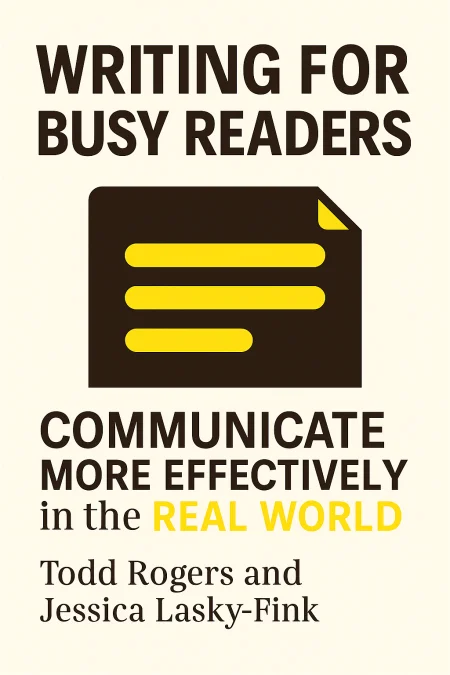
Writing for Busy Readers
Communicate More Effectively in the Real World
byTodd Rogers, Jessica Lasky-Fink
Book Edition Details
Summary
In an era drowning in digital chatter, where every inbox competes for a glance, Todd Rogers and Jessica Lasky-Fink offer a beacon of clarity. "Writing for Busy Readers" isn't just another guide—it's a revolution in communication, blending behavioral science with practical wisdom to reshape how we connect through words. Imagine transforming your writing into a compelling force, capturing attention with surgical precision. This book distills the chaos of modern communication into six potent principles, each designed to slice through the noise and leave an indelible impact. With insights that marry the timeless tenets of Strunk and White with the demands of today's fast-paced world, this guide is your ally in the quest for effective expression. Elevate your messages, engage your audience, and master the art of writing that truly resonates.
Introduction
In our information-saturated world, why do some messages capture attention while others disappear into digital oblivion? The challenge isn't just about writing well—it's about understanding how busy minds actually process written communication. This work presents a scientifically-grounded framework for effective communication that addresses a fundamental disconnect: writers often assume their audience has unlimited time and attention, while readers operate under severe cognitive constraints. The authors introduce a systematic approach built around six core principles that bridge cognitive psychology with practical communication needs. Their framework addresses how selective attention works, why mental shortcuts dominate decision-making, and how formatting choices influence comprehension. This isn't simply another style guide, but rather a behavioral science blueprint that explains why certain writing techniques consistently outperform others. The central theoretical contribution lies in applying insights from human cognition research to everyday communication challenges, offering writers a evidence-based methodology for crafting messages that actually get read, understood, and acted upon.
Understanding the Busy Reader's Brain
The human attention system operates under strict biological constraints that most writers fail to recognize. Our cognitive architecture evolved for face-to-face communication and simple environmental scanning, not for processing the relentless stream of emails, texts, and documents that define modern life. The brain can actively hold approximately seven items in working memory, plus or minus two, creating an inherent bottleneck that affects every reading decision. This cognitive limitation manifests through selective attention mechanisms that automatically filter information. When confronted with text, readers unconsciously apply mental shortcuts to determine what deserves focus. Visual contrast draws attention first—formatted text stands out like a bright object in peripheral vision. The brain actively suppresses awareness of non-essential elements, meaning readers literally cannot notice everything on a page simultaneously. Mental fatigue compounds these challenges significantly. Focused attention depletes like a finite resource, with studies showing that sustained concentration can exhaust cognitive capacity within minutes. A reader who struggles through complex sentences early in a document will have diminished comprehension ability for subsequent content. Physical tiredness further impairs attention control, explaining why dense messages often fail when encountered during busy periods. The multitasking myth reveals another crucial insight. While people believe they can juggle multiple cognitive tasks effectively, research demonstrates that task-switching creates substantial performance penalties. Reading while mentally planning other activities, checking notifications, or processing competing priorities dramatically reduces comprehension and retention, making concise, focused communication essential for busy audiences.
The Six Principles of Effective Writing
The theoretical framework consists of six interconnected principles that address different aspects of cognitive processing during reading. These principles operate synergistically rather than independently, creating a comprehensive system for reader-centered communication that acknowledges human cognitive limitations while maximizing message effectiveness. The "Less is More" principle reflects cognitive load theory, recognizing that every additional word, idea, or request competes for limited mental resources. Shorter messages receive higher engagement rates not merely because they require less time, but because they align with how attention systems prioritize information processing. This principle extends beyond simple brevity to encompass strategic content selection that emphasizes essential elements while eliminating cognitive distractions. Making reading easy addresses linguistic processing efficiency through word choice and sentence structure optimization. Research demonstrates that familiar words activate recognition pathways faster than complex alternatives, while straightforward syntax reduces the working memory burden required for comprehension. This principle draws from psycholinguistics to explain why presidential speeches have shortened from 60-word sentences in 1789 to 7-word sentences in 2021. Navigation design principles leverage visual attention research to create text that functions like a mental roadmap. Readers approach documents similarly to how they use maps—seeking orientation cues, scanning for relevant sections, then diving deeper into areas of interest. Effective headings, logical information hierarchy, and visual separation techniques guide this natural scanning behavior while preventing cognitive overload.
Practical Application and Implementation Strategies
Implementing these principles requires understanding contextual factors that influence communication effectiveness. The framework acknowledges that optimal application varies based on audience, medium, cultural norms, and specific communication goals, while maintaining core cognitive principles as universal constants. Strategic formatting serves as a powerful attention-direction tool when properly calibrated. Bold, underlined, and highlighted text functions like visual magnets, drawing focus to specific content areas. However, excessive formatting creates competing attention demands that can reduce overall comprehension. The key lies in matching formatting choices to reader expectations while using emphasis sparingly to maintain its effectiveness. Reader perspective integration represents perhaps the most challenging aspect of implementation. Writers must shift from self-focused expression to audience-centered communication, consistently asking "So what?" and "Why me?" from the reader's viewpoint. This requires empathy-building exercises and systematic revision processes that prioritize reader needs over writer preferences. Response optimization techniques acknowledge that many communications seek specific actions rather than passive consumption. Simplifying required steps, organizing essential information accessibly, and minimizing cognitive effort needed for compliance dramatically improve response rates. Studies show that reducing form complexity from seven requirements to two increased completion rates by 27%, demonstrating the powerful impact of cognitive burden reduction.
Summary
Effective communication succeeds by honoring the cognitive realities of human attention rather than fighting against them. This framework transforms writing from an intuitive art into a systematic application of behavioral science principles, recognizing that reader-centered design benefits both message senders and recipients. The long-term significance extends beyond individual communication improvements to encompass broader societal impacts—more accessible information, reduced cognitive inequality, and enhanced democratic participation through clearer public discourse. For practitioners, mastering these principles offers a sustainable competitive advantage in our attention-scarce economy while contributing to more humane and effective human connection.
Related Books
Download PDF & EPUB
To save this Black List summary for later, download the free PDF and EPUB. You can print it out, or read offline at your convenience.
By Todd Rogers
