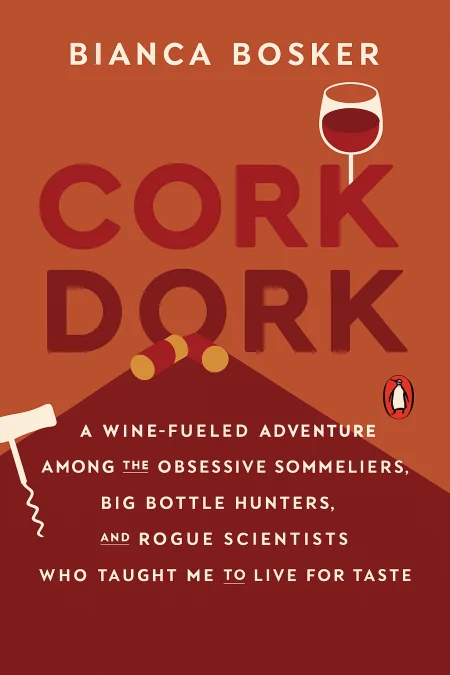
Cork Dork
A Wine-Fueled Adventure Among the Obsessive Sommeliers, Big Bottle Hunters, and Rogue Scientists Who Taught Me to Live for Taste
Book Edition Details
Summary
Bianca Bosker's Cork Dork invites you into a realm where wine is more than just a drink—it's an art form, a science, and a lifestyle. When tech journalist Bosker swaps her keyboard for a corkscrew, she dives headlong into the fascinating subculture of wine savants who transform tasting into a near-magical experience. Journey with her as she infiltrates clandestine tasting clubs, dines in the most exclusive NYC eateries, and even subjects herself to scientific scrutiny, all to unravel the mystique surrounding this ancient elixir. Bosker's narrative is a blend of humor and discovery, peeling back layers to reveal how the nuances of wine tasting can enrich both mind and spirit. This is a tale for anyone who's ever wondered what lies beyond the glass.
Introduction
Imagine standing in an upscale restaurant, watching a sommelier approach your table with the confidence of a surgeon. She lifts a glass of wine, inhales deeply, and begins describing aromas of "wet limestone" and "honeysuckle kissed by morning dew." You nod politely while secretly wondering if she's making it all up. This moment captures something profound about our relationship with our own senses—we've become strangers to the very tools that connect us to the world around us. Most of us live in what experts call a "pastel world" compared to the "neon world" of those who have trained their senses. We've accepted that some people are simply born with better palates, that sensory acuity is a genetic lottery. But what if that's not true? What if the ability to truly taste, smell, and experience the richness of flavor is a skill that can be developed through dedication and practice? This exploration takes us deep into the obsessive world of professional sommeliers—people who have restructured their entire lives around sensory excellence. Through their stories of sacrifice, dedication, and transformation, we discover not just how wine expertise is built, but how any of us can awaken our dormant senses. Their journey reveals that the barriers between expert and amateur are often more psychological than physical, and that we all possess extraordinary sensory capabilities waiting to be unlocked through curiosity, practice, and the courage to begin.
From Cellar Rat to Student: Entering Wine's Secret World
The journey began in the most humbling way possible—as a cellar rat in a cramped, freezing wine cellar at L'Apicio. Armed with nothing but determination and a dangerous lack of experience, our protagonist faced a reality that would have sent most people running back to their desk jobs. The cellar was barely wide enough for two people, stocked with nearly two thousand bottles whose names she couldn't pronounce, from places she'd never heard of, made with grapes that might as well have been fictional. Her supervisor handed her "the Bible"—a clipboard covered in cryptic codes like "DETTORI MOSCADEDDU 2010 L12 DE." Each entry represented a wine's location in the cellar's labyrinthine system, but to untrained eyes, it looked like madness. The physical demands were brutal: navigating a terrible ladder to an attic storage space, carrying forty-pound cases while trying not to plummet to concrete below. She lost bottles, misplaced entire cases, and once spent a month searching for a $192 bottle that had vanished into the depths. During her first attempt at decanting wine for an important dinner, she managed to spill wine everywhere, stain the candles with Sangiovese, and leave her supervisor wondering if he'd made a terrible mistake. Yet something magical happened during those months of fumbling through fundamentals. Each mistake became a lesson, each small success a building block toward understanding. The cellar rat's awakening revealed a fundamental truth about expertise: mastery doesn't spring from natural talent alone, but is forged through countless hours of practice, failure, and the willingness to start at the very bottom. In wine, as in life, true learning begins not with knowing everything, but with admitting how much you don't know and having the courage to begin anyway.
The Science of Taste: Training the Mind to Perceive
At a research facility in Dresden, surrounded by scientists who had dedicated their careers to studying taste and smell, a revelation emerged that challenged centuries of scientific dogma. For nearly two hundred years, researchers had accepted that humans had essentially "forgotten" how to smell as they evolved. This belief suggested that as humans stood upright and developed advanced vision, their olfactory abilities withered away—we were told our sense of smell was inferior to dogs, rats, and other animals. But modern research shattered this myth completely. When scientists actually tested human olfactory abilities against supposedly superior animals, they found humans often outperformed mice, hedgehogs, shrews, pigs, rabbits, and even rats on most odor detection tests. We can track scent trails like bloodhounds, distinguish body odors of friends from strangers, and detect illness in others through smell alone. Our brains are far more sophisticated processing centers for sensory information than anyone had imagined. The most exciting discovery was that our sense of smell is remarkably plastic—it can be trained and improved throughout our lives. Dr. Thomas Hummel's research showed that people who practiced smelling specific odors for just minutes twice daily experienced measurable improvements in their olfactory sensitivity. Even more remarkably, people who were "odor blind" to certain scents could learn to perceive them through training. This scientific revolution revealed that sensory expertise isn't about being born with special gifts—it's about understanding how our senses actually work and training them systematically. The sommeliers' obsessive practice routines weren't just tradition; they were inadvertently following principles that neuroscience has now proven effective. The path to sensory mastery lies not in accepting our limitations, but in recognizing our incredible, largely untapped potential waiting to be awakened.
Service Under Fire: Real Expertise in High-Stakes Dining
The dining room at Marea operated like a carefully choreographed theater production, where every gesture and movement had been rehearsed to create an illusion of effortless luxury. Victoria, the restaurant's young sommelier, had mastered the art of psychological profiling through wine selection. When an elderly woman asked for something "cold and crisp, like Chablis or Sancerre," Victoria instead brought her a rich, buttery Italian wine—the exact opposite of what was requested. The guest loved it. The evening unfolded like a masterclass in human psychology. Tables were categorized not just by their orders, but by their potential: "PX" for big spenders, "F/O" for friends of staff, "HWC" for difficult customers. The sommeliers moved through the dining room like skilled anthropologists, reading signals from clothing, jewelry, body language, and conversation to determine not just what wines to recommend, but how to present them. As bottles worth hundreds of dollars flowed freely, the evening revealed the strange economics of fine dining, where wine serves as both equalizer and differentiator. Behind the polished exterior lay intense pressure and split-second decisions. Sommeliers had to memorize extensive wine lists, manage inventory worth hundreds of thousands of dollars, and read subtle social cues indicating whether a table wanted to spend twenty dollars or two thousand on a bottle. They developed elaborate systems for categorizing guests while maintaining the fiction that every guest received equal attention. The magic of places like Marea lies not just in wine quality or food, but in creating experiences where every detail has been considered and every interaction carefully calibrated. It's a world where expertise meets theater, where knowledge serves emotion, and where the ultimate goal transcends mere service to create moments of connection and discovery that justify the extraordinary investment of passion that fine dining represents.
Testing Limits: The Ultimate Challenge of Sommelier Certification
The Court of Master Sommeliers examination represents the pinnacle of wine expertise, and preparing for it revealed the extraordinary lengths people will go in pursuit of sensory mastery. At the exam in Virginia Beach, candidates faced a grueling test combining wine theory, blind tasting, and practical service skills. Standing before Master Sommelier judges, they had to open and serve wine while answering rapid-fire questions about everything from cocktail recipes to food pairings, all while maintaining grace under intense scrutiny. The blind tasting portion proved even more challenging. Given anonymous wines, candidates had minutes to analyze color, aroma, taste, and structure, then make educated guesses about grape variety, region, and vintage. Success required not just trained senses, but the ability to quiet mental chatter and trust perceptions—a kind of meditative focus that some call "no mind," a state of pure attention without preconceptions or anxiety. Meeting Annie, a fellow candidate who had failed twice before, highlighted the personal stakes involved. For Annie, certification wasn't about prestige—it was about economic survival and providing better for her family. Her determination despite repeated setbacks illustrated how the pursuit of excellence often requires resilience in the face of failure. The statistics were daunting: only a few hundred people worldwide have achieved Master Sommelier status, with staggering failure rates that see many candidates attempting advanced levels repeatedly over years or decades. Yet this difficulty only fueled the passion of those pursuing qualification. The examination process, while rigorous, ultimately served as a gateway to deeper understanding and professional opportunity for those willing to persist through its challenges. It revealed that true expertise emerges not from avoiding failure, but from embracing it as an essential part of the journey toward mastery and using each setback as fuel for continued growth.
Summary
The journey from wine novice to expert reveals a profound truth about human potential: the abilities we admire in others are far more accessible than we imagine. The sommeliers' world, with all its obsessive dedication and seemingly superhuman sensory abilities, demonstrates that expertise is not a birthright but a choice—a decision to reorganize one's life around the pursuit of mastery and heightened awareness. The path requires sacrifice and the willingness to start at the bottom, to fail repeatedly, and to persist through countless moments of doubt. But it offers something invaluable: the awakening of senses we never knew we possessed and the discovery of richness in everyday experiences we had previously overlooked. When we train our palates, we don't just learn to taste wine better—we learn to live more fully, to notice more deeply, and to find pleasure in subtleties that once passed us by completely. Perhaps most importantly, this exploration reveals that the barriers between expert and amateur are often more psychological than physical. We are all capable of developing our senses, of learning to distinguish nuances in flavor and aroma, of finding meaning and beauty in experiences we once dismissed as beyond our reach. The question is not whether we have the genetic gifts of a master sommelier, but whether we have the curiosity and dedication to begin the journey of awakening our own dormant potential and discovering the extraordinary world that awaits our attention.
Related Books
Download PDF & EPUB
To save this Black List summary for later, download the free PDF and EPUB. You can print it out, or read offline at your convenience.
By Bianca Bosker
