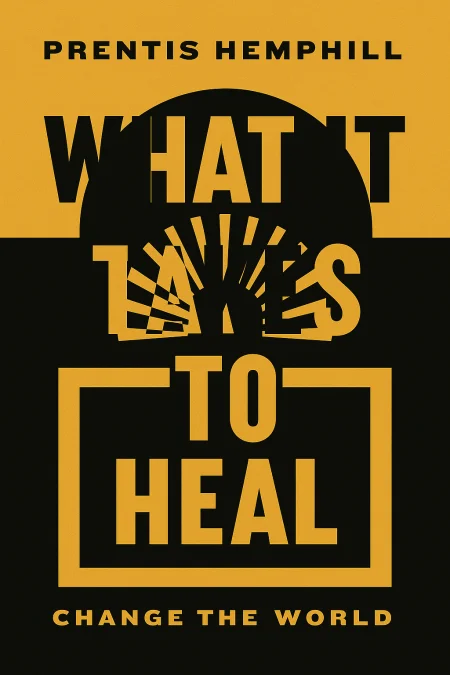
What It Takes to Heal
How Transforming Ourselves Can Change the World
Book Edition Details
Summary
In the wake of global tumult, Prentis Hemphill beckons us to a transformative path of healing and connection. What It Takes to Heal is not just a book; it's a rallying cry for those yearning to mend both self and society. Hemphill, a luminary in trauma recovery and social change, deftly intertwines personal stories with profound insights, guiding readers to recognize the body's whispers and the beliefs shaping our world. This work is a vivid tapestry of hope and action, urging us to place healing at the heart of our lives and communities. Hemphill's vision is clear: through collective healing, we unlock a future of joy, authenticity, and justice.
Introduction
Modern society faces an unprecedented convergence of crises that demand more than conventional approaches to change. The traditional separation between personal healing and social transformation has created a false dichotomy that undermines both individual growth and collective progress. This exploration challenges the assumption that we must choose between inner work and outer activism, proposing instead that genuine social change requires deep personal transformation, and authentic healing necessitates engagement with systemic injustice. The framework presented here emerges from lived experience within social movements, therapeutic practice, and the recognition that trauma operates simultaneously at individual and collective levels. Through examining the interconnections between embodied healing, authentic relationship, and courageous action, readers will discover how personal transformation becomes a prerequisite for sustainable social change. The analysis reveals that our current moment of chaos and conflict offers profound opportunities for both individual awakening and collective healing, if we develop the capacity to hold both simultaneously.
The Foundation: Vision, Healing, and Embodied Transformation
Vision serves as the generative force that transforms possibility into reality, yet most people operate within inherited visions that limit rather than expand their potential. The capacity to envision alternatives emerges from longing rather than mere wanting, representing a deep bodily knowing of what we need to become whole. Harriet Tubman exemplified this prophetic capacity, receiving visions that guided her through seemingly impossible terrain because her imagination transcended the constraints of her historical moment. Healing requires redefining trauma not as individual pathology but as the disruption of safety, belonging, and dignity that ripples through relationships and communities. The mechanistic approach to healing, which separates mind from body and individual from collective, fails to address the interconnected nature of wounding and recovery. Genuine healing restores these core capacities while recognizing that personal transformation cannot occur in isolation from systemic change. Embodiment bridges the gap between intention and action, allowing visions to take root in the body rather than remaining abstract concepts. The Western tradition of mind-body dualism has created a culture that privileges thinking over feeling, rational analysis over somatic wisdom. Reclaiming the body as a site of knowledge and transformation enables authentic change that emerges from lived experience rather than imposed ideology.
The Practice: Relationships, Engagement, and Expanding Community
Authentic relationships require dismantling the historical scripts that determine how we relate across lines of difference, recognizing that our interpersonal dynamics carry the residue of collective trauma and oppression. The practice of authenticity means removing the masks created for survival while developing the capacity to remain present with others without losing connection to ourselves. Boundaries become expressions of love rather than barriers to intimacy, creating space for genuine encounter. Engagement with the world represents a necessary component of healing rather than a distraction from inner work. The personal is always political because individual suffering often reflects systemic dysfunction, and lasting change requires action at multiple levels simultaneously. This engagement transforms participants as much as it changes external conditions, creating communities of practice that model the values they seek to implement more broadly. Expanding community beyond familiar circles challenges the tendency toward fragmentation and isolation that characterizes contemporary life. The practice of kinship transcends biological or chosen family to encompass our fundamental interdependence with all life. This expansion requires developing empathy as an embodied capacity rather than an intellectual concept, allowing us to feel our way into authentic solidarity across difference.
The Process: Navigating Conflict, Change, and Courage
Conflict contains essential information about what needs to change, yet most approaches either avoid confrontation or weaponize disagreement rather than mining it for wisdom. The vulnerability required to receive conflict's teaching transforms potential destruction into opportunities for deeper connection and understanding. Moving beyond innocence and guilt toward accountability creates space for the complexity that characterizes real human relationships. Change operates as a continuous process rather than a destination, requiring sustained practice rather than momentary inspiration. The embodied approach to transformation recognizes that lasting change occurs through repetition and integration, allowing new ways of being to become automatic rather than effortful. This process demands patience with failure and commitment to long-term development rather than immediate results. Courage emerges not from the absence of fear but from the capacity to act in service of what matters most while feeling afraid. Embodied courage includes fear rather than overriding it, using the energy of activation to fuel purposeful action. This approach transforms courage from individual heroism into collective practice, creating cultures that support risk-taking in service of shared values.
The Purpose: Love as the Center of Liberation
Love provides the foundational motivation for both personal healing and social transformation, yet contemporary culture either sentimentalizes or commodifies love rather than recognizing its revolutionary potential. The practice of love requires facing the barriers within ourselves and our systems that prevent authentic connection and mutual care. This love extends beyond romantic or familial relationships to encompass a commitment to the flourishing of all life. Justice without love becomes retribution, while love without justice remains sentiment. The integration of these forces creates the possibility for transformation that addresses both individual suffering and collective oppression. This synthesis requires understanding that our liberation is fundamentally interconnected, that none of us can be fully free while others remain constrained by systems of domination. The cultivation of love as a political force challenges the assumption that power must operate through domination and control. Love-centered approaches to change create abundance rather than scarcity, expanding possibilities rather than limiting them. This orientation transforms the means of change as much as the ends, ensuring that the process of transformation embodies the values we seek to create in the world.
Summary
The central insight emerges from recognizing that authentic transformation requires simultaneous attention to individual healing and collective change, with embodied love serving as both the means and the end of this integrated practice. The methodology demonstrates that lasting social change becomes possible only when we develop the capacity to hold our own complexity while remaining in authentic relationship with others, particularly across lines of historical division and current disagreement. This approach offers profound relevance for anyone seeking to contribute to positive change without losing themselves in either spiritual bypassing or activist burnout, providing practical wisdom for navigating the complexity of our interconnected personal and political lives.
Related Books
Download PDF & EPUB
To save this Black List summary for later, download the free PDF and EPUB. You can print it out, or read offline at your convenience.
By Prentis Hemphill
