
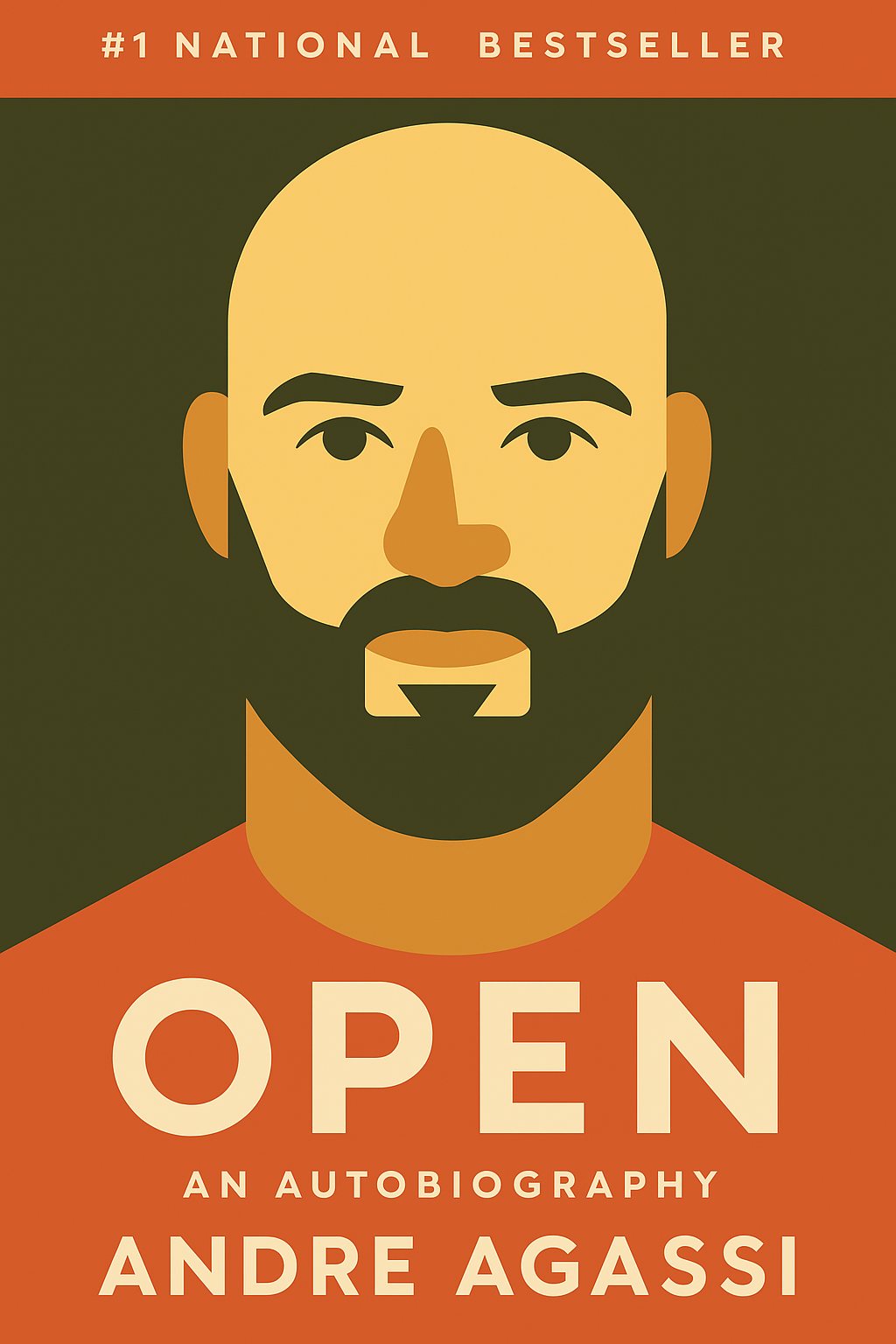
Open
An Autobiography
Book Edition Details
Summary
From the relentless heat of the tennis court to the searing introspection of a life under the spotlight, "Open" peels back the curtain on Andre Agassi's extraordinary journey. This memoir doesn't just serve aces in storytelling; it volleys between the dizzying heights of athletic triumph and the poignant depths of personal turmoil. Born with a racket in hand, Agassi's destiny seemed scripted for greatness, yet behind the trophies and fame lay a man wrestling with identity and purpose. With unflinching honesty, he navigates the turbulence of fame, a high-profile marriage, and a sport he both loved and loathed. "Open" is not merely a sports memoir; it's a powerful testament to the human spirit's quest for meaning and self-discovery amidst life's relentless volleys.
Introduction
At seven years old, Andre Agassi stood on a tennis court in the Nevada desert, whispering to himself through tears: "Just quit, Andre, just give up." Yet something deep within him, some unseen muscle of the soul, wouldn't let him walk away. This contradiction between what he wanted to do and what he actually did would define his entire life. Here was a boy who would become one of tennis's greatest champions while harboring a secret that would have shocked the world: he hated the very game that made him famous. Agassi's story transcends sport to become a profound meditation on identity, authenticity, and the courage to live truthfully. Born into a world where his destiny was predetermined by an obsessive father, he spent decades trapped between public adoration and private anguish. His journey from reluctant prodigy to genuine champion reveals the complex relationship between talent and passion, between what we're given and what we choose to make of it. Through his remarkable transformation, readers will discover how one man learned to find purpose beyond performance, meaning beyond winning, and ultimately, how to become the author of his own life rather than merely the protagonist in someone else's dream.
The Unwilling Prodigy: Tennis as Prison
Andre Agassi's tennis career began not with a dream, but with a nightmare. At age three, his father Mike strapped a sawed-off racket to his tiny hand and hung a mobile of tennis balls above his crib. By seven, Andre was hitting 2,500 balls daily against a modified ball machine he called "the dragon" - a mechanical monster that fired balls at 110 miles per hour while young Andre cowered beneath its towering frame. His father's philosophy was brutally simple: hit one million balls a year, and you'll be unbeatable. The math was relentless, and so was the training. The Agassi household operated like a tennis laboratory, with Mike's stringing machine dominating the kitchen table and rackets in various stages of dissection scattered throughout the house. Mike, an Iranian immigrant and former Olympic boxer, had found in tennis his path to the American dream. He saw in his youngest son not just talent, but destiny. Andre's siblings had already fallen by the wayside - Rita rebelling, Tami plateauing, Philly lacking the killer instinct their father demanded. Andre was the last hope, the chosen one, blessed with what his father called "a horseshoe up your ass." Yet even as Andre's skills developed at a supernatural pace, his hatred for the game grew equally strong. Tennis represented everything he couldn't control about his life - the endless hours of practice, the isolation from normal childhood experiences, the crushing weight of expectations. When he won his first tournament at age eight, there was no celebration, only the understanding that this was what he was supposed to do. When he lost, the consequences were severe. His father's rage was legendary, his disappointment devastating. Andre learned early that his worth as a person was inextricably tied to his performance on the court. The contradiction at the heart of Andre's existence became clear during those formative years: he possessed an almost supernatural gift for a game he despised. His reflexes were otherworldly, his court sense intuitive, his ability to read the ball's trajectory uncanny. Yet every victory felt hollow, every loss catastrophic. He was becoming a champion against his will, driven not by love of the game but by fear of disappointing the man who had sacrificed everything for his success. This internal conflict would shadow him for decades, creating a champion who won in spite of himself rather than because of any burning desire for greatness.
Professional Struggles and the Search for Identity
When Andre turned professional at sixteen, he carried with him not just exceptional talent but a profound sense of displacement. The tennis tour became another form of exile, a continuation of the isolation he'd experienced at the Bollettieri Academy. His flamboyant appearance - the flowing mullet, neon clothing, and denim shorts - wasn't rebellion for its own sake but a desperate attempt to maintain some sense of individual identity in a world that seemed determined to define him solely by his tennis ability. The "Image Is Everything" campaign became a defining moment of misunderstanding between Agassi and the public. What was meant to be a simple commercial for Canon cameras became a millstone around his neck, with critics using the slogan to dismiss him as style over substance. The irony was crushing: here was a young man desperately trying to figure out who he was beneath the image, being condemned for supposedly caring only about image. The backlash was swift and merciless, turning him into tennis's favorite villain before he'd even won a major championship. His early professional years were marked by a series of heartbreaking near-misses at Grand Slam tournaments. The 1990 French Open final against Andrés Gómez was particularly devastating - not just because he lost, but because of the circumstances surrounding it. The night before the match, his hairpiece began disintegrating in the shower, forcing him to secure it with twenty bobby pins. He spent the entire final terrified that his secret would be exposed, playing not to win but simply to keep his hair from falling off on international television. The loss was inevitable, but the humiliation felt complete. These struggles weren't merely professional setbacks but existential crises. Each loss reinforced his sense that he was living someone else's life, playing someone else's game. The crowds that cheered for him didn't know the real Andre - they loved or hated an image, a persona, a carefully constructed public figure. Meanwhile, the real Andre remained hidden, confused, and increasingly angry. He began to understand that his father's voice had become his own internal critic, that the rage and perfectionism he'd absorbed as a child now drove him to self-destruction. The question that haunted him wasn't whether he could win, but whether winning would ever make him feel whole.
Rock Bottom to Redemption: The Great Comeback
By 1997, Agassi had reached his personal and professional nadir. Ranked 141st in the world, struggling with substance abuse, and facing the potential end of his career, he confronted the consequences of years of internal conflict and poor choices. His admission of crystal methamphetamine use, though handled quietly by tennis authorities, represented a moment of profound personal reckoning. The shame and fear of discovery forced him to examine the destructive patterns that had brought him to this point. The decision to rebuild his career from the ground up required extraordinary humility and determination. Starting at challenger tournaments - tennis's minor leagues - Agassi faced opponents he would have easily defeated in his prime, playing before sparse crowds for minimal prize money. This experience, while humbling, proved transformative. Stripped of pretense and expectation, he rediscovered his competitive fire and began to understand tennis as a craft rather than a burden. Each small victory became meaningful, each improvement a step toward reclaiming not just his ranking but his sense of self. Central to his redemption was the support system he had cultivated over the years, particularly his relationship with trainer Gil Reyes. Gil's unwavering loyalty and belief in Andre's potential provided the foundation for his comeback. Their work together went beyond physical conditioning to encompass mental and emotional healing. Gil's philosophy of treating Andre as a "racehorse" rather than trying to change his fundamental nature allowed him to embrace his strengths while addressing his weaknesses. Under Gil's guidance, Andre learned to channel his intensity productively rather than destructively. The culmination of this redemption came with his victory at the 1999 French Open, completing his career Grand Slam and proving that his comeback was genuine. The image of Agassi collapsing to his knees on the clay courts of Roland Garros, tears streaming down his face, captured the profound emotional journey he had undertaken. This wasn't just athletic achievement but spiritual resurrection - the transformation of a man who had lost everything into someone who had found meaning in the struggle itself. The tournament that had once represented his greatest humiliation became the stage for his most complete triumph.
Beyond Tennis: Finding Purpose Through Service
Agassi's most significant transformation came through his discovery of education as a vehicle for lasting impact. The establishment of the Andre Agassi College Preparatory Academy in Las Vegas represented more than philanthropy - it was his attempt to provide disadvantaged children with opportunities he never had. Located in one of the city's most troubled neighborhoods, the school embodied his belief that education could break cycles of poverty and despair that trapped too many young people. The charter school project revealed Agassi's capacity for long-term thinking and genuine leadership. Unlike his tennis career, which was largely shaped by others' expectations, the school represented his own vision and values. He invested not just money but personal time and attention, regularly visiting classrooms and connecting with students. This hands-on approach reflected his understanding that meaningful change required sustained commitment rather than symbolic gestures. Through the school, he discovered that his greatest victories might come not from what he achieved for himself but from what he made possible for others. His later marriage to Steffi Graf and their life together demonstrated his growth in personal relationships. Having learned from the failures of his first marriage, he approached this relationship with greater self-awareness and emotional maturity. Their partnership, built on mutual respect and shared values rather than public image, provided the stability that had eluded him throughout his earlier career. Together, they created a family environment that prioritized authenticity over appearance, giving their children the choice and support that Andre had never experienced. The contrast between Agassi's public persona during his playing career and his post-retirement focus on education illustrates the possibility of radical personal transformation. His willingness to be vulnerable about his struggles - including his hatred of tennis, his drug use, and his failed relationships - created space for genuine connection with others facing similar challenges. By embracing his flaws rather than hiding them, he discovered that authenticity, not perfection, was the key to both personal fulfillment and meaningful contribution to others' lives.
Summary
Andre Agassi's journey from reluctant champion to purposeful educator demonstrates that our greatest struggles often contain the seeds of our most meaningful contributions. His story reveals that success without authenticity is ultimately hollow, while failure faced honestly can become the foundation for genuine transformation. The man who once hated the sport that made him famous discovered that his true calling lay not in winning tournaments but in opening doors for others through education and mentorship. Agassi's experience offers crucial insights for anyone struggling with identity and purpose: the courage to acknowledge our deepest truths is essential for authentic living, and our most painful experiences, when processed with honesty and supported by genuine relationships, can become our greatest sources of wisdom and compassion for others. His legacy suggests that the measure of a life well-lived lies not in avoiding failure but in how we transform our struggles into service to something larger than ourselves.
Related Books
Download PDF & EPUB
To save this Black List summary for later, download the free PDF and EPUB. You can print it out, or read offline at your convenience.
By Andre Agassi
