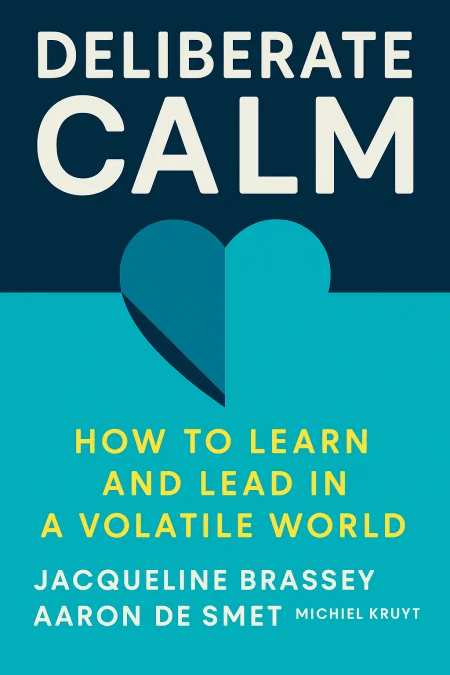
Deliberate Calm
How to Learn and Lead in a Volatile World
byJacqueline Brassey, Aaron de Smet, Michiel Kruyt
Book Edition Details
Summary
In a world where change is the only constant, three seasoned experts unveil a transformative guide for leaders navigating the choppy waters of uncertainty. Deliberate Calm challenges the instinct to retreat into old habits when the tides of complexity rise, introducing the radical concept of Dual Awareness. By harmonizing the inner and outer landscapes of the mind, this approach empowers leaders to break free from the chains of reactive behavior. Rooted in a fusion of cutting-edge neuroscience, psychology, and consciousness practices, this book is not just a manual but a beacon for unlocking potential. With decades of international boardroom wisdom distilled into its pages, Deliberate Calm is your invitation to lead with intentionality, resilience, and vision—no matter how tumultuous the world becomes.
Introduction
When uncertainty strikes and pressure mounts, why do some leaders rise to the occasion while others freeze or react counterproductively? In our increasingly volatile world, the very moments that demand our best thinking often trigger our worst responses. Traditional leadership approaches, designed for predictable environments, crumble when faced with genuine adaptive challenges that have no clear playbook. This work introduces a revolutionary framework that integrates neuroscience, psychology, and leadership development to address what the authors term the "adaptability paradox"—our tendency to become less adaptable precisely when adaptability matters most. At its core lies the concept of Deliberate Calm, a practice that enables leaders to maintain awareness and choice even in the most challenging circumstances. The framework centers on developing "Dual Awareness"—the simultaneous recognition of both our external environment and our internal state, allowing us to consciously choose our response rather than react from habit or emotion. The book presents several interconnected models: the Zone Recognition Framework that distinguishes between familiar and adaptive challenges, the Iceberg Model that reveals the hidden drivers of our behavior, and systematic approaches for building both individual and team capacity for learning under pressure. These theoretical constructs work together to create a comprehensive system for navigating complexity with intentionality rather than reactivity.
The Dual Awareness Framework and Zone Recognition
The foundation of effective leadership in volatile environments rests on developing what the authors call "Dual Awareness"—the integrated perception of both our external circumstances and our internal state. This framework represents a fundamental shift from traditional leadership models that focus primarily on external strategy and tactics, recognizing instead that our internal experience directly shapes our capacity to respond effectively to external challenges. Central to this framework is the distinction between two primary environmental contexts: the Familiar Zone and the Adaptive Zone. The Familiar Zone encompasses situations where we possess the necessary skills, knowledge, and experience to succeed using established approaches. Here, execution and performance optimization are key, much like a skilled musician performing a well-rehearsed piece. The Adaptive Zone, however, presents novel challenges that cannot be solved through existing methods, requiring us to learn, experiment, and potentially transform our approach entirely. The framework further recognizes that within any zone, we can operate from different internal states. The most critical distinction lies between states of "protection" and "learning." In protection, we feel threatened and tend to contract, defending our existing beliefs and reverting to familiar patterns even when they prove ineffective. In learning, we remain open to new information and possibilities, treating challenges as opportunities for growth and discovery. Consider a technology executive facing industry disruption. In the Familiar Zone of managing daily operations, they can rely on established systems and processes. But when confronted with an entirely new competitive threat that renders their business model obsolete, they enter the Adaptive Zone. The natural tendency is to shift into protection—doubling down on what worked before, blaming external factors, or becoming paralyzed by uncertainty. Dual Awareness enables the leader to recognize this shift and consciously choose to remain in a learning state, approaching the disruption with curiosity rather than defensiveness. This framework's power lies in its practical applicability across contexts, from boardroom crises to family dynamics, providing a universal lens for navigating complexity with greater intentionality and effectiveness.
The Iceberg Model and Internal Transformation
Understanding why we react as we do requires exploring what lies beneath the surface of our visible behavior. The Iceberg Model reveals that our actions represent merely the tip of a vast, mostly hidden structure that drives our responses to challenging situations. This model provides a systematic way to examine and ultimately transform the unconscious patterns that limit our effectiveness. At the surface level, we observe behaviors—what people actually say and do. These visible actions, however, are driven by deeper layers that remain largely hidden from both ourselves and others. The first hidden layer consists of our immediate thoughts and feelings in any given situation, the internal commentary and emotional reactions that arise moment by moment. Beneath this lies the layer of mindsets and beliefs—our fundamental assumptions about how the world works, what constitutes success, and what our role should be in various situations. The deepest layer contains our core identity—our values, unmet needs, fears, hopes, and life purpose. This foundation shapes everything above it, often based on formative experiences from childhood or significant life events. These identity elements operate largely outside conscious awareness yet exert tremendous influence over our daily responses to challenges. The model's transformative power emerges when we recognize that changing surface behaviors without addressing deeper layers typically proves ineffective. A leader who struggles with micromanagement might repeatedly resolve to delegate more, only to find themselves reverting to old patterns under pressure. The Iceberg Model suggests examining the underlying beliefs driving this behavior—perhaps the conviction that delegation equals loss of control, or that their value depends on being indispensable. Real transformation occurs through what the authors call "iceberg work"—the process of making unconscious patterns conscious and then deliberately choosing new beliefs and mindsets that better serve our goals. This might involve shifting from a mindset of "I must have all the answers" to "I create value by empowering others to find solutions." Such shifts, when practiced consistently, can fundamentally alter our behavioral patterns and dramatically improve our effectiveness in adaptive situations. The metaphor extends to teams and organizations, which develop their own collective icebergs—shared assumptions and beliefs that shape group behavior and culture, often limiting collective adaptability when circumstances change.
From Individual Practice to Team Implementation
While individual mastery of Deliberate Calm provides significant benefits, its true potential emerges when applied at the team and organizational level. The transition from personal practice to collective capability requires understanding how individual icebergs interact and how teams can develop shared capacity for learning under pressure. Teams face unique challenges when operating in the Adaptive Zone. Individual protection responses can cascade through the group, creating what the authors term a "domino effect" where one person's defensive reaction triggers similar responses in others. A team member who becomes defensive about their approach might trigger another's need to assert control, which in turn activates someone else's tendency to withdraw, progressively diminishing the team's collective intelligence and adaptability. The foundation for high-performing teams in volatile environments is psychological safety—the shared belief that team members can take interpersonal risks without fear of negative consequences. When psychological safety exists, teams can surface mistakes quickly, challenge assumptions openly, and experiment with new approaches without fear of blame or ridicule. This environment enables what the authors call "double-loop learning"—the ability to question not just how to do things better, but whether current approaches are fundamentally appropriate. Building such teams requires specific practices and interventions. Leaders must model vulnerability by acknowledging their own mistakes and uncertainties. Teams need structured ways to check their collective state and call "skylight moments"—pauses that allow members to observe whether they're operating from learning or protection. Regular practices like "origin stories" help team members understand each other's deeper motivations and triggers, building empathy and reducing misinterpretation of behavior. The most effective teams develop the capacity to navigate conflict constructively, recognizing that disagreement often signals an opportunity for deeper learning rather than a threat to harmony. They learn to distinguish between different types of communication—requests, recognition, feedback, and learning conversations—using each appropriately to build understanding and drive progress. When teams master these practices, they become capable of what the authors describe as "creative collision"—the ability to leverage their diverse perspectives and expertise to generate insights and solutions that none could achieve individually. This represents the ultimate expression of Deliberate Calm at scale, where collective wisdom emerges from skillful navigation of difference and complexity.
Summary
The essence of Deliberate Calm lies in transforming our relationship with uncertainty from threat to opportunity, developing the awareness and skills to choose our response rather than react from unconscious patterns. This comprehensive framework offers a path toward more conscious, effective leadership in an increasingly unpredictable world. The implications of this work extend far beyond individual leadership development, pointing toward a fundamental shift in how we conceive of human potential and organizational capability. As our world becomes increasingly complex and interconnected, the capacity to remain calm, curious, and adaptable in the face of uncertainty becomes not just a professional advantage but a crucial skill for navigating life itself. For readers willing to engage in the challenging but rewarding work of developing Deliberate Calm, the promise is profound: the ability to meet whatever challenges arise with presence, wisdom, and the confidence that comes from knowing we can learn and grow through any circumstance.
Related Books
Download PDF & EPUB
To save this Black List summary for later, download the free PDF and EPUB. You can print it out, or read offline at your convenience.
By Jacqueline Brassey
