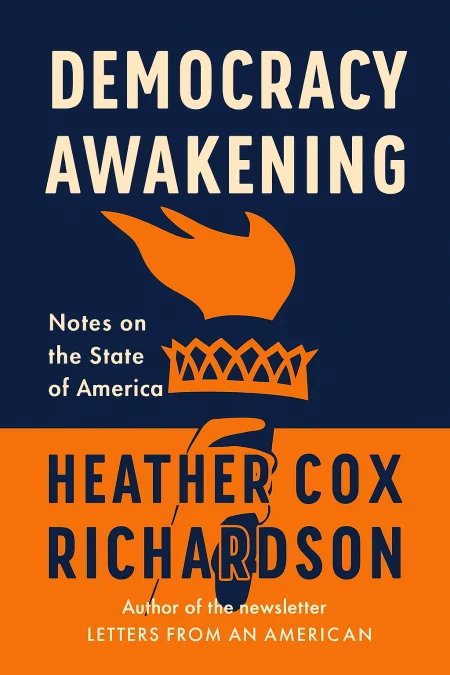
Democracy Awakening
Notes on the State of America
Book Edition Details
Summary
America's democratic spirit stands at a precipice, teetering between its founding ideals and the encroaching shadow of autocracy. In "Democracy Awakening," historian Heather Cox Richardson offers a masterful narrative that unravels how a privileged few have strategically reshaped the nation's identity, wielding rhetoric and revisionist history as weapons. From the tumult of the 2019 impeachment crisis, Richardson’s incisive essays captivated millions, revealing the roots of our present struggle. This book isn't just a chronicle; it’s a clarion call, urging us to reclaim democracy by honoring the true history upheld by marginalized voices. With a deft touch, Richardson connects past political legacies to today's challenges, mapping a hopeful path forward. Here, the past isn't just a story—it's a guide to preserving the democratic promise of the future.
Introduction
In the summer of 1787, fifty-five men gathered in a sweltering Philadelphia hall to craft something the world had never seen: a government deriving its power not from kings or nobles, but from ordinary people themselves. Yet from that very moment, America has wrestled with a profound contradiction. The same founders who proclaimed that "all men are created equal" simultaneously held enslaved human beings, excluded women from political life, and dismissed entire populations as unworthy of citizenship. This tension between the promise of equality and the practice of hierarchy has shaped every chapter of American history. It explains why the nation that declared liberty to the world also built its wealth on enslaved labor, why the country that defeated fascism abroad maintained Jim Crow at home, and why a democracy founded on popular sovereignty now faces threats from those who would restrict voting rights and concentrate power among the few. Understanding this ongoing struggle reveals not just where America has been, but illuminates the forces still battling for its future. This exploration will resonate with anyone seeking to comprehend how democratic ideals survive authoritarian challenges, how marginalized groups have repeatedly renewed America's founding promises, and why the battle between equality and hierarchy remains as urgent today as it was nearly two and a half centuries ago.
Founding Contradictions: Revolutionary Ideals vs. Systemic Exclusion (1776-1860)
The American Revolution unleashed ideas more powerful than its architects ever intended. When Thomas Jefferson penned those immortal words about equality and self-governance, he articulated principles so radical they challenged centuries of European tradition. The notion that no person was born to rule over another set in motion forces that would reshape the world, yet the revolutionaries themselves didn't fully grasp what they had unleashed. The contradiction was stark and deliberate. These same men who risked everything to establish that governments derive their just powers from the consent of the governed simultaneously held hundreds of thousands in bondage. They spoke eloquently of liberty while systematically denying it to women, Indigenous peoples, and the enslaved. This wasn't mere oversight but a calculated limitation that made their version of equality possible. By excluding vast populations from the political community, white men could imagine themselves as having similar interests and being capable of self-governance. Yet the excluded immediately recognized the revolutionary power of these principles and began demanding inclusion. Poet Phillis Wheatley observed the "strange Absurdity" of those crying for liberty while practicing oppression. Abigail Adams urged her husband to "Remember the Ladies" in crafting new laws. Enslaved Americans like Elizabeth Freeman sued for freedom in Massachusetts courts, arguing that constitutional declarations of equality applied to them as well. These early challenges revealed that the Declaration had unleashed ideas that could not be contained within the narrow boundaries the founders had drawn. As the nation expanded westward and new territories sought statehood, the fundamental question became unavoidable: Would America fulfill its founding promises or abandon them for a system based on racial hierarchy and elite rule? The growing tensions of the antebellum period made clear that this contradiction could not persist indefinitely.
Civil War to Progressive Era: Reconstruction's Promise and Betrayal (1860-1920)
By 1860, America's founding contradiction had reached a breaking point. Southern elites, representing less than one percent of the population, had captured federal power and were using it to spread slavery nationwide. They explicitly rejected Jefferson's equality principle, with leaders like James Henry Hammond declaring that society naturally divided between "mudsills" who performed menial labor and a superior class destined to lead civilization forward. Abraham Lincoln and the Republican Party offered a fundamentally different vision. They argued that society progressed through the hard work and innovation of ordinary people, not through the efforts of a wealthy elite. Government's role was ensuring equal access to resources and equal treatment before the law. When Lincoln won the presidency, southern leaders chose secession rather than accept a government committed to equality, triggering a war that would become America's second founding. The Civil War transformed the federal government's relationship to individual rights in unprecedented ways. Republicans used national power to create taxation systems, establish land-grant colleges, build transcontinental railroads, and ultimately abolish slavery. The Thirteenth, Fourteenth, and Fifteenth Amendments fundamentally restructured the Constitution, empowering the federal government to protect individual rights against state oppression and guaranteeing citizenship and voting rights regardless of race. Yet Reconstruction's promise proved tragically brief. By 1877, federal troops had withdrawn from the South, and white supremacists systematically disenfranchised Black Americans through violence, legal restrictions, and economic coercion. The Supreme Court's rulings provided legal cover for excluding not just Black men but women and immigrants from political participation. America's experiment in multiracial democracy gave way to legalized inequality that would persist for nearly a century, demonstrating how quickly democratic gains could be reversed when political will faltered.
Conservative Revolution: Dismantling the Liberal Consensus (1930-2016)
The Great Depression shattered faith in unregulated capitalism and created space for unprecedented government activism. Franklin Roosevelt's New Deal used federal power to regulate business, provide social insurance, and invest in infrastructure, establishing what historians call the "liberal consensus." This system persisted through World War II and into the 1960s, based on the principle that government should actively ensure equal opportunity and protect ordinary Americans from economic insecurity. From the beginning, however, a coalition of business leaders, southern segregationists, and conservative intellectuals worked systematically to destroy this consensus. They branded any government action helping working people or protecting civil rights as "socialism," deliberately invoking fears of foreign ideology to discredit domestic reforms. Conservative intellectuals like William F. Buckley Jr. argued that Americans had been misled by Enlightenment ideals of reason and equality, advocating instead for traditional hierarchies based on religion and inherited wealth. The civil rights movement gave conservatives their crucial opening. When the federal government began enforcing racial equality, opponents argued that civil rights really meant redistributing wealth from hardworking white taxpayers to undeserving minorities. Richard Nixon's "Southern Strategy" welded together racial resentment, anti-government ideology, and cultural traditionalism into a powerful political coalition that would dominate American politics for the next half-century. By the 1980s, this conservative movement had captured the Republican Party and begun systematically dismantling the liberal consensus. Reagan's tax cuts shifted wealth upward while deregulation weakened worker protections and environmental safeguards. Conservative legal organizations stacked courts with judges committed to limiting federal power and rolling back civil rights. Meanwhile, right-wing media created an alternative information ecosystem portraying any challenge to conservative orthodoxy as an attack on American values, setting the stage for even more radical departures from democratic norms.
Trump Era Crisis: The Big Lie and Democracy Under Siege (2016-Present)
Donald Trump's 2016 election marked the culmination of decades of conservative attacks on democratic institutions. Trump synthesized various strands of American authoritarianism: the white supremacist tradition that had rejected equality from the beginning, the oligarchic impulse seeking to concentrate wealth and power, and populist resentment that blamed America's problems on internal enemies rather than systemic failures. Trump's presidency revealed democracy's fragility in alarming ways. He openly courted foreign election interference, weaponized government power against political opponents, and systematically undermined public faith in democratic institutions. His supporters embraced conspiracy theories portraying political opponents as illegitimate usurpers rather than fellow citizens with different views. When Trump lost the 2020 election, he refused to accept results and incited followers to attack the Capitol in an unprecedented attempt to overturn the outcome. The January 6th assault represented the logical endpoint of America's anti-democratic tradition. Rioters carrying Confederate battle flags through Congress halls acted on the same ideology that drove 1861 secession: the belief that their vision of America was the only legitimate one, justifying violence to impose it on the majority. Their chants of "1776" revealed how thoroughly they had absorbed a mythological version of history that justified assaulting democracy itself. Yet Trump's authoritarianism also sparked the largest pro-democracy movement in American history. Millions who had previously taken democratic institutions for granted suddenly recognized their fragility and began working to protect them. The 2020 election saw the highest voter turnout in over a century, as Americans of all backgrounds united to defend the principle that political power should flow from consent of the governed rather than force or fraud, demonstrating that the struggle between equality and hierarchy continues with each generation.
Summary
The central thread running through American history remains the ongoing struggle between two competing visions of nationhood. One vision, rooted in the Declaration of Independence, holds that all people are created equal with the right to participate in their own governance. The other, drawing on traditions of hierarchy and exclusion, maintains that some people are naturally superior and should rule over others. This fundamental tension has never been resolved, requiring each generation to choose anew between equality and authoritarianism. The historical record demonstrates that democracy's survival depends not on leaders' wisdom but on ordinary citizens' active engagement. Time and again, marginalized groups have renewed America's founding promises by demanding inclusion in the political community. From enslaved Americans suing for freedom to women demanding suffrage to civil rights activists challenging segregation, those excluded from power have kept equality's ideal alive even when the powerful abandoned it. Today's threats to democracy are not unprecedented, but they are urgent. Americans who value democratic governance must learn from history's lessons: democracy requires constant vigilance, institutions alone cannot protect freedom, and liberty's price is eternal participation in citizenship's hard work. The choice between equality and authoritarianism remains as stark today as in 1776, and the outcome will depend on whether Americans choose to fulfill their founding promises or abandon them for hierarchy's false comfort.
Related Books
Download PDF & EPUB
To save this Black List summary for later, download the free PDF and EPUB. You can print it out, or read offline at your convenience.
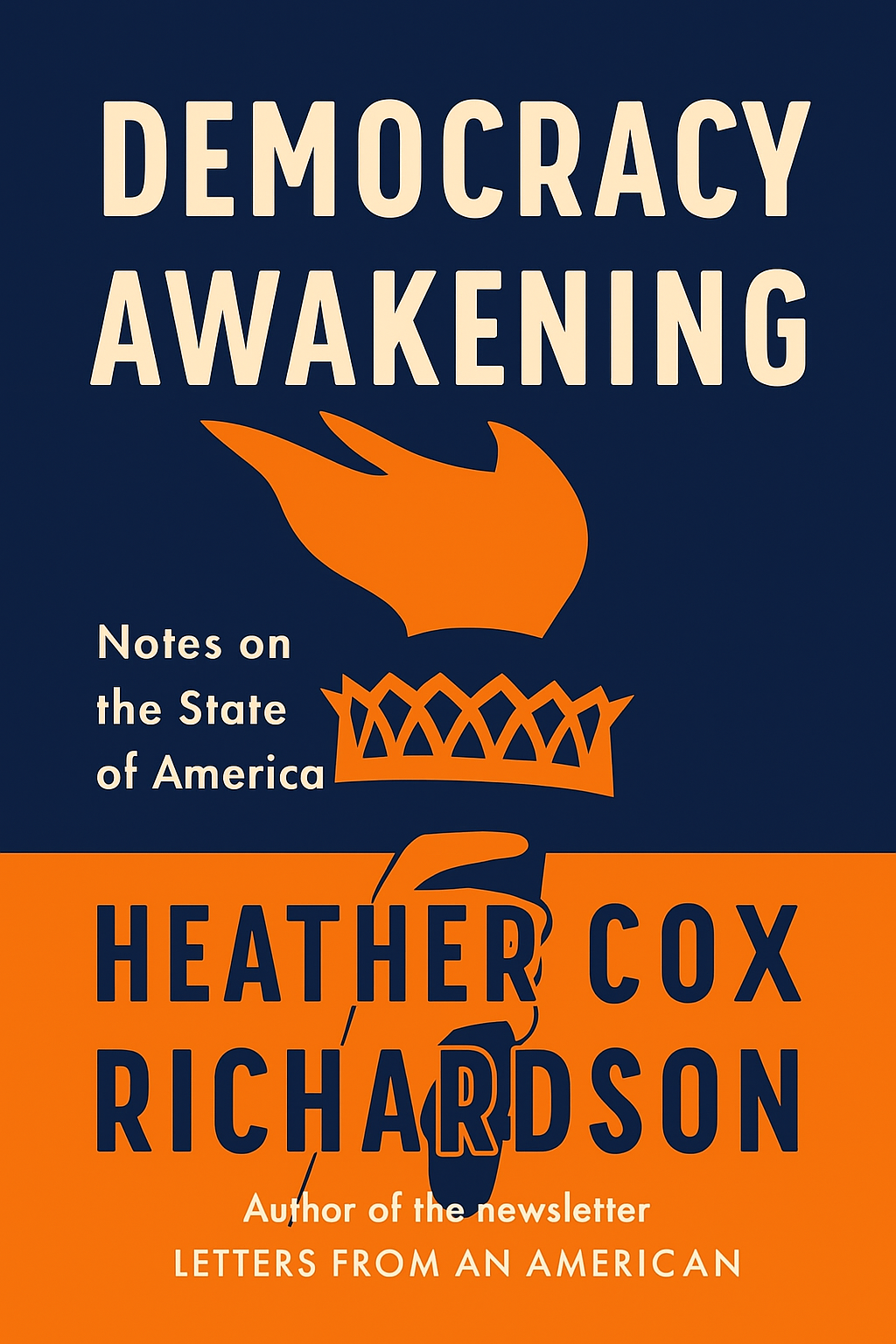
By Heather Cox Richardson
