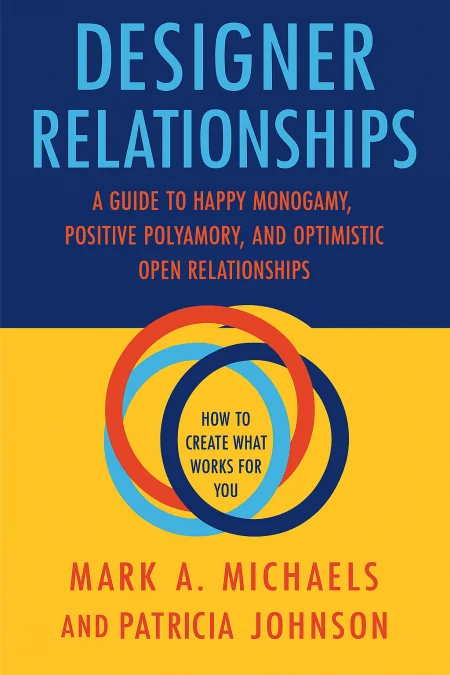
Designer Relationships
Happy Monogamy, Positive Polyamory, and Optimistic Open Relationships
byMark A. Michaels, Patricia Johnson
Book Edition Details
Summary
In the kaleidoscope of modern love, relationships are no longer confined to a single shade. Patricia Johnson and Mark A. Michaels invite you to paint your own masterpiece with "Designer Relationships," a guide to crafting partnerships that reflect your true desires and individuality. Whether you're dreaming of emotional connections sans the physical, embracing non-exclusivity, or exploring the thrills of kink, this book is your toolkit for constructing a love life without boundaries. Armed with insights from best-selling experts, you'll learn to redefine romance through mutual understanding, radical honesty, and boundless empathy. Say goodbye to societal molds and discover the freedom to design a love that’s uniquely yours, where every choice is deliberate, every bond is intentional, and kindness is your guiding light.
Introduction
Contemporary society stands at a crossroads regarding intimate relationships, where traditional monogamous models increasingly clash with evolving human needs and desires. This exploration challenges the deeply embedded assumption that lifelong sexual exclusivity between two people represents the pinnacle of mature, healthy relating. Rather than accepting monogamy as an unquestionable default, this analysis reveals how cultural conditioning has created artificial limitations that often generate more suffering than satisfaction in our most intimate connections. The examination proceeds through systematic deconstruction of prevalent relationship myths while simultaneously presenting evidence-based alternatives that prioritize conscious choice over cultural compliance. Through careful analysis of historical precedents, biological realities, and contemporary research, the argument emerges that designer relationships—consciously crafted arrangements based on mutual agreement rather than social expectation—offer superior pathways to authentic intimacy and lasting satisfaction. The investigation employs both critical analysis of existing paradigms and constructive exploration of alternative models, demonstrating that relationship structures can be intentionally designed rather than unconsciously inherited.
The Case for Conscious Relationship Design
The fundamental premise underlying conscious relationship design rests on recognizing relationships as creative endeavors rather than fixed institutions. Historical analysis reveals that the contemporary model of romantic love as the foundation for lifelong monogamous partnership represents a historical anomaly, emerging only within the last few centuries and primarily within Western cultures. Prior to this relatively recent development, human societies demonstrated remarkable diversity in their approaches to bonding, sexuality, and domestic arrangements. This historical perspective illuminates the artificial nature of current relationship orthodoxy while opening space for more intentional approaches. Designer relationships emerge from this understanding as partnerships where all parties actively participate in defining terms, boundaries, and expectations rather than defaulting to culturally prescribed roles. The evidence suggests that such conscious approaches yield higher levels of satisfaction, stronger communication skills, and greater resilience in the face of inevitable life changes. The design process itself transforms relationships from static commitments into dynamic collaborations. Partners regularly revisit agreements, adapt to evolving circumstances, and maintain awareness that their connection requires ongoing attention and intentional cultivation. This approach acknowledges the reality that humans change over time while providing frameworks for navigating such changes without automatically viewing them as threats to relationship stability. Contemporary research supports the efficacy of consciously designed relationships across various structures, from monogamous partnerships that actively choose exclusivity to complex multi-partner arrangements. The common thread remains the emphasis on awareness, choice, and mutual agreement rather than unconscious conformity to external expectations. Such relationships demand higher levels of communication skill, emotional intelligence, and self-awareness, but they also offer correspondingly greater rewards in terms of authenticity and satisfaction.
Debunking Monogamous Myths and Nonmonogamous Misconceptions
Several deeply embedded cultural myths sustain the current relationship paradigm despite mounting evidence of their inadequacy. The soul mate mythology, with its promise that one perfect partner exists for each individual, creates impossible expectations while simultaneously suggesting that people remain incomplete until finding their "other half." This belief system generates chronic dissatisfaction as individuals constantly measure their relationships against an impossible standard of perfect compatibility. The related myth of "happily ever after" further distorts relationship expectations by implying that successful partnerships reach a static state of perpetual happiness. Reality demonstrates that all relationships involve ongoing challenges, periods of growth and difficulty, and continuous evolution. When couples encounter inevitable rough patches, they often interpret these as signs of fundamental failure rather than normal relationship dynamics requiring skillful navigation. Conversely, nonmonogamous arrangements face their own set of misconceptions, many rooted in moral panic rather than empirical observation. The assumption that consensual nonmonogamy inevitably leads to emotional chaos, sexually transmitted infections, or relationship breakdown finds little support in available research. Studies consistently show that people in consensually open relationships practice safer sex more consistently than those engaging in clandestine affairs, report higher levels of relationship satisfaction, and demonstrate superior communication skills. The misconception that nonmonogamy represents a failure of commitment or inability to form deep bonds reflects projection of monogamous assumptions onto fundamentally different relationship structures. Research on polyamorous individuals and swinging couples reveals strong pair-bonds and deep emotional connections, often enhanced rather than threatened by additional relationships. The key distinction lies not in the number of partners but in the presence or absence of honesty, consent, and mutual support within whatever structure people choose.
Essential Skills for All Relationship Structures
Regardless of chosen relationship structure, certain fundamental skills prove essential for maintaining healthy, satisfying connections. Self-knowledge forms the foundation, requiring ongoing exploration of one's sexual needs, emotional patterns, and relationship preferences. This self-awareness must remain dynamic, acknowledging that desires and capacities evolve throughout life rather than remaining fixed from early adulthood. Communication skills extend far beyond simple honesty to encompass timing, kindness, and discernment about when and how to share various types of information. The ability to distinguish between privacy and secrecy becomes particularly crucial, as does the capacity to express needs and boundaries clearly while remaining receptive to partners' communications. Advanced communication includes the development of compersion—the ability to take pleasure in partners' joy and growth even when not directly participating. Trust building operates through consistent demonstration of reliability, transparency, and care for partners' wellbeing. This process requires moving beyond initial attraction or chemistry to develop deeper confidence through repeated positive interactions. Trust manifests not only in sexual fidelity (however defined) but in emotional reliability, follow-through on commitments, and willingness to prioritize relationship health over individual convenience. The cultivation of flexibility allows relationships to adapt to changing circumstances, evolving desires, and life transitions without automatically triggering crisis. This includes flexibility about roles, activities, and even relationship structures themselves. Partners who develop comfort with uncertainty and change position themselves to navigate inevitable life challenges more successfully than those who insist on rigid adherence to initial agreements regardless of changing circumstances.
Ethical Considerations in Alternative Relationships
Ethical relationship conduct encompasses both practical safety measures and deeper considerations of consent, honesty, and care for all affected parties. Safer sex practices become particularly important in nonmonogamous contexts, requiring regular testing, honest disclosure of sexual history, and consistent use of appropriate protection. The responsibility extends beyond protecting oneself to actively safeguarding all partners' health and emotional wellbeing. Informed consent requires that all parties understand not only the immediate terms of their involvement but also the broader context of partners' other relationships and commitments. This transparency enables people to make genuinely informed decisions about their participation rather than operating from incomplete or misleading information. Ethical practitioners recognize that consent remains ongoing and can be withdrawn as circumstances or feelings change. The principle of minimizing harm guides ethical relationship conduct beyond formal agreements to encompass consideration for partners' emotional states, life circumstances, and broader community connections. This might involve discretion about public displays of affection with secondary partners, sensitivity to timing of new relationship announcements, or recognition that what feels comfortable for primary partners may affect others differently. Responsibility extends to honest self-examination about motivations, capabilities, and emotional availability. Ethical relationship design requires acknowledging limitations as well as desires, avoiding over-commitment or making promises that cannot realistically be maintained. This includes recognition that different relationship styles work better at different life stages and under varying circumstances, requiring ongoing assessment rather than rigid adherence to initial preferences.
Summary
The transformation from culturally mandated relationship structures to consciously designed partnerships represents a fundamental shift toward authenticity and intentional living. Through systematic examination of relationship myths, careful analysis of alternative models, and honest assessment of required skills and ethical considerations, a compelling case emerges for approaching intimate connections as creative collaborations rather than prescribed institutions. The evidence consistently demonstrates that conscious choice, clear communication, and mutual respect produce superior outcomes across all relationship structures, whether monogamous or nonmonogamous. For readers seeking greater authenticity in their intimate lives, the framework of designer relationships offers both practical tools and philosophical foundation for creating connections that truly serve human flourishing rather than merely conforming to social expectation.
Related Books
Download PDF & EPUB
To save this Black List summary for later, download the free PDF and EPUB. You can print it out, or read offline at your convenience.
By Mark A. Michaels
