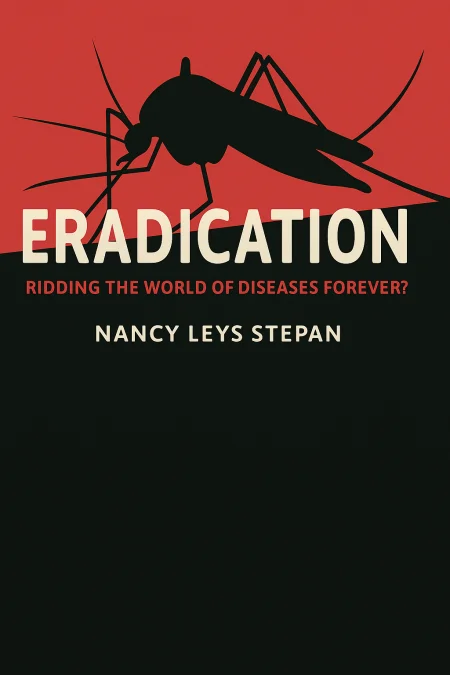
Eradication
Ridding the World of Diseases Forever
Book Edition Details
Summary
In the intricate dance of disease and public health, the quest for eradication stands both as a beacon of hope and a contentious battleground. Nancy Leys Stepan, a lauded historian of medicine, delves into this complex narrative in her masterfully researched work. With a storyteller's flair, she traces the journey from the nascent dreams of the 20th century to today's bold campaigns against maladies like malaria and polio. At the heart of her exploration lies Dr. Fred Lowe Soper, a relentless figure whose campaigns against diseases like yellow fever and smallpox are recounted with gripping detail. As Stepan navigates through the intertwining paths of imperialism, technological advancements, and international health strategies, she raises thought-provoking questions: Are our resources better spent on eradication or enhancing primary health care? Her analysis culminates in a compelling argument that, under the right conditions, these two approaches can harmoniously coexist, potentially transforming the lives of the world's most vulnerable populations.
Introduction
In the sweltering heat of Havana in 1901, American army doctors achieved something that would have seemed impossible just months earlier: they eliminated yellow fever from a city that had been terrorized by the disease for over two centuries. This triumph, born from the desperate needs of imperial expansion, sparked one of humanity's most audacious dreams—the complete eradication of diseases from the face of the Earth. What began as a military necessity in occupied Cuba would evolve into a century-long crusade that would reshape international health, consume billions of dollars, and reveal profound truths about the intersection of science, politics, and human ambition. This remarkable history illuminates three critical questions that resonate powerfully today: How do technical solutions interact with complex social realities in addressing global health challenges? What happens when humanitarian ideals become entangled with political power and cultural imperialism? And perhaps most urgently, as we face new pandemics and persistent health inequalities, what can the dramatic successes and failures of past eradication campaigns teach us about building more effective approaches to global health? The story reveals how medical campaigns became weapons in the Cold War, how the dream of disease-free world both inspired unprecedented international cooperation and exposed the limits of top-down interventions. This exploration will fascinate anyone interested in global health, international relations, medical history, or the unintended consequences of ambitious humanitarian projects. Whether you're a public health professional grappling with contemporary challenges, a student of history curious about the forces that shaped our modern world, or simply someone who wants to understand how humanity has attempted to conquer its oldest enemies, this journey through the politics and science of disease eradication offers essential insights into one of our species' most revealing undertakings.
Imperial Foundations: Mosquito Wars and Colonial Health Control (1900-1940)
The modern concept of disease eradication emerged not from humanitarian ideals but from the brutal necessities of American imperial expansion. When U.S. forces occupied Cuba in 1898, they confronted an enemy more deadly than Spanish resistance: yellow fever, which killed more American soldiers than combat itself. This crisis forced a revolutionary rethinking of disease control that would echo through the next century of global health interventions. The breakthrough came through the Reed Commission's dangerous human experiments in 1900, which definitively proved that yellow fever was transmitted by mosquitoes rather than the "miasmatic vapors" that medical authorities had blamed for centuries. This discovery transformed public health from a broad social enterprise focused on general sanitation into a precise military operation targeting specific biological enemies. Major William Gorgas applied these findings with remarkable efficiency in Havana, organizing systematic house-to-house inspections, mosquito breeding site elimination, and meticulous record-keeping that would become the template for all future eradication campaigns. The success in Cuba established what would become known as the "Gorgasian model": single-disease focus, technical precision, top-down authority, and the unwavering belief that specific biological interventions could solve complex health problems without addressing underlying social conditions. As one observer noted, these methods had "driven the last nail in the coffin of the filth theory of disease." The approach reflected the broader imperial mindset of the era, which viewed tropical diseases as obstacles to be conquered rather than complex phenomena rooted in poverty, ecology, and social organization. The Rockefeller Foundation institutionalized this approach in the 1910s and 1920s, launching the world's first official eradication campaigns against hookworm and yellow fever. These efforts created the international infrastructure and intellectual framework that would dominate global health for decades, with foundation officials confidently predicting the complete elimination of yellow fever within a decade. Yet even these early campaigns revealed troubling patterns that would plague future efforts: incomplete scientific understanding, resistance from local populations, and the tendency for diseases to return when control measures were relaxed. The imperial origins of eradication had planted seeds of both triumph and tragedy that would shape the field for generations to come.
Cold War Optimism: The Rise and Fall of Global Malaria Campaigns (1945-1980)
The end of World War II ushered in an era of unprecedented optimism about humanity's ability to conquer disease through international cooperation and technological innovation. Armed with revolutionary new tools like DDT and chloroquine, and driven by Cold War competition for influence in the developing world, the newly formed World Health Organization embarked on the most ambitious disease eradication campaign in history: the complete elimination of malaria from the globe. The Malaria Eradication Programme, launched in 1955, embodied the supreme confidence of the post-war era. Public health officials believed they had discovered the perfect weapon in DDT, which could kill mosquitoes so effectively that malaria transmission would be permanently interrupted. The strategy was elegantly simple: spray every house in malaria-endemic areas for several years, eliminate the mosquito vectors, and watch the disease disappear forever. Fred Soper, the campaign's intellectual architect, possessed what he called "a capacity for fanaticism" about eradication, declaring that "once committed to eradication, all disease that continues to occur above zero has to be explained." Early results seemed to vindicate this absolutist approach spectacularly. Countries like Venezuela, Sri Lanka, and parts of India saw malaria cases plummet by over ninety percent within just a few years of systematic DDT spraying. Entire regions that had suffered from endemic malaria for centuries suddenly found themselves virtually disease-free. These successes convinced international health officials that they had entered a revolutionary new era where ancient plagues could be systematically eliminated through technical precision and unwavering commitment. Yet beneath these triumphs, warning signs were accumulating that would ultimately doom the global campaign. Mosquitoes began developing resistance to DDT, requiring ever-higher doses and more frequent applications. The vertical, single-disease focus created parallel health systems that ignored other pressing medical needs while local health services withered from neglect. Most devastatingly, when campaigns were scaled back due to funding constraints or political changes, malaria often returned with explosive force, sometimes reaching levels higher than before intervention began. By 1969, WHO quietly abandoned the goal of global eradication, marking the end of an era of unbounded confidence in technical solutions and forcing a painful reckoning with the ecological and social complexity that earlier experts had fatally underestimated.
Smallpox Triumph and Lessons in International Cooperation (1967-1980)
Just as confidence in disease eradication reached its nadir following the malaria debacle, an unlikely success story emerged that would vindicate the entire enterprise while simultaneously transforming its methods. Smallpox, a disease that had killed more people throughout history than any other infection, became the target of an intensified global campaign in 1967 that would achieve what malaria eradication could not: the complete elimination of a major human disease. Unlike malaria, smallpox possessed several characteristics that made eradication feasible: it had no animal reservoir, no insect vector, and a highly effective vaccine that had existed for over a century. More importantly, the smallpox campaign pioneered innovative strategies that broke decisively from the rigid, top-down model of earlier eradication efforts. Instead of attempting to vaccinate entire populations, health workers focused on "surveillance and containment," rapidly identifying outbreaks and creating rings of immunity around them through targeted vaccination and community engagement. The campaign's leaders, notably Donald Henderson and his international team, recognized that success required genuine partnership with local communities rather than the military-style imposition that had characterized previous efforts. They worked with traditional healers in some regions, offered rewards for case reporting in others, and adapted their strategies to local conditions rather than applying universal protocols. This flexibility proved crucial as the campaign pursued the last cases of smallpox through remote villages in Bangladesh, Ethiopia, and Somalia, where success depended entirely on community cooperation and local knowledge. When Ali Maow Maalin, a young Somali cook, recovered from the last naturally occurring case of smallpox in October 1977, it marked humanity's first complete victory over a major infectious disease. This triumph occurred at a crucial moment when the entire eradication enterprise was under attack from environmentalists, social medicine advocates, and critics of technological approaches to health. The success provided powerful vindication for eradication while demonstrating how the approach could evolve beyond its authoritarian origins. The smallpox victory would inspire renewed interest in eliminating other diseases and establish new standards for international cooperation, proving that under the right circumstances, humanity could indeed achieve the seemingly impossible through sustained commitment and adaptive strategies.
Modern Philanthropy and Persistent Challenges in Global Health (1980-Present)
The landscape of disease eradication has been fundamentally transformed by the rise of private philanthropy, technological innovation, and the complex realities of globalization. The Bill and Melinda Gates Foundation, with resources that dwarf many national health budgets, has emerged as the dominant force in contemporary eradication efforts, funding ambitious campaigns against polio, malaria, and neglected tropical diseases with unprecedented financial commitment and technological sophistication. Modern eradication campaigns have attempted to learn from past failures by embracing more participatory approaches that engage local communities as partners rather than passive recipients of interventions. The Guinea worm disease campaign, led by the Carter Center, exemplifies this evolution by relying on village volunteers and health education rather than top-down technical interventions. Similarly, the ongoing polio eradication campaign has mobilized millions of volunteers worldwide, creating what may be the largest peacetime mobilization in human history while reducing cases by over ninety-nine percent since 1988. Yet fundamental tensions persist between the pursuit of absolute eradication and broader goals of health equity and system strengthening. The polio campaign's struggle to eliminate final pockets of transmission in Afghanistan, Pakistan, and Nigeria has revealed how political instability, religious opposition, and social marginalization can undermine even the most well-funded technical interventions. Critics argue that the enormous costs of pursuing the "final inch" of eradication—estimated at over fifteen billion dollars for polio alone—raise difficult questions about opportunity costs in a world where millions lack access to basic healthcare. The COVID-19 pandemic has fundamentally challenged eradication thinking by demonstrating both the interconnectedness of global health and the limitations of technical solutions to complex social problems. As new diseases emerge and old ones resurge due to climate change, conflict, and inequality, contemporary eradication efforts must navigate between the absolutist logic that defines their goals and the participatory, community-based approaches that modern global health demands. The tension between these paradigms continues to shape debates about whether humanity should continue its quest to rid the world of diseases forever, or focus instead on building resilient health systems capable of responding to multiple challenges simultaneously.
Summary
The century-long history of disease eradication reveals a fundamental contradiction between technological optimism and social reality that continues to shape global health policy today. From its origins in American imperial expansion to its current incarnation in high-tech philanthropic campaigns, eradication has embodied both humanity's highest aspirations for international cooperation and its most dangerous blind spots about the complexity of health and disease. The central tension lies in the persistent attempt to solve intricate social and ecological problems through narrow technical interventions, achieving remarkable successes while often ignoring the deeper determinants of health that sustain disease transmission in the first place. This historical experience offers crucial lessons for contemporary global health challenges that extend far beyond specific disease campaigns. First, sustainable health improvements require both effective technical tools and robust social systems to deploy them equitably, as demonstrated by the contrast between malaria's failure and smallpox's success. Second, the most effective interventions have combined vertical, disease-specific approaches with horizontal investments in health systems and genuine community engagement, rather than imposing external solutions on local populations. Finally, the environmental and social costs of large-scale interventions must be carefully weighed against their benefits, particularly as climate change and inequality create new vulnerabilities that technical solutions alone cannot address. Moving forward, the challenge is not to abandon the eradication ideal but to pursue it more wisely within a broader framework of health equity and social justice. This means selecting targets based on biological feasibility rather than political convenience, building local capacity rather than creating dependency on external expertise, and recognizing that eliminating diseases ultimately requires creating conditions where all people can thrive. The dream of ridding the world of diseases forever remains powerful and important, but achieving it will require learning from both the triumphs and tragedies of the past century's ambitious campaigns while addressing the fundamental inequalities that make some lives more vulnerable to disease than others.
Related Books
Download PDF & EPUB
To save this Black List summary for later, download the free PDF and EPUB. You can print it out, or read offline at your convenience.
By Nancy Leys Stepan
