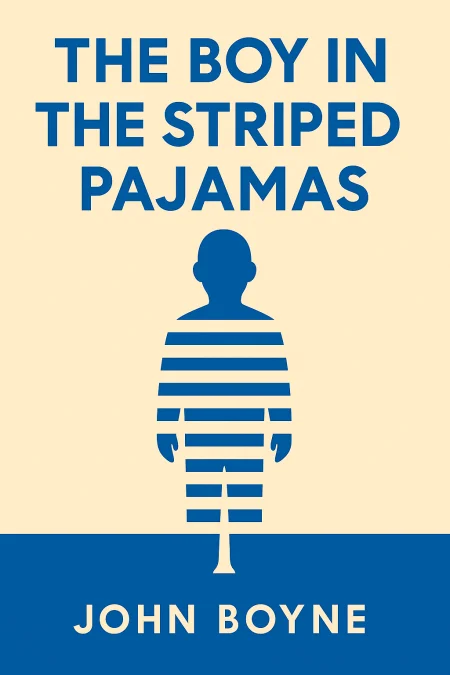
The Boy in the Striped Pajamas
Heartbreaking Truths Unfold in a Tale of Friendship and Innocence
Book Edition Details
Summary
Beyond a barbed wire boundary lies the fragile bond of two boys—Bruno and Shmuel—caught in the silent horrors of Auschwitz. This isn't just a tale of youthful curiosity; it's a poignant exploration of innocence marred by the shadows of history. "The Boy in the Striped Pajamas" weaves a delicate narrative of friendship that defies the stark divisions of their worlds, leaving an indelible mark on the heart. As you turn each page, you're invited to ponder the invisible fences we erect in our own lives, and the bravery it takes to see beyond them. Prepare to be captivated by this heart-wrenching story that speaks to the enduring spirit of human connection amidst unimaginable circumstances.
Introduction
In the autumn of 1943, a nine-year-old boy named Bruno discovers that his comfortable world in Berlin is about to change forever. His father, a Nazi commandant, receives a new assignment that will uproot the entire family and transport them to a place the boy struggles to pronounce: Auschwitz, which he calls "Out-With." What follows is a story that illuminates one of history's darkest chapters through the eyes of childhood innocence, revealing how ordinary people became complicit in extraordinary evil. This tale forces us to confront uncomfortable questions about moral responsibility, the banality of evil, and the tragic consequences of hatred disguised as ideology. Through the friendship between Bruno and Shmuel, a Jewish boy on the other side of the camp's fence, we witness how human connection can transcend the artificial barriers created by prejudice and propaganda. The narrative demonstrates how children, uncontaminated by adult hatred, naturally recognize the humanity in others regardless of the circumstances that divide them. This book serves as both a historical reminder and a moral compass for readers seeking to understand how genocide becomes possible when ordinary people choose comfort over conscience. It speaks particularly to those who wonder how entire societies can become complicit in atrocity, and what happens when we fail to question the systems of power that claim to act in our name.
Berlin to Out-With: The Relocation (1943)
The year 1943 marked a turning point in Nazi Germany's implementation of the "Final Solution." As the Holocaust machinery reached its peak efficiency, the Nazi regime required experienced administrators to oversee the systematic murder of European Jews. This period saw the expansion of extermination camps and the promotion of SS officers who had proven their ruthless competence in earlier phases of persecution. Bruno's father represents the archetypal Nazi bureaucrat: ambitious, dutiful, and utterly convinced of his righteousness. His promotion to commandant of Auschwitz reflects the regime's need for men who could transform mass murder into an administrative procedure. The family's relocation from their comfortable Berlin home to the bleak landscape surrounding the concentration camp symbolizes the moral journey many German families undertook during this period, trading their humanity for career advancement and social status. The contrast between Bruno's bewilderment and his parents' resigned acceptance reveals how Nazi ideology infiltrated domestic life. While the boy mourns the loss of his friends and familiar surroundings, his mother's increasing reliance on "medicinal sherries" and afternoon naps suggests an awareness of their complicity that she cannot consciously acknowledge. His father's transformation from a somewhat distant but loving parent into a cold functionary of genocide demonstrates how institutional evil corrupts personal relationships. This displacement also represents the broader German society's willingness to remain willfully ignorant of the Holocaust's reality. Just as Bruno's family moves to a place where they can directly observe the camps yet choose not to truly see, millions of Germans maintained their comfortable distance from the systematic destruction occurring in their name, preferring the safety of plausible deniability to the moral obligation of resistance.
Discovery and Friendship Across the Fence
The encounter between Bruno and Shmuel occurs during the height of the Holocaust's implementation, when approximately 6,000 Jews were being murdered daily at Auschwitz alone. Their friendship develops against the backdrop of systematic dehumanization, revealing the artificial nature of the racial hierarchies that justified genocide. Both boys, born on the same day and sharing similar childish concerns, demonstrate the fundamental humanity that Nazi ideology sought to obscure. Shmuel's story reflects the typical trajectory of Jewish persecution: the gradual restriction of rights, forced relocation to ghettos, deportation in cattle cars, and finally imprisonment in concentration camps. His quiet dignity and persistent hope, despite facing starvation and brutality, embodies the resilience that enabled many Holocaust victims to maintain their humanity under inhuman conditions. His friendship with Bruno becomes an act of resistance against the Nazi attempt to reduce Jews to less-than-human status. The physical barrier of the fence serves as a powerful metaphor for the ideological divisions that enabled genocide. While the boys can communicate across this boundary, they remain separated by the systematic hatred that adults have constructed between their communities. Bruno's inability to understand why such divisions exist reflects the learned nature of prejudice, while his natural empathy demonstrates the possibility of human connection transcending artificial barriers. Their clandestine meetings reveal the dangerous nature of compassion under totalitarian rule. Even Bruno's small acts of kindness, sharing food with his starving friend, represent a form of resistance to the regime's attempt to eliminate Jewish lives. The secrecy required for their friendship illustrates how the Nazi system made basic human decency a subversive act, forcing individuals to choose between personal safety and moral obligation.
Understanding and Tragedy: The Final Journey
By early 1944, the Nazi extermination program had reached its most horrifically efficient phase. The gas chambers at Auschwitz operated with industrial precision, capable of murdering thousands daily while maintaining the facade of "resettlement" that fooled many victims until their final moments. Bruno's tragic end occurs during this period of peak killing efficiency, when the line between perpetrator and victim could be crossed with terrifying swiftness. The culminating tragedy emerges from Bruno's innocent desire to help his friend find his missing father, a search that leads both boys into the very machinery of destruction his own father administers. This convergence represents the ultimate collision between innocence and evil, as Bruno's natural compassion draws him into the system designed to eliminate human compassion entirely. His transformation into a victim occurs through his voluntary adoption of the striped uniform, symbolizing how easily the artificial categories of perpetrator and victim could be reversed. The gas chamber scene, rendered with devastating subtlety, demonstrates how the Nazi killing apparatus functioned through deception and bureaucratic efficiency. The victims' confusion and fear contrasts sharply with the systematic nature of their murder, revealing how genocide depends on reducing human beings to administrative problems requiring industrial solutions. Bruno's final moments, holding hands with Shmuel in solidarity, represent the triumph of human connection over institutional hatred. The aftermath of Bruno's disappearance illustrates the moral reckoning that many perpetrators faced when the consequences of their actions touched their own lives. His father's eventual understanding of what occurred, and his subsequent self-destruction, suggests the psychological impossibility of maintaining the fiction that enabled genocide once its personal cost becomes undeniable. The tragedy demonstrates how systems of oppression ultimately consume their creators alongside their intended victims.
Legacy of Innocence Lost
Bruno's story illuminates the broader tragedy of the Holocaust: the systematic destruction of innocence and the perversion of ordinary human institutions into instruments of genocide. His journey from comfortable ignorance to tragic understanding mirrors the moral awakening that many Europeans experienced too late to prevent catastrophe. The narrative demonstrates how individual choices, however small they might seem, contribute to historical outcomes of enormous consequence. The friendship between Bruno and Shmuel serves as a testament to the human capacity for connection across artificial barriers of race, religion, and nationality. Their relationship proves that hatred is learned rather than natural, and that children's instinctive recognition of shared humanity offers hope for overcoming the divisions that adults create. Yet their tragic end also illustrates the terrible cost of challenging systems built on dehumanization and hatred. The book's contemporary relevance lies in its demonstration of how ordinary people become complicit in extraordinary evil through small compromises and willful ignorance. Bruno's parents, neither monsters nor heroes, represent the millions who chose personal comfort over moral courage, enabling genocide through their passive acceptance of injustice. Their story serves as a warning about the dangers of prioritizing career advancement and social status over ethical responsibility. The narrative's power emerges from its refusal to offer easy consolation or simple moral categories. Instead, it presents the Holocaust as a human-created tragedy that emerged from choices made by individuals like Bruno's parents, who convinced themselves that their personal advancement justified their participation in systematic murder. This understanding transforms the Holocaust from a distant historical event into an urgent moral lesson about the ongoing human capacity for both evil and redemption.
Summary
The story of Bruno and Shmuel reveals the central paradox of the Holocaust: how a civilized society transformed systematic murder into an administrative procedure while ordinary families like Bruno's maintained the illusion of moral respectability. The tragedy emerges not from the actions of monsters, but from the choices of seemingly normal people who prioritized personal advancement over ethical responsibility, demonstrating how genocide requires the complicity of entire societies willing to maintain comfortable ignorance about inconvenient truths. The enduring relevance of this narrative lies in its illustration of how quickly democratic societies can slide toward authoritarianism when citizens abandon their moral obligations in favor of personal safety and material comfort. Bruno's parents represent the millions who enable atrocity through passive acceptance, while his friendship with Shmuel demonstrates the transformative power of individual courage to recognize shared humanity across artificial barriers. Their story reminds us that preventing future genocides requires active moral engagement rather than comfortable indifference. We must learn to recognize the early warning signs of systematic dehumanization in our own societies and choose moral courage over personal convenience when confronted with injustice. The friendship across the fence teaches us that human connection transcends the divisions that power seeks to impose, while the tragic ending reminds us that individual acts of conscience, however small, carry profound historical significance. Most importantly, we must remember that the choice between complicity and resistance remains ours to make, and that claiming ignorance becomes impossible once we truly open our eyes to the suffering around us.
Related Books
Download PDF & EPUB
To save this Black List summary for later, download the free PDF and EPUB. You can print it out, or read offline at your convenience.
By John Boyne
