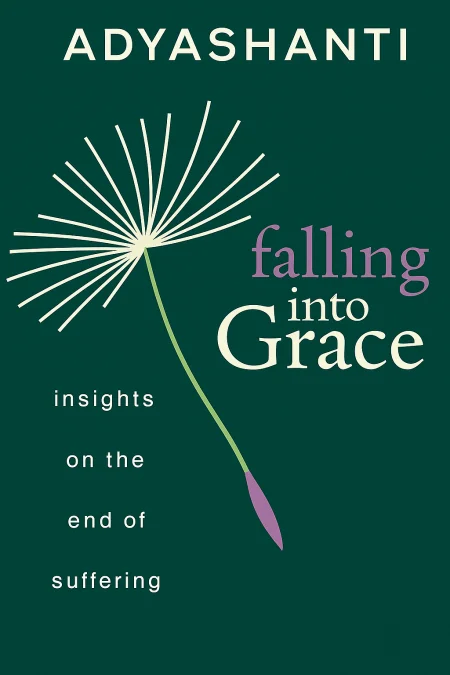
Falling into Grace
Insights on the End of Suffering
Book Edition Details
Summary
In the quiet spaces between our thoughts lies a profound truth waiting to be discovered. "Falling Into Grace" by Adyashanti invites you to unravel the illusions of the self and step into a world where suffering dissolves into spiritual clarity. With the gentle wisdom of a seasoned guide, this book explores the mind's role in crafting the very barriers that confine us. Adyashanti reveals how surrendering our illusions of control opens a gateway to an awakened existence, rich with peace and boundless love. This is not just a book; it is an invitation to awaken from the dream of separation and embrace the grace that infuses every moment. Let your heart expand and your mind clear as you embark on a transformative journey to see life through new, enlightened eyes.
Introduction
The human predicament appears paradoxical: despite unprecedented material progress and technological advancement, suffering remains our most persistent companion. We chase happiness through external achievements, relationships, and experiences, yet find ourselves trapped in cycles of dissatisfaction, anxiety, and separation from both ourselves and others. The very mechanisms we've developed to understand and control our experience—our thoughts, beliefs, and mental constructs—have become the primary source of our imprisonment. This exploration challenges the fundamental assumption that we are separate beings struggling against an indifferent universe. Through direct inquiry into the nature of thought, identity, and consciousness itself, a radical possibility emerges: that suffering is not an inevitable consequence of human existence, but rather the result of a case of mistaken identity. The investigation proceeds not through philosophical speculation, but through immediate examination of our lived experience, revealing how the mind creates the illusion of separation and how this illusion can be dissolved. The journey unfolds as a progressive dismantling of our most cherished beliefs about reality, inviting readers to question not merely what they think, but the very nature of thinking itself. This inquiry demands nothing less than a complete willingness to have our fundamental assumptions about ourselves and the world turned upside down, leading to a recognition that what we seek has never been absent from our experience.
The Root of Human Suffering: Believing Our Thoughts
The genesis of human suffering lies not in external circumstances, but in a profound misunderstanding about the nature of thought itself. From childhood, we learn to identify with the mental commentary running through our minds, gradually building an entire sense of self from these ephemeral mental formations. This process appears so natural and inevitable that we rarely question whether our thoughts accurately reflect reality or whether we are what we think ourselves to be. The relationship between language and suffering reveals itself upon closer examination. While language serves as a powerful tool for communication and practical navigation of the world, it simultaneously creates a shadow effect that obscures direct experience. When we name something, we unconsciously substitute the concept for the living reality, creating a world of symbols that gradually becomes more real to us than actual experience. The word "tree" replaces the mysterious, ever-changing phenomenon before us; the label "anger" obscures the raw energy moving through our bodies. This symbolic overlay becomes particularly problematic when applied to our sense of identity. The collection of thoughts, memories, and concepts we call "myself" appears solid and continuous, yet investigation reveals it to be nothing more than a mental construct with no substantial reality. Each thought about who we are arises spontaneously, exists momentarily, and dissolves back into the spaciousness from which it emerged. The persistent feeling of being a separate self results from our identification with this stream of mental activity. The liberation from suffering begins with the recognition that thoughts are not facts, but rather temporary appearances in consciousness. They arise without our permission, exist without our effort, and disappear without our control. When we stop believing our thoughts to be ultimate truth and begin to recognize them as passing phenomena, the entire foundation of psychological suffering begins to crumble, revealing the natural freedom that was never actually obscured.
Awakening from Egoic Consciousness and the Vortex of Suffering
Egoic consciousness operates as a closed system, a self-reinforcing pattern of perception that maintains the illusion of separation through constant comparison, judgment, and resistance. This state of consciousness functions like a vortex, drawing our attention into repetitive cycles of thought and emotion that feel absolutely real and compelling. The ego's primary mechanism involves creating problems to solve, enemies to defeat, and goals to achieve, ensuring its continued relevance and survival. The vortex gains power through our emotional investment in its content. Anger, fear, pride, and the desire for control become entry points that pull consciousness into the spinning cycle of egoic thinking. Once caught in this pattern, we experience life through the lens of inadequacy, constantly seeking something outside ourselves to complete our sense of wholeness. The tragedy lies not in the existence of these emotions, but in our identification with them as defining features of who we are. Breaking free from this trance requires recognizing the mechanical nature of egoic consciousness. Like a record player stuck in a groove, the ego replays the same patterns of thought and reaction, creating the illusion of movement while actually remaining static. The key insight emerges when we realize that we are not the ego, but rather the awareness in which these patterns appear. This awareness remains unchanging and peaceful regardless of the mental and emotional weather passing through it. The process of awakening often involves a period of apparent intensification of suffering as consciousness begins to withdraw its identification from egoic patterns. This temporary increase in difficulty signals not a problem but progress, as the light of awareness begins to illuminate previously unconscious aspects of our conditioning. The willingness to experience this discomfort without trying to fix, change, or escape it allows the natural intelligence of consciousness to dissolve these patterns from within.
Beyond Duality: Transcending the World of Opposites
The ordinary world operates through the interplay of opposites: day and night, joy and sorrow, success and failure. Our minds naturally organize experience through dualistic categories, creating a framework for understanding and navigating practical reality. However, when consciousness identifies exclusively with one side of any polarity, suffering inevitably follows. The attempt to maintain permanent happiness, avoid all pain, or achieve lasting security fights against the fundamental nature of manifest existence. Transcending duality does not mean eliminating distinctions or differences, but rather recognizing the underlying unity that gives rise to all apparent oppositions. Like waves on the ocean, all polarities emerge from and return to the same source. This recognition allows us to participate fully in the relative world while remaining rooted in the absolute dimension of being that underlies all appearances. The virgin birth symbolism found across spiritual traditions points to this transcendence of duality. It represents the emergence of consciousness that is not born from the coming together of opposites but arises directly from the source itself. This birth happens not in historical time but in the eternal present moment, available to anyone willing to release their exclusive identification with either pole of experience. Living beyond duality requires what ancient traditions called "abiding in non-abiding"—remaining fully present and engaged while not clinging to any particular state or position. This fluid awareness allows life to move through its natural cycles without creating the resistance that generates suffering. We begin to appreciate both the relative and absolute dimensions of existence, seeing them not as contradictory but as complementary aspects of one seamless reality.
True Autonomy: Embodying Spirit in Human Form
Authentic spiritual autonomy emerges not through separation from others or from life, but through the complete integration of transcendent awareness with human existence. This autonomy differs radically from ego-based independence, which maintains itself through opposition and control. True autonomy flows from the recognition that individual expression and universal consciousness are not contradictory but represent the natural flowering of awakened awareness in form. The development of spiritual autonomy requires learning to discern the difference between genuine inner guidance and the subtle ways the ego co-opts spiritual understanding for its own agenda. This discrimination develops through sustained inquiry into the source of our motivations and the willingness to act from authentic wisdom rather than conditioned patterns. True autonomy expresses itself as spontaneous right action that arises from intimate connection with present-moment reality. The process involves a fundamental shift from trying to become someone else or somewhere else to fully inhabiting our current experience. Rather than seeking to transcend our humanity, we learn to allow spirit to express itself through our unique human configuration. This embodiment requires the courage to be completely authentic, expressing our deepest nature without concern for others' approval or understanding. The ultimate expression of spiritual autonomy manifests as unconditional love in action. This love does not depend on others meeting our expectations or the world conforming to our preferences. Instead, it flows naturally from the recognition that separation is an illusion and that serving the highest good in any situation serves the totality of existence. Such autonomy represents not the achievement of the individual but the natural expression of awakened consciousness through the vehicle of human form.
Summary
The fundamental insight underlying this inquiry reveals that human suffering stems from a case of mistaken identity—the belief that we are separate entities struggling against an indifferent universe, when in reality we are expressions of the same consciousness that gives rise to all experience. The dissolution of this illusion requires not the acquisition of new knowledge or experiences, but the willingness to recognize what has always been present: the aware, peaceful presence that serves as the foundation for all appearances. This recognition transforms our relationship to thoughts, emotions, and life circumstances from one of resistance and control to one of intimate availability and unconditional love. The result is not the achievement of a particular state, but the natural expression of our essential nature through the unique circumstances of our human existence, allowing life to flow with unprecedented grace, wisdom, and spontaneous compassion.
Related Books
Download PDF & EPUB
To save this Black List summary for later, download the free PDF and EPUB. You can print it out, or read offline at your convenience.
By Adyashanti
