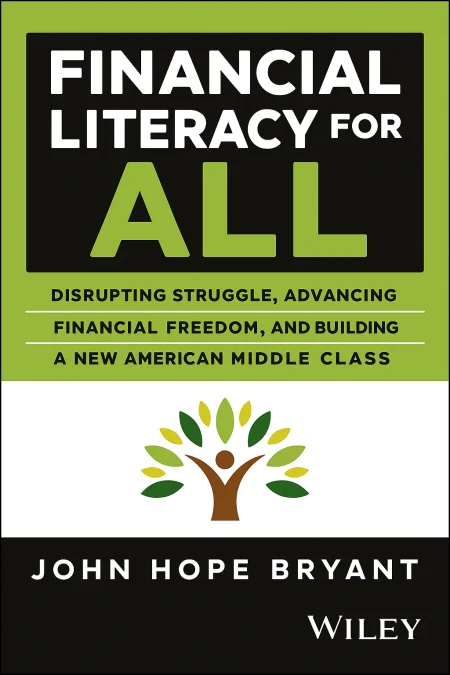
Financial Literacy for All
Disrupting Struggle, Advancing Financial Freedom, and Building a New American Middle Class
Book Edition Details
Summary
What if the path to financial freedom lies in redefining how you view money? In "Financial Literacy for All," John Hope Bryant, a leading voice in financial education, dismantles the complexity surrounding personal finance. This engaging guide is not just a book; it's a powerful catalyst for change, tailored for anyone eager to break free from economic uncertainty. Whether you're a seasoned professional, a young family member, or a blue-collar worker, Bryant equips you with the knowledge to navigate the financial landscape with confidence. By transforming your understanding of budgeting, saving, and borrowing, this book empowers you to construct a wealth-building mindset, irrespective of your starting point. It's a roadmap to stability and prosperity, illuminating how informed financial decisions can reshape your future and your community. Embrace this opportunity to revolutionize your relationship with money and unlock doors to economic empowerment.
Introduction
Picture this: In 1875, a former enslaved person carefully walks into a bank that was supposed to help freed slaves learn about money, only to discover that their life savings have vanished due to the mismanagement and greed of white trustees. This scene encapsulates one of America's most overlooked tragedies - the systematic denial of financial knowledge to entire communities. This book reveals how financial illiteracy became the invisible force that shaped American inequality, from the failure of Lincoln's Freedman's Bank to today's paycheck-to-paycheck existence affecting 60% of Americans. Through a sweeping historical lens, we discover how broken capitalism systematically excluded Black Americans, left behind working-class whites during economic transitions, and created financial deserts in communities across the nation. Yet this is not merely a tale of economic injustice - it's the blueprint for America's most powerful civil rights movement of our time. The author argues that financial literacy represents the key to unlocking the American Dream for all, offering concrete solutions through education, community empowerment, and systemic change. This work speaks to every American who has struggled to understand our complex financial system, to policymakers seeking sustainable solutions to inequality, and to business leaders recognizing that a financially educated population benefits everyone. It's a call to action for those ready to transform financial knowledge from a privilege of the few into a fundamental right for all.
Broken Capitalism: From Slavery to Systematic Financial Exclusion (1865-1965)
The period from 1865 to 1965 represents one of the most devastating examples of broken capitalism in American history, where economic systems were deliberately structured to exclude entire populations from wealth-building opportunities. This century-long era began with the promise of the Freedman's Bank, chartered by President Lincoln in 1865 with the revolutionary mission of teaching formerly enslaved people about money. The bank's strategic location across from the White House symbolized America's commitment to financial inclusion, yet Lincoln's assassination just one month later foreshadowed the tragic fate awaiting this bold experiment. The bank's collapse in 1874 devastated more than 60,000 Black depositors who lost their life savings to the reckless speculation and outright theft by white trustees like Henry Cooke. Unlike future banking crises, the federal government offered no reimbursement to these victims, setting a precedent of financial abandonment. This betrayal coincided with the systematic exclusion of Black Americans from the Homestead Act, which granted 160 acres to families willing to farm the land. While 1.6 million white families received these land patents representing 96% of the 270 million acres distributed, fewer than 5,500 African American families benefited from what became the foundation of generational wealth for white America. The Jim Crow era institutionalized this economic exclusion through redlining, where the Federal Housing Administration literally drew red lines around Black neighborhoods, deeming them too risky for mortgage guarantees. Even when Black communities like Tulsa's "Black Wall Street" achieved remarkable prosperity despite these barriers, white violence systematically destroyed these economic achievements. The 1921 Tulsa Race Massacre and the 1923 destruction of Rosewood, Florida, demonstrated that Black economic success would not be tolerated. This systematic exclusion created what we now understand as broken capitalism - an economic system where success for some came at the deliberate expense of others. The psychological and economic trauma of this era created deep distrust of financial institutions while simultaneously denying communities the knowledge and tools needed to build wealth. These historical wounds explain why nearly half of Black Americans today have credit scores below 620, effectively locking them out of homeownership, business loans, and wealth-building opportunities that define the American Dream.
The Great Reversal: How Economic Shifts Left Communities Behind (1965-2008)
The period from 1965 to 2008 witnessed a dramatic economic transformation that fundamentally altered the American landscape, leaving entire communities stranded as the economy evolved beyond their understanding and preparation. This era began with the promise of the Second Reconstruction and the civil rights movement, which successfully secured voting rights and public accommodations for African Americans. Yet as Dr. King recognized in 1968 with his Poor People's Campaign, legal equality meant little without economic empowerment and the tools to participate in America's free enterprise system. Simultaneously, the industrial economy that had provided stable middle-class wages for working-class whites began its inexorable decline. Globalization and automation eliminated millions of manufacturing jobs that once required only a high school education but offered decent wages, benefits, and pensions. The formula that had sustained white working-class prosperity - finish high school, get a factory job, work hard, and achieve the American Dream - suddenly became obsolete. Communities built around steel mills, coal mines, and manufacturing plants found themselves economically hollowed out, with no alternative pathways to middle-class stability. The emergence of easy credit during this period created a dangerous illusion of prosperity. Credit cards became ubiquitous, but without financial education, they transformed from wealth-building tools into instruments of debt enslavement. The culture shifted toward immediate gratification and "keeping up with the Joneses," while wages stagnated relative to the rising cost of living. Families increasingly required two incomes to maintain middle-class lifestyles, yet received no education on how to manage this new economic complexity. Women entered the workforce in unprecedented numbers, breaking barriers and demanding equality, yet faced persistent wage gaps and the "double burden" of career and domestic responsibilities. Despite their contributions, systematic exclusion from financial education and wealth-building opportunities meant that even successful women struggled to achieve true economic independence. The period's defining characteristic became the growing disconnect between a rapidly evolving economy and a population lacking the financial literacy to navigate it. This created the conditions for the crisis that would soon follow, as millions of Americans found themselves financially vulnerable despite apparent prosperity.
Crisis and Awakening: Financial Illiteracy as National Emergency (2008-2020)
The years from 2008 to 2020 exposed the devastating consequences of widespread financial illiteracy, transforming what many considered an individual failing into a recognized national crisis. The 2008 financial collapse revealed that millions of Americans, including those earning six-figure salaries, lacked the basic financial knowledge to protect themselves from predatory lending and make sound economic decisions. The crisis disproportionately impacted communities of color and working-class families who had been systematically excluded from financial education, but its effects rippled through all levels of society. As the economy slowly recovered, alarming statistics emerged that painted a stark picture of America's financial health. Studies revealed that 60% of Americans were living paycheck to paycheck, including half of those earning over $100,000 annually and one-third of those making more than $250,000. The National Financial Educators Council estimated that financial illiteracy cost Americans $388 billion annually - a sum rivaling the GDP of entire nations. Young adults graduated from college with crushing student debt but no understanding of interest rates, compound growth, or basic budgeting principles. The period witnessed the emergence of financial deserts in communities across America, where check cashers, payday lenders, and rent-to-own stores replaced traditional banks. These predatory businesses thrived in neighborhoods where residents had credit scores below 620, creating cycles of debt that trapped families for generations. Research began revealing the stark correlation between community credit scores and quality of life indicators - life expectancy, crime rates, educational attainment, and homeownership rates all tracked closely with average credit scores. The decade also saw growing recognition among business and political leaders that financial literacy represented a critical national security issue. The connection between individual financial stability and national economic strength became undeniable as consumer spending - representing 70% of the U.S. economy - remained vulnerable to the financial shocks that devastated unprepared families. By 2020, forward-thinking organizations began viewing financial education not as charity work but as essential infrastructure for national prosperity, setting the stage for a comprehensive response to this crisis.
The New Reconstruction: Building Financial Democracy for All (2020-Present)
The period from 2020 to the present marks the emergence of what historians may call the Third Reconstruction - a comprehensive movement to democratize financial knowledge and create pathways to economic empowerment for all Americans. This new era was catalyzed by the COVID-19 pandemic, which exposed the fragility of American households as millions faced financial crisis overnight. The emergency revealed that even employees of major corporations lacked basic financial safety nets, as evidenced by over $1 billion in emergency withdrawals from Delta Airlines employees' retirement accounts in the pandemic's early days. This crisis sparked unprecedented collaboration between government, business, and nonprofit sectors to address financial illiteracy as a systemic threat to national stability. Major corporations began implementing comprehensive financial wellness programs, recognizing that financially stressed employees are less productive and more likely to leave. Delta's partnership with Operation HOPE created a model where companies provide both financial education and emergency savings accounts, resulting in measurable improvements in employee financial confidence and retention. The movement gained momentum through the Financial Literacy for All Initiative, uniting Fortune 500 CEOs around the principle that financial education is the civil rights issue of our generation. This coalition leveraged the power of American brands to make financial literacy culturally relevant and accessible, using everything from social media campaigns to workplace education programs. Technology played a crucial role, with online platforms and mobile apps making financial education available to millions who previously lacked access to such resources. Perhaps most significantly, this period saw the development of data-driven approaches to community transformation through tools like the HOPE Financial Wellness Index. This innovation mapped every zip code in America by average credit score, revealing the direct correlation between financial health and community wellbeing. Communities with 580 credit scores averaged 61-year life expectancy, high crime rates, and single-parent households, while 700 credit score communities enjoyed 81-year life expectancy, low crime, and stable families. This evidence-based approach enabled targeted interventions that could raise credit scores by over 50 points in six months, demonstrating that systemic change is possible when communities receive proper financial education and support.
Summary
The central thread running through America's financial history reveals a persistent pattern: economic systems that create prosperity for some while systematically excluding others ultimately weaken the entire nation. From the betrayal of the Freedman's Bank to the hollowing out of manufacturing communities to today's paycheck-to-paycheck existence among high earners, the common denominator has been the deliberate or neglectful withholding of financial knowledge from those who need it most. The evidence overwhelmingly demonstrates that financial literacy is not merely a personal responsibility issue but a fundamental requirement for national prosperity and security. When 70% of the economy depends on consumer spending yet 60% of consumers live paycheck to paycheck, the mathematical impossibility of sustained growth becomes clear. The solution lies not in finger-pointing or partisan politics but in the systematic democratization of financial knowledge across all communities, regardless of race, class, or geography. The path forward requires three concrete actions: embedding financial education in every school curriculum from kindergarten through college, creating workplace financial wellness programs that treat financial health as seriously as physical health, and transforming communities through targeted interventions that raise credit scores and create pathways to wealth building. This is not utopian thinking but practical necessity - communities with higher average credit scores consistently demonstrate lower crime rates, better health outcomes, and greater economic stability. The tools exist, the evidence is clear, and the coalition of willing partners continues to grow. The question is not whether America can solve its financial literacy crisis, but whether we possess the collective will to complete this new reconstruction and finally fulfill the promise of economic opportunity for all.
Related Books
Download PDF & EPUB
To save this Black List summary for later, download the free PDF and EPUB. You can print it out, or read offline at your convenience.
By John Hope Bryant
