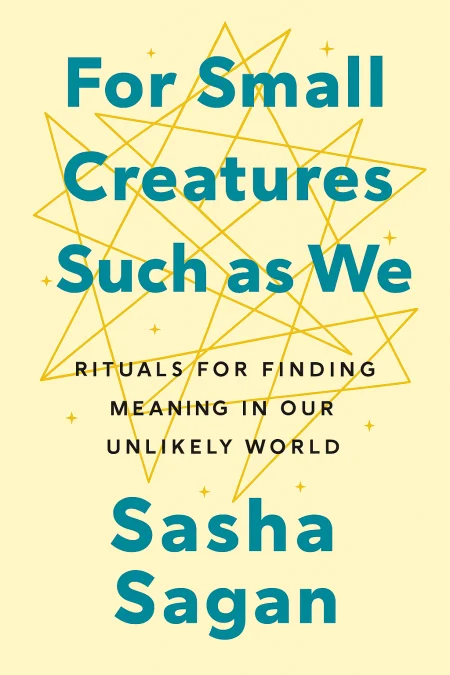
For Small Creatures Such as We
Rituals for Finding Meaning in Our Unlikely World
Book Edition Details
Summary
Beneath the celestial wonders that have long intrigued humanity, Sasha Sagan invites us to rediscover the profound beauty woven into the fabric of everyday life. Raised by Carl Sagan and Ann Druyan, Sasha was imbued with a deep reverence for the scientific marvels that eclipse any myth. Her journey into motherhood sparked an exploration of life's milestones—births, unions, departures—through a lens that celebrates the wonders of existence without leaning on religious tradition. "For Small Creatures Such as We" unfolds as a heartfelt homage to family, love, and the universe itself. It’s a beckoning to craft rituals that speak to the secular soul, offering comfort and connection amidst the vastness of the cosmos. Embrace the extraordinary in the ordinary, and find meaning in the stardust that connects us all.
Introduction
Picture a young woman standing in a cemetery on the morning of her wedding day, tears streaming down her face as she speaks to her father's headstone. This isn't a scene of despair, but one of profound connection—a daughter creating her own ritual to honor the past while embracing the future. This moment captures the heart of our deepest human need: to find meaning, create ceremonies, and mark the passages of our lives, even when traditional religious frameworks don't fit our worldview. In our modern age, millions of us find ourselves caught between two worlds. We may not believe in supernatural explanations, yet we hunger for the same sense of wonder, community, and ritual that religion has provided for millennia. We want to celebrate births and mourn deaths, mark seasons and honor love, but we need ways that align with what we understand about science and the natural world. This exploration reveals how we can create sacred meaning without sacrificing intellectual honesty. Through personal stories and universal truths, we discover that the most profound rituals often emerge from the most fundamental facts of existence—the rotation of our planet, the changing seasons, the miracle of consciousness emerging from stardust. Here lies an invitation to build new traditions that honor both our rational minds and our emotional hearts, creating ceremonies that celebrate the extraordinary nature of ordinary life.
Building Rituals from Wonder and Loss
When Helena was born, her mother held her for the first time and marveled at an overwhelming sensation of recognition. "Of course, it's you!" she whispered, as if this tiny stranger had been waiting in the wings of existence all along. The mathematical improbability of any individual birth—the countless chance encounters, survived plagues, and perfect timing spanning thousands of generations—suddenly became viscerally real. Every ancestor had to meet their partner at precisely the right moment, survive wars and disasters, and pass on their genetic heritage for this exact human being to emerge. The author's great-grandmother Chaiya had arrived in America with only one dollar, unable to read or write, carrying the hopes of generations in her worn traveling clothes. She died shortly after giving birth, but her legacy lived on in the genetic code that would eventually create her great-great-granddaughter Helena. Looking at her newborn, the author could see echoes of long-dead relatives in the shape of tiny toes and the curve of an ear—a living connection to ancestors she would never meet but whose presence moved through her child's very cells. Traditional cultures have always recognized birth as a moment requiring ritual acknowledgment. Some plant trees that will grow alongside the child, others bury umbilical cords in sacred ground, and many communities gather to formally welcome the new soul into their midst. Even without religious framework, birth calls us to pause and recognize the astronomical odds we have overcome simply by existing. The magnitude of our existence—emerging from stardust, inheriting the genetic memories of countless ancestors, and arriving conscious on a planet perfectly positioned for life—demands celebration. When we understand the science behind our being here, rather than diminishing wonder, it amplifies it beyond anything our ancestors could have imagined.
Finding Community Through Secular Celebration
The email invitation was formal but warm: "The Ladies Dining Society cordially invites you to join us for an evening of conversation and cocktails." What began as a simple desire to gather female friends in one place transformed into something unexpected—a secular congregation that met monthly around restaurant tables instead of pews. These dinners became a ritual of connection, where women shared their struggles and triumphs, their career changes and relationship discoveries, their losses and celebrations. Each month brought the same comforting rhythm: cocktails at the bar while waiting for stragglers, the settling into conversations that ranged from politics to parenting to poetry, the photo booth pictures that documented their evolving faces and friendships. Some women attended religiously, others dropped in occasionally, but all contributed to a sense of community that sustained them through life's inevitable upheavals. When someone moved away, got married, or faced tragedy, the group rallied with the same care traditionally provided by religious congregations. The author maintained detailed records—who attended, what she wore, how many responded—creating an orthodoxy of inclusion that felt both meaningful and slightly absurd. When friends relocated to other cities, they founded their own chapters, adapting the ritual to local needs while maintaining the essential spirit of gathering, sharing, and mutual support. A Los Angeles chapter prioritized healthy food over cocktails, an Oklahoma City version combined dinner with classic movies, but each maintained the core purpose of creating chosen family. These secular gatherings fulfill the same fundamental needs that draw people to religious services: regular community connection, shared ritual, mutual support during difficulties, and celebration of joys. We don't need divine mandate to create sacred time together. The simple act of consistently showing up for each other, of marking time through shared meals and conversations, creates its own form of worship—worship of human connection and the preciousness of friendship.
Honoring Life's Passages Without Faith
The nursing home Halloween parade haunted the author's childhood memories—not because of artificial ghosts and goblins, but because of the very real specter of mortality embodied in the elderly residents. Seeing these individuals who were clearly approaching death while dressed as a fairy or pirate created an inadvertent confrontation with the deepest mystery of existence. This annual ritual, meant to bring joy, instead became an early education in the reality that awaits us all. Years later, planning her own wedding without her deceased father present, she faced the challenge of honoring absence while celebrating presence. The solution came through weaving his memory into the ceremony itself—wrapping his necktie around her bouquet, getting married beneath an art installation called "Cosmos" that honored his work, visiting his grave on the morning of her wedding to have her cry of grief and prepare for her day of joy. These weren't traditional religious rituals, but personal ceremonies created to acknowledge loss while embracing future happiness. The wedding itself became a blend of borrowed traditions and invented meanings: standing under a Jewish chuppah reinterpreted as a symbol of openness to community, lighting a unity candle to represent the joining of two lives, breaking glass to signify the impossibility of undoing their commitment. Each element carried weight not because of ancient religious mandate, but because the couple chose to imbue these actions with personal significance. Life's major transitions—birth, coming of age, marriage, death—seem to cry out for ritual acknowledgment. Without inherited religious frameworks, we must become architects of our own sacred moments. The key lies not in the specific actions we choose, but in our intentional marking of transformation, our conscious recognition that these passages deserve honor, reverence, and the gathered attention of our communities.
Embracing Mystery While Seeking Truth
Standing in the cemetery with her infant daughter, surrounded by headstones bearing the names of ancestors she had never met, the author felt the weight of continuity across generations. Her great-grandfather had walked to synagogue every week while dying of cancer, sustained by faith she couldn't share. Her grandfather had courageously declared his nonbelief, choosing intellectual honesty over inherited tradition. Now she held Helena, the inheritor of both their courage and their questions, trying to find meaning in the space between certainty and mystery. The autumn ritual of fasting on Yom Kippur became not an act of religious observance but a meditation on privilege and gratitude. Feeling genuine hunger for one day served as a reminder of the billions who experience it constantly, creating empathy across the vast distances that separate the well-fed from the starving. This physical discomfort became a doorway to understanding how fortunate her life had been—not through divine blessing, but through the random lottery of circumstances that determines where and when we are born. When Helena stared up at her mother during these moments of contemplation, the author saw in those innocent eyes both the accumulated wisdom of ancestors and the fresh possibility of a mind not yet constrained by others' certainties. What stories would she tell this child about the nature of existence? How could she convey wonder without requiring belief, mystery without mysticism, reverence without religion? The greatest mystery isn't what happens after death or whether consciousness arose by design or accident. The greatest mystery is how to live fully in the face of so much we cannot know. We can embrace uncertainty as an invitation rather than a threat, letting our questions lead us deeper into engagement with the world as it reveals itself through science, art, and human connection. In acknowledging the limits of our knowledge, we find not despair but liberation—the freedom to create meaning, build community, and celebrate existence on our own terms.
Summary
The journey from inherited religious tradition to personally created meaning reveals that the hunger for ritual and transcendence runs deeper than any specific belief system. Whether lighting candles to mark the passage of time, gathering monthly with friends for connection, creating new ceremonies for weddings and births, or finding wonder in scientific understanding of our cosmic origins, we discover that meaning-making is fundamentally a human activity that requires no supernatural authorization. The most profound realization emerges through countless small recognitions: that we are made of star-stuff temporarily arranged into consciousness, that our existence represents the successful completion of an unbroken chain stretching back billions of years, that love and community and wonder are as natural as breathing and as necessary as food. When we ground our rituals in gratitude for the actual miracle of existence—the rotation of planets, the evolution of consciousness, the statistical impossibility of any particular life—we find that reality provides more than enough material for a lifetime of celebration and reverence. Rather than choosing between science and spirituality, between reason and wonder, between intellectual honesty and emotional fulfillment, we can weave them together into new forms of secular sacred practice. In creating our own rituals, gathering our own communities, and marking our own passages, we become authors of meaning in a universe that seems to specialize in the transformation of stardust into stories, of cosmic accidents into conscious beings capable of creating beauty, connection, and hope.
Related Books
Download PDF & EPUB
To save this Black List summary for later, download the free PDF and EPUB. You can print it out, or read offline at your convenience.
By Sasha Sagan
