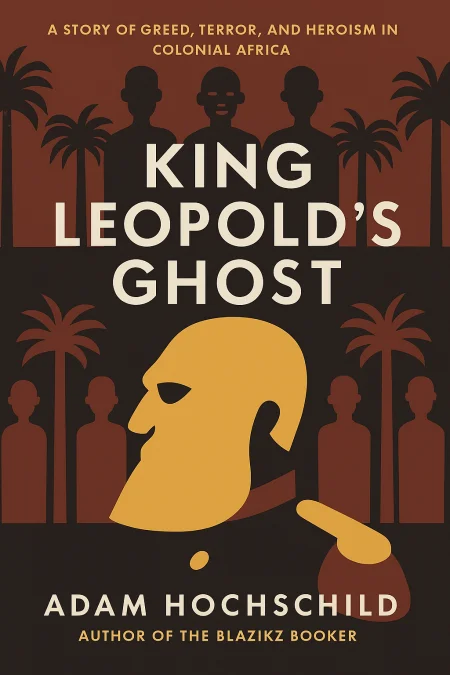
King Leopold's Ghost
A Story of Greed, Terror, and Heroism in Colonial Africa
Book Edition Details
Summary
A dark chapter in history unfolds as the ruthless ambition of King Leopold II of Belgium turns the Congo into his personal empire. In a chilling tale where benevolence masks brutality, Leopold's voracious quest for rubber and ivory costs ten million lives. Yet, from the shadows of this atrocity, a tapestry of unlikely heroes emerges: a British shipping clerk turned crusader, an Irish patriot destined for martyrdom, and courageous black Americans who dared to expose the horror. Adam Hochschild's "King Leopold’s Ghost" weaves a gripping narrative of villainy and valor, a haunting reminder of forgotten sins that demands to be etched into the collective conscience.
Introduction
In the heart of Africa during the late nineteenth century, while European nations celebrated their civilizing missions, one of history's most devastating colonial regimes was quietly unfolding. A Belgian king who never set foot on African soil orchestrated a system of exploitation so brutal that it would claim millions of lives while generating enormous personal wealth. This extraordinary tale reveals how humanitarian rhetoric can mask the most systematic brutality, and how a small group of courageous individuals created the world's first international human rights movement in response. The story illuminates three profound questions that resonate powerfully today. How do powerful interests manipulate moral language to justify exploitation, transforming genuine humanitarian concerns into cover for economic predation? What happens when corporate power operates beyond democratic oversight, as an entire territory becomes a private business enterprise run through terror? And how do ordinary people become complicit in atrocities, as thousands of European officials participated in or ignored unprecedented cruelty while maintaining their sense of civilized superiority? This account serves anyone seeking to understand the foundations of modern humanitarian activism, the historical roots of corporate exploitation, and the mechanisms by which civilized societies can perpetrate unspeakable acts. The emergence of organized resistance to these horrors offers both sobering warnings about human capacity for evil and inspiring examples of moral courage challenging overwhelming power.
The Scramble Begins: Leopold's Imperial Deception (1870s-1890s)
The transformation of central Africa began not in Congo's rainforests but in European drawing rooms, where King Leopold II of Belgium nursed imperial dreams that seemed absurdly disproportionate to his small nation's resources. During the 1870s, as other European powers focused on established territories, Leopold recognized that Africa's vast interior remained unclaimed, waiting for someone bold enough to seize it through cunning rather than military might. Leopold's genius lay in his masterful manipulation of the era's humanitarian sentiments. As Henry Morton Stanley's dramatic exploration of the Congo River captured global attention, Leopold positioned himself as the patron of African civilization and enemy of the slave trade. His Brussels Geographical Conference of 1876 brought together Europe's leading explorers and humanitarians, who unknowingly provided legitimacy for what would become a purely commercial venture disguised as philanthropic mission. The king understood that new industrial technologies, particularly steamboats and repeating rifles, could allow small forces to control vast territories. More importantly, he grasped that Congo societies, weakened by centuries of slave trading, would offer limited resistance to conquest. While European powers squabbled over established colonies, Leopold quietly assembled the infrastructure for his African empire through patient diplomacy and strategic deception. The Berlin Conference of 1884-1885 marked the triumph of Leopold's careful planning. By convincing the great powers that his International Association of the Congo was a humanitarian organization dedicated to free trade and African uplift, he secured international recognition for his claims. Europe's civilized nations had just handed over a territory seventy-six times the size of Belgium to a king based entirely on his promises of philanthropic governance, setting the stage for unprecedented exploitation.
Rubber Terror: Systematic Exploitation and Mass Atrocities (1890s-1900s)
The establishment of the Congo Free State revealed the brutal reality behind Leopold's humanitarian facade as his agents spread across the territory, creating a system of exploitation that transformed entire populations into forced laborers. The discovery that wild rubber vines grew throughout Congo's rainforests provided Leopold with the perfect commodity for the industrial age, but harvesting this resource required methods that would shock the world. The rubber regime operated through carefully orchestrated terror designed to maximize production while maintaining plausible deniability. Villages received quotas requiring virtually full-time labor from adult males, who had to venture deep into dangerous forests for weeks at a time. When communities resisted or failed to meet quotas, Leopold's Force Publique employed tactics including taking women and children hostage, burning villages, and severing hands of those killed in punitive expeditions as proof of their efficiency. The transformation of the Force Publique from exploration escort into an army of occupation illustrates how colonial control required constant violence. With fewer than three thousand white officials governing twenty million Africans across a territory larger than Western Europe, the regime depended on African soldiers and auxiliaries to enforce its will. The chicotte, a whip made from hippopotamus hide, became the symbol of white rule, administered thousands of times daily to maintain discipline and extract labor. Leopold's system was particularly insidious because of its bureaucratic nature. The king never issued written orders for atrocities, instead creating economic incentives that made brutality inevitable. Officials received commissions based on rubber quantities collected, while soldiers had to provide severed hands as proof they hadn't wasted ammunition. This structure allowed everyone from Brussels bureaucrats to village chiefs to claim they were simply following orders or economic logic, while the system generated unprecedented profits through systematic terror.
Voices of Resistance: The First International Human Rights Campaign (1900s-1908)
The first cracks in Leopold's carefully constructed facade appeared when independent observers began witnessing the reality of Congo rule. George Washington Williams, an African American journalist and historian, became the regime's first major critic after traveling through the territory in 1890. His devastating "Open Letter" to Leopold systematically documented the gap between the king's humanitarian claims and the brutal reality of forced labor, arbitrary violence, and systematic exploitation. Williams's critique was particularly powerful because it came from someone who had initially supported Leopold's mission, believing it offered opportunities for African Americans to contribute to African development. His complete disillusionment provided a template for future investigations, as he documented how treaties had been obtained through deception, how military posts terrorized surrounding populations, and how the entire system operated through slavery in all but name. Edmund Morel's transformation from shipping clerk to global campaigner marked the birth of modern human rights activism. His recognition that valuable goods flowed out of Congo while only weapons went in led him to deduce the existence of slave labor, launching the Congo Reform Association. This organization pioneered techniques that became standard in human rights campaigns: systematic documentation of abuses, strategic media use, celebrity endorsements, and coordinated pressure on governments through public opinion. The movement's success lay in combining moral outrage with practical politics. Morel understood that exposing atrocities was insufficient without creating political pressure for change. The campaign targeted not just Leopold but the governments that had recognized his regime, arguing that democratic nations bore responsibility for their diplomatic decisions. This approach forced governments to choose between supporting an increasingly indefensible regime and responding to growing public pressure, ultimately compelling Leopold to surrender the Congo to the Belgian government in 1908.
Colonial Legacy: From Belgian Rule to Modern Congo's Struggles
Leopold's surrender of the Congo to the Belgian government in 1908 represented both victory and limitation for the human rights movement. While the worst excesses of the rubber regime ended, the fundamental structure of colonial exploitation remained intact under Belgian state administration. The new colonial system continued prioritizing resource extraction over African development, maintaining forced labor for mining operations and infrastructure projects while preventing the development of indigenous leadership and democratic institutions. The patterns established during Leopold's rule created lasting damage that would plague the region for decades. Belgian colonial policy deliberately limited African education and political participation, leaving the territory with fewer than thirty university graduates at independence in 1960. This legacy of authoritarian rule and resource extraction created conditions that successive leaders would exploit, from Mobutu's kleptocratic dictatorship to contemporary strongmen who replicated many of the same exploitative patterns. The Congo's post-independence trajectory tragically illustrates how colonial legacies shape contemporary conflicts. The assassination of democratically elected leader Patrice Lumumba, orchestrated by Belgian and American intelligence services, demonstrated how former colonial powers continued intervening to protect their economic interests. The subsequent rule of Mobutu Sese Seko, supported by Western governments throughout the Cold War, perpetuated the same pattern of personal enrichment through resource extraction that Leopold had pioneered. Today's ongoing crises in the Democratic Republic of Congo reveal both the progress and limitations of human rights advocacy since the early reform movement. While organizations continue the tradition of bearing witness to atrocities, the fundamental economic relationships that drive conflict remain largely unchanged. The Congo's mineral wealth continues fueling violence and instability, as armed groups and multinational corporations compete for control of resources while ordinary Congolese people bear the costs of this ongoing exploitation.
Summary
The story of Leopold's Congo reveals how humanitarian rhetoric can mask systematic exploitation, demonstrating that behind every claim of civilizing mission lies the fundamental question of who benefits and who bears the costs. Leopold's genius was understanding how moral language could camouflage brutal extraction, a pattern that persists in contemporary forms of economic imperialism and humanitarian intervention. The complicity of thousands of ordinary Europeans in maintaining this system illustrates how civilized societies can become instruments of unspeakable cruelty when economic incentives align with racial prejudice and bureaucratic distance from consequences. Yet this dark chapter also illuminates the power of moral courage and organized resistance. The emergence of the world's first international human rights movement established crucial precedents for challenging injustice across borders, proving that determined individuals could expose and ultimately defeat even the most powerful perpetrators of systematic abuse. Edmund Morel's transformation from shipping clerk to global campaigner, supported by voices like George Washington Williams and William Sheppard, demonstrated that sustained public pressure combined with rigorous documentation could overcome seemingly insurmountable political and economic obstacles. The Congo's legacy offers essential lessons for contemporary struggles against exploitation and injustice. We must remain vigilant against humanitarian rhetoric that masks commercial interests, demanding transparency and accountability from those claiming to act for others' benefit. The power of systematic documentation and sustained public pressure can overcome powerful obstacles when combined with strategic organization and moral clarity. Finally, the responsibility to protect vulnerable populations extends beyond national borders, requiring international cooperation and courage to act on universal human values rather than narrow self-interest. Only by remembering what we have chosen to forget can we hope to build a more just future.
Related Books
Download PDF & EPUB
To save this Black List summary for later, download the free PDF and EPUB. You can print it out, or read offline at your convenience.
By Adam Hochschild
