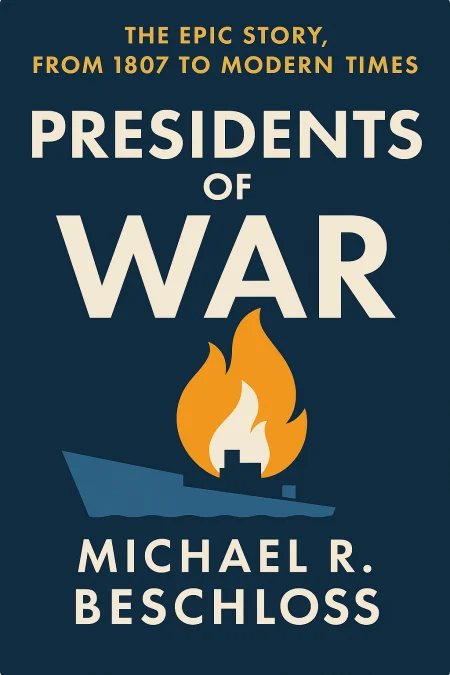
Presidents of War
The epic story, from 1807 to modern times
Book Edition Details
Summary
In the crucible of conflict, where history's weight meets the sharp edges of leadership, "Presidents of War" casts a spotlight on America's commanders-in-chief as they navigate the turbulent seas of warfare. Spanning from the War of 1812 to the relentless quagmire of Vietnam, this narrative exposes the raw humanity behind the Oval Office's grand facade. Here, power tussles with conscience as presidents wrestle with Congress, confront dissenting voices, and seek solace in whispered prayers and familial bonds. Through the lens of once-hidden documents and voices of the era, Michael Beschloss reveals the burdens that either forge or fracture the souls of these wartime leaders. This book isn't just a recount of battles fought; it's a profound exploration of the evolving might of presidential authority and its staggering implications for the very fate of humanity.
Introduction
Imagine standing in the White House in 1807, watching Thomas Jefferson wrestle with perhaps the most momentous decision of his presidency. British warships had just attacked an American vessel in broad daylight, killing sailors and humiliating the young nation. The public screamed for war, Congress seemed ready to fight, yet Jefferson chose restraint over revenge. Now fast-forward to 1846, where James Polk deliberately positioned American troops in disputed territory, knowing full well that Mexican forces would attack them, giving him the perfect excuse to seize nearly half of Mexico. Then witness Abraham Lincoln suspending constitutional rights and waging America's bloodiest war without ever asking Congress for a formal declaration. These pivotal moments reveal a fundamental transformation in how America goes to war. The Founding Fathers, haunted by European monarchs who dragged nations into conflict for personal glory, carefully designed a system where Congress alone could declare war. They feared giving any single person the power to spill American blood on foreign soil. Yet step by step, crisis by crisis, American presidents seized that very authority the founders sought to constrain. This exploration traces how critical conflicts reshaped the balance of power between president and Congress, revealing patterns that echo in every modern military intervention. For anyone seeking to understand how America became a nation where presidents routinely commit troops to combat without congressional approval, these early precedents hold the key to comprehending our current constitutional crisis.
Early Republic Tensions: Jefferson's Restraint and Madison's War (1807-1815)
The young American republic faced its first major test of constitutional war powers when British warships attacked the USS Chesapeake in June 1807, killing American sailors in what many considered an act of war. The nation erupted in fury, with newspapers calling for immediate retaliation and crowds burning British goods in the streets. Never since Lexington and Concord had Americans been so united in their rage against Britain. Yet President Thomas Jefferson, who later reflected that "the affair of the Chesapeake put war into my hand," chose a radically different path. Jefferson understood that his response would set crucial precedents for the young democracy. Rather than ride the wave of popular anger into hasty conflict, he employed every tool of diplomacy and economic pressure to avoid war. He imposed an embargo on British trade, sent envoys to London, and deliberately delayed calling Congress into session until public passions could cool. Jefferson knew America was militarily unprepared, having deliberately weakened the navy and army to prevent the kind of military adventurism that plagued European monarchies. His restraint came at enormous political cost, as critics accused him of cowardice and his embargo devastated the American economy. When James Madison inherited the presidency, he faced the same British provocations but lacked Jefferson's political skill and moral authority. The War Hawks in Congress, led by Henry Clay, pressed relentlessly for military action to defend American honor. Madison, despite his role as architect of the Constitution's careful limits on presidential war powers, gradually succumbed to pressure. In 1812, he asked Congress to declare war against Britain, becoming the first president to lead America into major foreign conflict. Madison's war proved disastrous in its early phases, culminating in the humiliating British capture and burning of Washington in 1814. Yet the conflict's surprising conclusion, with Andrew Jackson's victory at New Orleans and the favorable Treaty of Ghent, allowed Americans to reframe the struggle as a glorious "Second War of Independence." This mythologizing obscured the war's questionable origins and Madison's constitutional overreach, establishing a dangerous precedent that presidents could manipulate public opinion and congressional sentiment to achieve military objectives that lacked clear justification or overwhelming necessity.
Manifest Destiny and Presidential Deception: Polk's Mexican War (1845-1849)
James Knox Polk entered the presidency in 1845 with secret territorial ambitions that would fundamentally alter the American continent. While publicly claiming he sought only to defend Texas's disputed border, Polk privately plotted to acquire California and New Mexico through military conquest. His presidency marked a watershed in executive deception, as he systematically misled Congress and the American people about his true war aims while manufacturing the pretext for conflict. The crisis began when Polk ordered General Zachary Taylor's army to the Rio Grande, a provocative move that placed American forces on territory claimed by Mexico. When Mexican troops attacked Captain Seth Thornton's patrol in April 1846, Polk seized upon the incident to claim that Mexico had "shed American blood on American soil." His war message to Congress was a masterpiece of misdirection, presenting the conflict as defensive while concealing his expansionist agenda. Congress, inflamed by reports of American casualties, approved the war declaration with minimal debate, though many members later realized they had been manipulated. Polk's conduct of the war revealed the dangers of concentrated executive power. He secretly negotiated with Mexican leaders, deployed forces far beyond what Congress had authorized, and expanded the war's objectives without legislative approval. When critics like Congressman Abraham Lincoln demanded to know the exact spot where American blood had been shed, Polk's supporters attacked them as unpatriotic. The president's use of military success to silence opposition established a pattern that would recur throughout American history. The war's conclusion brought Polk his coveted territories through the Treaty of Guadalupe Hidalgo, adding over 900,000 square miles to the United States. Yet the victory came at enormous cost, not merely in lives and treasure, but in constitutional precedent. Polk had demonstrated that a determined president could manipulate Congress into authorizing wars fought for undisclosed purposes, then use military achievements to retroactively justify the deception. His methods would inspire future executives seeking to expand American power through military means, while his critics' warnings about presidential war-making would prove prophetic in conflicts yet to come.
Constitutional Crisis and Civil War: Lincoln's Unprecedented Powers (1860-1865)
Abraham Lincoln assumed the presidency facing an unprecedented crisis that would test every assumption about executive power in wartime. When Confederate forces fired on Fort Sumter in April 1861, Lincoln confronted a rebellion that threatened the Union's very existence. His response would shatter traditional constraints on presidential authority, establishing precedents that fundamentally altered the balance between executive and legislative power during national emergencies. With Congress out of session, Lincoln acted unilaterally on a scale that dwarfed his predecessors' wartime measures. He called up 75,000 militia, expanded the army and navy without congressional authorization, suspended habeas corpus across vast regions, imposed a naval blockade of Southern ports, and spent federal funds without appropriation. When Congress finally convened on July 4, 1861, Lincoln presented these actions as fait accompli, arguing that the rebellion's urgency had required immediate executive response. His message to Congress was both defiant and apologetic, acknowledging that his actions were "whether strictly legal or not" while insisting that preserving the Union justified extraordinary measures. Lincoln's expansion of presidential power accelerated as the war intensified. He authorized military arrests of civilians, shut down newspapers, and eventually issued the Emancipation Proclamation as a war measure, fundamentally altering the conflict's purpose without congressional approval. The Joint Committee on the Conduct of the War, led by Radical Republicans like Benjamin Wade, attempted to reassert legislative oversight, but Lincoln skillfully managed these challenges while maintaining ultimate control over military strategy and war aims. The president's greatest constitutional innovation was his refusal to seek a formal declaration of war, instead treating the conflict as an insurrection requiring executive suppression. This framing allowed Lincoln to claim inherent presidential powers while avoiding the congressional constraints that formal war declarations might impose. His success in preserving the Union and ending slavery retroactively legitimized these extraordinary measures, creating a template for future presidents facing national crises. Lincoln's precedent established that in extreme circumstances, executive power could expand dramatically, limited primarily by political rather than constitutional constraints.
Cold War to Modern Era: The Imperial Presidency Emerges (1950-Present)
Harry Truman's decision to intervene in Korea without seeking a congressional declaration of war marked a watershed moment in American constitutional history. When North Korean forces crossed the 38th parallel in June 1950, Truman responded within days, framing the conflict as a "police action" under United Nations auspices rather than a war requiring legislative approval. His assertion that he didn't need congressional permission, only consultation, revealed how completely the balance of war powers had shifted from Congress to the presidency. The Korean conflict established the precedent that presidents could commit American forces to major overseas conflicts based solely on their interpretation of international obligations and national security needs. The Vietnam War represented the culmination of this trend toward presidential war-making. Lyndon Johnson's manipulation of the Gulf of Tonkin incident in August 1964 showed how presidents had learned to manufacture crises that would provide congressional authorization for predetermined military actions. Johnson's gradual escalation of the conflict from advisors to combat troops to massive bombing campaigns illustrated how presidents could transform limited interventions into major wars without ever returning to Congress for additional authorization. His conduct of the war also revealed the domestic costs of unchecked presidential war powers, as his administration surveilled antiwar activists, manipulated casualty figures, and attacked press credibility. The post-9/11 era has seen presidential war powers reach their ultimate expression. George W. Bush's response to the terrorist attacks launching wars in Afghanistan and Iraq based on broad congressional authorizations demonstrated how modern presidents could use genuine threats to justify conflicts that extended far beyond the original provocation. The Authorization for Use of Military Force passed just days after 9/11 provided presidents with virtually unlimited authority to pursue military operations anywhere in the world against loosely defined enemies. Today's presidents possess powers that would have shocked the founders: the ability to launch military operations globally, conduct surveillance on American citizens, and maintain a state of permanent warfare, all with minimal legislative oversight. Barack Obama's drone warfare campaigns and military interventions in Libya and Syria, often conducted with minimal congressional consultation, showed how modern technology enabled presidents to wage conflicts with reduced public visibility. The transformation from the founders' vision of congressional war-making to today's imperial presidency represents one of the most significant constitutional changes in American history, fundamentally altering both the nation's role in the world and the balance of power at home.
Summary
The transformation of American war powers from congressional prerogative to presidential dominance represents one of the most profound constitutional changes in the nation's history. What began as Jefferson's careful restraint in 1807 evolved through Polk's calculated deceptions, Lincoln's emergency powers, and modern presidents' claims of inherent authority to wage war anywhere in the world. The pattern is remarkably consistent: presidents manufacture or exploit crises to justify military action, claim emergency powers that become permanent, and gradually normalize what previous generations would have considered extraordinary presidential authority. This historical trajectory offers sobering lessons for contemporary democracy. Constitutional constraints on war powers mean nothing without vigilant congressional oversight and an informed public willing to demand accountability. Citizens must recognize that presidential claims of emergency or national security often serve to expand executive power rather than address genuine threats. The American people must demand transparency about military objectives before conflicts begin, understanding that wartime success often obscures the deceptions that initiated hostilities. Congress must jealously guard its war-making prerogatives, recognizing that powers surrendered during crises rarely return voluntarily. Most importantly, Americans must remember that the founders' constraints on presidential war powers weren't obstacles to effective governance, but essential safeguards against the concentration of life-and-death authority in any single person's hands. Restoring constitutional balance will require more than legislative fixes it demands a fundamental shift in how Americans think about presidential authority and democratic governance in an age of permanent global conflict.
Related Books
Download PDF & EPUB
To save this Black List summary for later, download the free PDF and EPUB. You can print it out, or read offline at your convenience.
By Michael R. Beschloss
