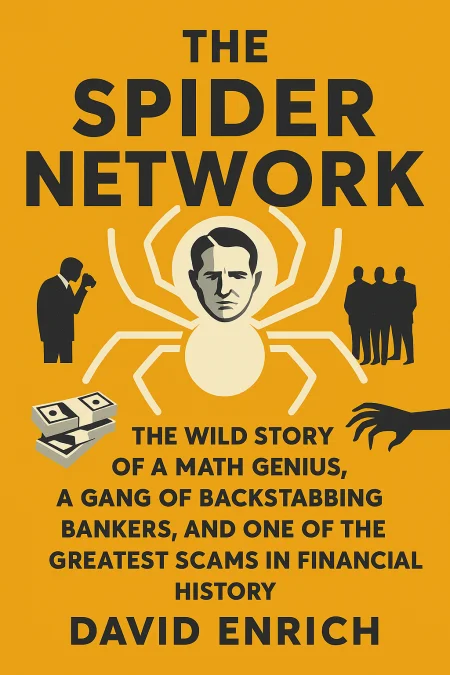
The Spider Network
The Wild Story of a Math Genius, a Gang of Backstabbing Bankers, and One of the Greatest Scams in Financial History
Book Edition Details
Summary
In the shadowy corridors of finance, where ethics are as elusive as shadows at dusk, a cabal of misfits discovered the keys to untold riches. 2006 marked the year when these renegade bankers and brokers, led by the enigmatic Tom Hayes—a mathematical savant with a flair for chaos—unraveled the secret vulnerabilities of Libor. This rate, shaping the global economic pulse, was manipulated at will by a motley crew including a Frenchman dubbed “Gollum,” a nudist broker, and a jittery chicken farmer. As fortunes soared, so did the stakes, until the inevitable collapse, a drama as gripping as it is revealing. "The Spider Network" masterfully chronicles this audacious saga, shining a light on the moral void within the financial industry's gilded walls.
Introduction
In the gleaming towers of London's financial district, a seemingly mundane number published each morning quietly determined the cost of borrowing for millions of people worldwide. Yet behind this routine calculation lay one of the most audacious financial conspiracies in modern history, where a small group of traders wielded extraordinary power over global interest rates through nothing more than instant messages and phone calls. This remarkable story reveals how a system built on trust became corrupted by greed, transforming from a gentleman's agreement among bankers into a playground for manipulation that would ultimately cost institutions and individuals billions of dollars. Through the rise and spectacular downfall of key players like Tom Hayes, we witness the dangerous intersection of cutting-edge financial innovation and age-old human weaknesses that created opportunities for systematic fraud on an unprecedented scale. The tale offers crucial insights into how modern financial markets actually operate beneath their polished surface, why regulatory systems failed so catastrophically to detect widespread manipulation, and what happens when individual ambition collides with systemic responsibility. For policymakers grappling with financial regulation, investors seeking to understand market integrity, and citizens wondering how banking scandals keep recurring, this story provides both a gripping narrative and sobering lessons about the true nature of power in global finance.
The Genesis of Deception (2001-2008): Building Networks of Influence
The early 2000s marked a golden age for financial innovation, where young mathematicians and engineers flocked to trading floors armed with complex models and insatiable ambition. Tom Hayes embodied this new breed of trader, arriving at the Royal Bank of Scotland in 2001 with a mathematics degree and an almost supernatural ability to understand the intricate relationships between interest rates and derivatives. His obsessive attention to detail and mathematical precision made him extraordinarily successful in the specialized Japanese yen derivatives market, yet also revealed troubling character traits that colleagues would later remember as warning signs. During these formative years, Hayes discovered that the London Interbank Offered Rate wasn't the objective measure it appeared to be. Banks submitted their borrowing cost estimates each morning, and these submissions could be influenced by their trading positions with minimal oversight or verification. What began as occasional requests to colleagues responsible for rate submissions gradually evolved into a more systematic practice, as Hayes learned to cultivate relationships with brokers who could influence multiple banks simultaneously. The period also witnessed LIBOR's emergence as the backbone of global finance. What had started as an informal arrangement among London banks to share borrowing costs had evolved into the world's most important benchmark interest rate, underpinning trillions of dollars in loans, mortgages, and derivatives. Yet this critical infrastructure remained surprisingly vulnerable, relying on banks' honest self-reporting in an era when financial institutions were transforming from service providers into massive gambling enterprises using their own capital to place increasingly complex market bets. Hayes's rapid ascent through the ranks at RBS demonstrated how the financial system rewarded results above all else. His ability to generate millions in profits overshadowed concerns about his methods or temperament, establishing a pattern that would define his career. The regulatory environment of this era, characterized by what British authorities proudly called "light touch" regulation, created perfect conditions for ambitious traders who learned that pushing boundaries wasn't just tolerated but actively rewarded with bigger bonuses and greater responsibility.
Peak Manipulation Era (2008-2012): Crisis as Cover for Systematic Fraud
The global financial crisis that erupted in 2008 should have exposed the fragility of systems like LIBOR, but instead provided Hayes and his expanding network with their greatest opportunity. As banks around the world teetered on the brink of collapse, the very institutions responsible for setting LIBOR were fighting for survival, creating both cover and incentive for more aggressive manipulation. Desperate to appear stable, many banks began submitting artificially low rates to avoid signaling distress to markets, while traders like Hayes saw opportunities to profit from the chaos. Moving to UBS in Tokyo, Hayes began cultivating an increasingly sophisticated operation that prosecutors would later term a "spider network" of manipulation. The mechanics were both elegant and audacious: Hayes would assess his trading positions each morning, then reach out to brokers at firms like ICAP and RP Martin, asking them to encourage rate-setters at various banks to submit LIBOR figures that would benefit his trades. These brokers, motivated by lucrative commissions and lavish entertainment, became willing accomplices who could coordinate across multiple institutions simultaneously. What made the conspiracy particularly effective was its exploitation of existing relationships and industry practices. The line between legitimate market intelligence and outright manipulation had always been blurry in the brokerage world, and Hayes simply pushed these gray areas to their logical extreme. To maintain loyalty, the conspirators developed elaborate systems of reciprocal benefits, with brokers receiving inflated commissions through sham trades and rate submitters enjoying expensive dinners and entertainment that created personal obligations. The scheme's success during this peak period reflected deeper structural problems within the financial system. LIBOR was administered by a trade association with no regulatory authority, calculated by a data company with no responsibility for accuracy, and submitted by banks with obvious conflicts of interest. No government agency had clear oversight responsibility, and the definition of what LIBOR was supposed to measure was sufficiently vague that almost any submission could be justified. This regulatory vacuum allowed manipulation to flourish unchecked for years, affecting an estimated $350 trillion worth of financial contracts worldwide while taxpayers pumped hundreds of billions into the same failing banks that were rigging rates for ordinary citizens.
Exposure and Reckoning (2012-2016): Investigation, Prosecution, and Uneven Justice
The unraveling began with a combination of academic curiosity and journalistic investigation that would expose the scandal's vast scope. Wall Street Journal reporters, following leads from researchers who questioned whether LIBOR accurately reflected banks' true borrowing costs, published groundbreaking articles that first raised serious questions about the benchmark's integrity. These reports, initially dismissed by the banking industry, planted seeds of doubt that would eventually grow into full-scale investigations across multiple jurisdictions. The regulatory response was initially sluggish and fragmented, hampered by jurisdictional confusion and the banking industry's resistance. The breakthrough came when Barclays, facing mounting pressure, decided to cooperate fully with investigators, leading to a $450 million settlement in June 2012 that sent shockwaves through the financial world. UBS followed with an even larger $1.5 billion settlement, while prosecutors prepared criminal charges against individual participants, with Hayes emerging as the primary target after Citigroup discovered his activities and fired him. Hayes's trial in 2015 became a defining moment in post-crisis financial accountability, yet it also exposed profound contradictions in how societies respond to financial misconduct. Despite overwhelming evidence of widespread manipulation involving dozens of individuals across multiple institutions, Hayes stood largely alone in the dock, portrayed as the mastermind of a vast conspiracy while his former employers depicted him as a rogue trader who had deceived them. His fourteen-year prison sentence was one of the longest ever imposed for a white-collar crime in Britain. The scandal's resolution demonstrated both the potential for meaningful accountability and the limitations of reform efforts. While billions of dollars in fines were imposed and LIBOR was eventually replaced with more robust alternatives based on actual transaction data, the focus on individual defendants like Hayes allowed banks and their senior executives to escape largely unscathed. The contrast between Hayes's treatment and that of his former colleagues highlighted the arbitrary nature of financial justice, reflecting society's difficulty in grappling with crimes that exist in moral and legal gray areas where traditional concepts of criminal law struggle to address the realities of modern financial markets.
Summary
The LIBOR conspiracy reveals a fundamental truth about modern finance: when the pursuit of profit becomes divorced from social responsibility, entire systems become vulnerable to manipulation and abuse. Hayes's story illustrates how individual ambition, institutional incentives, and regulatory failure combined to create conditions where rigging a crucial financial benchmark became not just possible, but routine practice across multiple institutions and continents. The deeper lesson extends beyond any single scandal to the very structure of contemporary banking and financial regulation. When financial institutions become primarily focused on trading profits rather than serving customers, when regulators adopt hands-off approaches based on misplaced faith in market discipline, and when the complexity of financial instruments makes oversight nearly impossible, the stage is set for systematic abuse. The LIBOR scandal wasn't an aberration but the logical outcome of a system that had lost its moral compass while concentrating enormous power in the hands of individuals with strong incentives to exploit structural weaknesses. For today's policymakers and market participants, this history offers crucial guidance for preventing future crises. First, financial benchmarks and market mechanisms require active oversight and verification, not passive trust in self-regulation by institutions with obvious conflicts of interest. Second, the complexity of modern finance demands that regulators develop sophisticated tools and expertise to match the institutions they oversee, while ensuring clear accountability frameworks that extend beyond individual scapegoats to include institutional leadership. Finally, we must acknowledge that meaningful reform requires addressing the systemic incentives that encourage manipulative behavior, rather than simply punishing those unlucky enough to be caught when the music stops. Only by learning from this conspiracy's rise and fall can we hope to build financial systems that serve society rather than exploiting it.
Related Books
Download PDF & EPUB
To save this Black List summary for later, download the free PDF and EPUB. You can print it out, or read offline at your convenience.
By David Enrich
