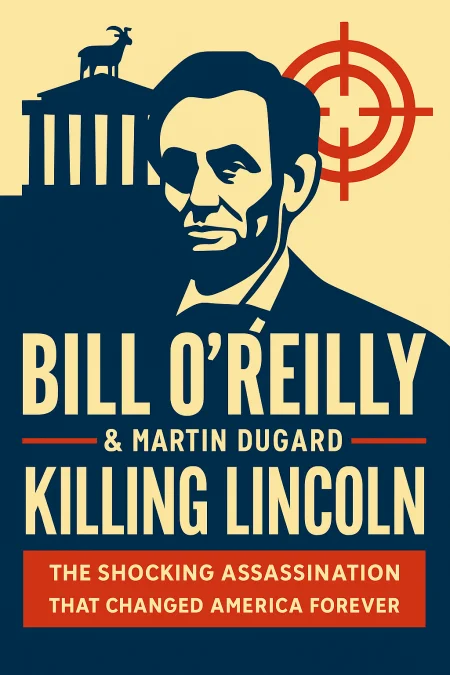
Killing Lincoln
The Shocking Assassination that Changed America Forever
byBill O'Reilly, Martin Dugard
Book Edition Details
Summary
In the shadowy aftermath of the Civil War, a conspiracy brews that will alter the trajectory of a nation forever. Bill O'Reilly's "Killing Lincoln" thrusts you into the turbulent final days of President Abraham Lincoln, unraveling the sinister plot that culminates in one of history's most infamous assassinations. Meet the conspirators and delve into their tangled motivations, as the narrative transports you to that fateful night at Ford's Theater. This gripping account reveals the intricate web of intrigue and betrayal, setting the stage for an unforgettable exploration of a pivotal moment that reshaped America. Prepare for a historical retelling that pulses with tension and reveals the human forces behind a national tragedy.
Introduction
On a fog-laden April evening in 1865, the United States stood at the threshold of reunion and reconciliation. The Civil War was ending, the slaves were free, and the great experiment of American democracy appeared to have survived its most severe test. Yet in the span of a single pistol shot, the nation's triumph transformed into its deepest tragedy. The assassination of Abraham Lincoln was not merely the death of a president—it was an act that reshaped the soul of America and demonstrated how quickly hope can turn to horror. This story reveals the intricate web of conspiracy that brought John Wilkes Booth to Ford's Theatre, the final desperate days of a collapsing Confederacy, and the manhunt that followed across the Maryland countryside. More than a tale of murder, it illuminates the fragile nature of democracy and the eternal struggle between those who seek to heal and those who choose to destroy. For anyone seeking to understand how a single moment can alter the course of history, this account offers both sobering lessons and enduring inspiration about the price of freedom and the cost of hatred.
The Final Days of War (April 1865)
The spring of 1865 found two exhausted armies locked in their final dance of death around Petersburg, Virginia. For nearly ten months, Ulysses S. Grant had held Robert E. Lee's Army of Northern Virginia in a strangling siege, slowly tightening his grip until the once-proud Confederate force resembled a collection of scarecrows more than soldiers. Lee's men survived on meager rations of raw bacon and tree bark, their uniforms reduced to rags, their boots worn through to bare feet. Yet their devotion to their beloved commander remained unshaken. The end came with shocking swiftness. Grant's massive assault on April 2 shattered Lee's defensive lines like glass, forcing the Confederate general into a desperate retreat westward. What followed was a running battle across the Virginia countryside, with Lee's dwindling army racing toward promised supplies while Grant's forces pursued them like hunting hounds. The roads became littered with abandoned weapons, dead horses, and Confederate soldiers too weak to continue. At Sayler's Creek, the Army of Northern Virginia suffered its death blow, losing thousands of men in a savage battle that left the field carpeted with bodies. The pursuit revealed the profound transformation that four years of war had wrought upon both armies. Grant's soldiers, once dismissed as shopkeepers and farmers playing at war, now moved with the ruthless efficiency of professional killers. They had learned that victory required not just courage but the willingness to pursue a beaten enemy without mercy. Meanwhile, Lee's veterans, who had once seemed invincible, finally acknowledged the arithmetic of defeat. Their cause was not lost because they lacked courage or skill, but because they were simply overwhelmed by the Union's superior numbers and resources. When Lee finally surrendered at Appomattox Court House on April 9, he did so with the quiet dignity that had marked his entire military career. The surrender terms offered by Grant were remarkably generous—Confederate soldiers could return home unmolested, keeping their horses and personal effects. This magnanimity reflected Abraham Lincoln's vision of reunion without revenge, a healing of the national wounds rather than the punishment of the defeated. Yet even as the war officially ended, darker forces were already in motion, preparing to turn triumph into tragedy.
The Conspiracy Takes Shape
While the nation celebrated Lee's surrender, a shadow plot was crystallizing in the heart of Washington, D.C. John Wilkes Booth, a talented actor consumed by Confederate sympathies and personal demons, had spent months assembling a band of conspirators dedicated to striking back at the Union leadership. What began as a kidnapping scheme had evolved into something far more sinister—a coordinated assassination plot targeting President Lincoln, Vice President Andrew Johnson, and Secretary of State William Seward. Booth possessed the perfect combination of access and anonymity that made him uniquely dangerous. As a celebrated actor, he could move freely through Washington's social circles, entering theaters and government buildings without suspicion. His Confederate contacts had provided him with funding from Jefferson Davis's secret service, while his recruitment of conspirators like Lewis Powell, David Herold, and George Atzerodt gave him the manpower to execute simultaneous attacks. The conspiracy represented more than personal hatred—it was the final desperate gambit of a dying cause. The transformation of Booth from kidnapper to assassin reflected the broader radicalization that war's end had brought to Confederate sympathizers. As long as Lee's army remained in the field, there was hope that Lincoln might be captured and exchanged for Confederate prisoners or concessions. But with the Confederacy's collapse, only the most extreme measures offered any chance of reversing the Union victory. Booth convinced himself that killing Lincoln would somehow resurrect the Confederate cause and make him a martyr to Southern independence. The conspiracy revealed the dangerous undercurrents that still flowed beneath the surface of American politics. Washington, D.C., remained filled with Confederate sympathizers who had never accepted the legitimacy of Lincoln's government. Boarding houses like Mary Surratt's provided safe havens for plotters, while smuggling networks along the Potomac offered escape routes to the South. The very openness of American democracy, which allowed citizens free access to their leaders, created vulnerabilities that enemies could exploit. As April 14 approached, all the elements of tragedy were falling into place with the inexorable precision of a Greek drama.
The Night That Changed America Forever
Good Friday, April 14, 1865, dawned bright and clear in Washington, promising a day of celebration as the nation continued to revel in the war's end. Abraham Lincoln awoke in an unusually cheerful mood, looking forward to an evening at Ford's Theatre with his wife Mary and their guests. The president had been invited to see "Our American Cousin," a popular comedy that promised light entertainment after years of national trauma. Yet even as Lincoln went about his daily routine of meetings and appointments, John Wilkes Booth was making his final preparations for murder. The assassination unfolded with the terrible precision that Booth had choreographed. Using his familiarity with Ford's Theatre, the actor gained access to the presidential box while Lincoln's bodyguard had abandoned his post for a drink at a nearby saloon. The president sat in his rocking chair, holding his wife's hand and enjoying the performance, when Booth stepped from the shadows and fired a single shot into the back of Lincoln's head. The derringer ball tore through the president's brain, destroying the mind that had guided the nation through its darkest hour. Booth's theatrical nature demanded a dramatic exit. After stabbing Major Henry Rathbone, who tried to stop him, the assassin leaped from the presidential box to the stage below, breaking his leg in the process. Rising to his feet despite the pain, he brandished his knife and shouted "Sic semper tyrannis"—thus always to tyrants—before limping offstage and mounting his waiting horse. Within minutes, he had disappeared into the night, leaving behind a scene of chaos and horror that would traumatize the nation for generations. The immediate aftermath revealed both the best and worst of human nature. As Lincoln lay dying in a cramped bedroom across the street from Ford's Theatre, prominent officials and ordinary citizens alike crowded around his deathbed, desperate to witness history in the making. Meanwhile, angry mobs roamed the streets of Washington, demanding vengeance against anyone suspected of Southern sympathies. The careful balance that Lincoln had maintained between justice and mercy threatened to collapse into a cycle of retribution and revenge. When the president drew his final breath at 7:22 the following morning, America lost not just its leader but its best hope for healing the wounds of civil war.
The Hunt for Lincoln's Killers
The largest manhunt in American history began even before Abraham Lincoln breathed his last. Secretary of War Edwin Stanton, assuming control of the government in the crisis, mobilized thousands of soldiers, detectives, and law enforcement officers in a desperate search for the assassins. Within hours, investigators had identified John Wilkes Booth as Lincoln's killer and begun unraveling the broader conspiracy that had targeted multiple government officials. The hunt would become a test of American justice and reveal the lengths to which a grieving nation would go to capture those who had murdered its beloved president. Booth's escape into the Maryland countryside became a harrowing game of cat and mouse played out across swamps, forests, and Confederate safe houses. Despite his broken leg and the massive search closing in around him, the assassin managed to evade capture for nearly two weeks. His flight was aided by a network of Confederate sympathizers who provided shelter, food, and guidance, demonstrating that the rebellion's spirit lived on even after Lee's surrender. Thomas Jones, a Confederate secret agent, kept Booth and David Herold hidden in a pine thicket for six agonizing days while federal troops combed the surrounding area. The pursuit revealed the sophisticated intelligence networks that had operated throughout the war. Detective Lafayette Baker, whose past connections to the conspiracy remain mysterious, seemed to possess an almost supernatural ability to track Booth's movements. Using telegraph lines and steamships, he deployed cavalry units with surgical precision, gradually tightening the noose around the fleeing assassins. The fact that Baker had previously been dismissed from government service for suspicious activities only added to the intrigue surrounding the investigation. The final confrontation at Garrett's farm in Virginia brought the manhunt to its violent conclusion. Trapped in a tobacco barn with federal troops surrounding him, Booth chose death over capture, proclaiming his defiance even as Sergeant Boston Corbett's rifle bullet severed his spine. The assassin's death denied the nation the satisfaction of seeing justice done in a courtroom, but it provided a sense of cosmic retribution. Meanwhile, the other conspirators faced military tribunals that resulted in four death sentences, including that of Mary Surratt, who became the first woman executed by the federal government. The trials satisfied the public's thirst for vengeance but raised troubling questions about due process and the rush to judgment that grief and anger can produce.
Summary
The assassination of Abraham Lincoln stands as a stark reminder that the forces of hatred and division can strike at the very heart of democratic institutions. Booth's conspiracy succeeded not through superior planning or execution, but because of the openness and accessibility that characterize American democracy. The president's vulnerability reflected his deep faith in the American people and his belief that a leader should remain close to those he serves. This tragic irony—that Lincoln's greatest strength became his fatal weakness—illuminates the eternal tension between security and democracy that continues to challenge nations today. The aftermath of the assassination demonstrated both America's resilience and its capacity for injustice. While the nation mourned its fallen leader and eventually found the strength to continue the work of reunion, the immediate response revealed how quickly grief can transform into vengeance. The military tribunals that condemned the conspirators, while satisfying public demand for swift justice, established troubling precedents for the suspension of civil liberties in times of crisis. The story serves as a cautionary tale about the importance of maintaining constitutional principles even when emotions run highest. Today's leaders and citizens must remember that preserving democracy requires not just defending it against external enemies, but protecting it from the internal corrosion of fear, hatred, and the desire for revenge that can poison the very institutions we seek to protect.
Related Books
Download PDF & EPUB
To save this Black List summary for later, download the free PDF and EPUB. You can print it out, or read offline at your convenience.
By Bill O'Reilly
