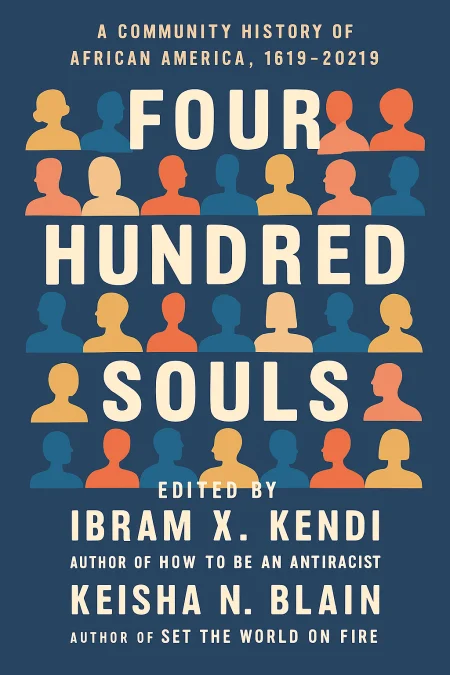
Four Hundred Souls
A COMMUNITY HISTORY OF AFRICAN AMERICA, 1619–2019
byIbram X. Kendi, Keisha N. Blain
Book Edition Details
Summary
A tapestry of voices weaves together a vivid chronicle in "Four Hundred Souls," where ninety distinguished Black authors lend their pens to capture the essence of four centuries of African American life. With Ibram X. Kendi and Keisha N. Blain at the helm, this monumental work traces a journey beginning in 1619 with the first enslaved Africans arriving on American shores. Through eighty meticulously crafted chapters, this anthology resurrects the stories of resilience, creativity, and defiance against the backdrop of oppression and segregation. Each page pulsates with the rhythm of survival and the melody of cultural triumphs. Here lies a profound reclamation of history, as vibrant personalities emerge from obscurity to reforge America's narrative, challenging us to redefine our understanding of the past and its profound impact on the present. "Four Hundred Souls" stands as a beacon of storytelling, a testament to the enduring spirit of a people and a nation reimagined.
Introduction
In August 1619, twenty African souls stepped off a Dutch vessel onto Virginia's shores, forever altering the trajectory of American history. This moment marked not merely the beginning of African American experience in the New World, but the birth of a profound contradiction that would define the nation for centuries to come. How could a land that would later proclaim that "all men are created equal" simultaneously embrace human bondage as its economic foundation? How did enslaved people and their descendants forge communities, cultures, and resistance movements that would ultimately reshape democracy itself? This sweeping chronicle reveals the untold stories of resilience, innovation, and struggle that built America from the ground up. Through four centuries of documented history, we witness the transformation of diverse African peoples into a unified community that would challenge the nation's conscience at every turn. From the earliest acts of resistance in colonial tobacco fields to the establishment of institutions that endure today, these stories illuminate how African Americans didn't merely survive oppression but actively shaped the very definition of American freedom. This narrative serves students, educators, activists, and anyone seeking to understand the true foundations of American society, the roots of contemporary racial dynamics, and the ongoing struggle for justice that continues to define our national character.
Colonial Bondage to Revolutionary Contradictions (1619-1820)
The arrival of those first Africans in Jamestown coincided with England's desperate need for labor in its struggling tobacco colony. Unlike European indentured servants who worked toward eventual freedom, these Africans found themselves trapped in an evolving system of permanent bondage. By the 1640s, colonial courts were already distinguishing between white servants, who would eventually gain liberty, and Black workers, who faced lifelong enslavement. Virginia's 1662 law declaring that children would follow the condition of their mothers institutionalized hereditary bondage, while subsequent legislation closed off pathways to freedom through conversion or military service. These weren't inevitable developments but calculated decisions by colonial elites who recognized that racial division could prevent the kind of cross-racial alliances that had threatened their power during events like Bacon's Rebellion in 1676. By offering privileges to poor whites while restricting the rights of all people of African descent, they created what historians call the "American paradox" – the simultaneous rise of slavery and freedom. The 1739 Stono Rebellion in South Carolina, where enslaved Africans marched toward Spanish Florida with drums beating and banners flying, demonstrated that resistance emerged alongside oppression. The Revolutionary era exposed these contradictions with unprecedented clarity. While colonists declared independence based on natural rights, they simultaneously held half a million human beings in bondage. Figures like Phillis Wheatley challenged this hypocrisy through poetry that demonstrated African intellectual capacity, while Crispus Attucks literally gave his life for American freedom. The Constitution's framers faced an impossible task: creating a unified nation while preserving slavery's economic foundation. Their solution embedded slavery into the nation's governing structure through the three-fifths clause, the fugitive slave provision, and twenty-year protection of the international slave trade. Yet this period also witnessed remarkable achievements by free Black communities. Richard Allen founded the African Methodist Episcopal Church, establishing the first independent Black denomination. Prince Hall created African American Freemasonry, providing leadership training and mutual support networks. These institutions laid the groundwork for organized resistance movements that would emerge in the following decades, proving that even under oppression, African Americans were building the foundations for future liberation struggles.
From Abolition Through Reconstruction's Rise and Fall (1820-1877)
The antebellum period witnessed both the entrenchment of slavery as a national institution and the rise of unprecedented resistance movements that would ultimately destroy it. The cotton gin's invention had made slavery enormously profitable, leading to the forced migration of over one million enslaved people to the Deep South in what historians call the "Second Middle Passage." By 1860, nearly four million people lived in bondage, their labor generating wealth that flowed to Northern banks, British textile mills, and global markets. This expansion triggered increasingly sophisticated resistance movements. Denmark Vesey's 1822 conspiracy in Charleston involved thousands of potential rebels across multiple plantations, while Nat Turner's 1831 rebellion sent shockwaves throughout the South. The Underground Railroad, led by figures like Harriet Tubman, helped thousands reach freedom while demonstrating the power of interracial cooperation. Meanwhile, free Black communities created newspapers, mutual aid societies, and political organizations that challenged slavery through moral suasion and direct action. Frederick Douglass became an internationally renowned orator, while the National Negro Convention movement provided forums for Black political thought. The Civil War transformed from a conflict over union into a struggle for human freedom as enslaved people fled to Union lines and eventually took up arms for their liberation. The service of 200,000 Black soldiers in federal forces ensured that the war's outcome would fundamentally reshape American society. Emancipation came not as a gift from above but as the result of enslaved people's own actions and persistent pressure on reluctant politicians. Reconstruction represented the most democratic moment in American history to that point, as newly freed people participated in electoral politics and served in legislatures. Black political leaders like Hiram Revels served in the U.S. Senate, while the Fourteenth and Fifteenth Amendments promised equal citizenship and voting rights. However, the end of Reconstruction in 1877 marked a tragic retreat from these gains. The withdrawal of federal troops enabled the rise of Jim Crow segregation, enforced through legal discrimination and extralegal violence, demonstrating how quickly democratic progress could be reversed without sustained commitment.
Jim Crow Era and the Modern Civil Rights Movement (1877-1970)
The establishment of Jim Crow segregation created a comprehensive system of racial oppression that touched every aspect of daily life. The 1896 Plessy v. Ferguson decision provided legal sanction for "separate but equal" facilities, though the reality was always separate and unequal. African Americans faced exclusion from public accommodations, inferior schools, limited economic opportunities, and the constant threat of lynching. Between 1877 and 1950, more than 4,000 African Americans were lynched, often for minor infractions or simply for achieving economic success. Yet this period also witnessed remarkable institution building within Black communities. Booker T. Washington's Tuskegee Institute emphasized vocational education and economic self-reliance, while W.E.B. Du Bois advocated for higher education and political rights through the NAACP. The Great Migration, beginning around 1915, saw millions of African Americans leave the rural South for industrial cities, creating new centers of Black political power. The Harlem Renaissance of the 1920s showcased African American cultural achievements, challenging racist stereotypes while celebrating Black identity through the works of Langston Hughes, Zora Neale Hurston, and Duke Ellington. World War II marked a crucial turning point, as the "Double V" campaign called for victory against both fascism abroad and racism at home. Black veterans returned from overseas service unwilling to accept second-class citizenship, while the moral contradictions of fighting for democracy while maintaining racial segregation became increasingly untenable. The 1954 Brown v. Board of Education decision declared segregated schools unconstitutional, providing legal foundation for challenging Jim Crow. The civil rights movement of the 1960s achieved remarkable legislative victories through sustained organizing and strategic nonviolence. The Montgomery Bus Boycott demonstrated the power of community action, while Martin Luther King Jr. provided moral leadership that could appeal to diverse audiences. The Civil Rights Act of 1964 and Voting Rights Act of 1965 dismantled legal segregation and restored voting rights, representing the fulfillment of Reconstruction's unfulfilled promises. These victories set the stage for new phases of struggle that would address economic inequality and systemic racism in more complex forms.
Black Power to Contemporary Liberation Movements (1970-Present)
The late 1960s saw the emergence of Black Power as both slogan and philosophy, challenging the integrationist assumptions of the earlier civil rights movement. Leaders like Stokely Carmichael and organizations like the Black Panther Party emphasized racial pride, community control, and international solidarity with liberation movements worldwide. While often portrayed as simply militant, Black Power actually encompassed diverse strategies from cultural nationalism to revolutionary socialism, all united by the belief that Black people must control their own destiny. The following decades brought new challenges as deindustrialization devastated urban Black communities while the War on Drugs led to mass incarceration that disproportionately affected African Americans. The crack epidemic and its punitive response created what scholars have termed "the New Jim Crow" – a new form of racial control through the criminal justice system. Simultaneously, affirmative action programs opened opportunities in education and employment, creating a growing Black middle class even as conditions worsened for many urban communities. The election of Barack Obama as the nation's first Black president in 2008 seemed to represent the fulfillment of civil rights dreams, yet it also triggered fierce backlash that revealed the persistence of white supremacist ideology. The Tea Party movement, birtherism, and eventually Donald Trump's election demonstrated that racial progress often provokes reactionary responses designed to restore white dominance. The emergence of Black Lives Matter in 2013, following Trayvon Martin's killing, marked a new phase of activism combining traditional organizing with social media mobilization. The movement's focus on state violence, particularly police brutality, connected contemporary struggles to the long history of racial terror in America. Unlike earlier movements, Black Lives Matter was explicitly intersectional, centering experiences of Black women, LGBTQ people, and other marginalized voices. The massive protests following George Floyd's murder in 2020 demonstrated the movement's ability to mobilize unprecedented numbers across racial lines, carrying forward the unfinished business of previous generations while addressing new challenges in the ongoing struggle for racial justice.
Summary
The four-century journey chronicled here reveals that American history cannot be understood without recognizing African Americans as central actors rather than passive victims. From the moment of their arrival, people of African descent shaped colonial development, challenged national contradictions, and ultimately forced the country to confront its founding ideals. Their resistance took countless forms – from armed rebellion to institution building, from legal challenges to cultural preservation – but it never ceased. This history illuminates how systems of oppression adapt and evolve rather than simply disappearing. The same legal and economic structures that sustained slavery found new expressions in Jim Crow, mass incarceration, and contemporary racial inequalities. The recurring pattern of progress followed by backlash – Reconstruction and its overthrow, civil rights victories and white resistance, Obama's election and Trump's response – demonstrates that racial justice requires constant vigilance and organizing. Understanding these continuities helps explain why racial justice remains an ongoing struggle rather than a completed achievement. The legacy of this history demands active engagement with its lessons. We must recognize that sustainable progress requires both institutional reform and cultural transformation – legal victories mean little without shifts in hearts and minds. We must understand that coalition-building across racial lines has been essential to every major advance, yet these coalitions must be built on genuine equality rather than subordination. Most importantly, we must remember that the arc of history bends toward justice only when people actively bend it through their courage, sacrifice, and unwavering commitment to human dignity. The story of African American resistance provides a blueprint for anyone committed to expanding democracy and human freedom in our own time.
Related Books
Download PDF & EPUB
To save this Black List summary for later, download the free PDF and EPUB. You can print it out, or read offline at your convenience.
By Ibram X. Kendi
