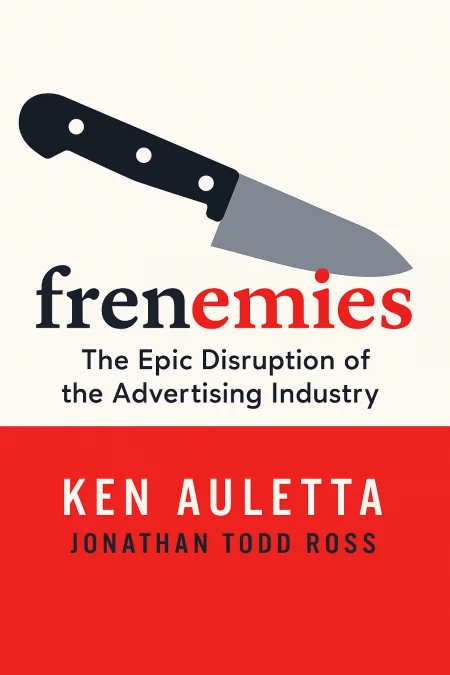
Frenemies
The Epic Disruption of the Advertising Industry (and Everything Else)
byKen Auletta, Jonathan Todd Ross
Book Edition Details
Summary
Beneath the glitzy facade of today's ad world lies a turbulent battlefield where the titans of yesteryear clash with digital disruptors. "Frenemies" by Ken Auletta peels back the curtain on a $2 trillion industry under siege, where the art of persuasion has morphed into data-driven precision. Journey into boardrooms rife with tension, where alliances teeter on the brink and once-unshakable empires tremble. Meet figures like Sir Martin Sorrell and Irwin Gotlieb, navigating a landscape where traditional power plays falter against the algorithms of tech giants like Facebook. At the heart of this tumult is Michael Kassan, the master connector, thriving amidst chaos. As advertising undergoes a seismic transformation, Auletta unravels the stakes for media's survival, revealing a gripping saga of reinvention and resilience.
Introduction
Picture the gleaming offices of Madison Avenue in the 1960s, where creative directors in sharp suits crafted campaigns over three-martini lunches, armed with little more than intuition and artistic flair. Now fast-forward to today's Silicon Valley conference rooms, where data scientists analyze billions of consumer touchpoints in real-time, using artificial intelligence to deliver personalized ads to individual smartphones within milliseconds. This dramatic transformation represents one of the most profound business revolutions of our time. The advertising industry's evolution from creative kingdoms to algorithmic empires reveals how entire industries can be reshaped by technological disruption. Through this lens, we witness the broader story of how digital platforms have fundamentally altered the relationship between businesses and consumers, how data has become the new currency of commerce, and how traditional intermediaries struggle to maintain relevance in an increasingly automated world. The journey illuminates three critical questions: How do established industries adapt when their core value propositions become obsolete? What happens when human creativity collides with machine precision? And who ultimately controls the flow of information and influence in our connected economy? This transformation offers crucial insights for business leaders navigating technological change, marketers adapting to new realities, and anyone curious about the forces reshaping our digital landscape. Whether you're defending against disruption or driving it, understanding how advertising evolved from Mad Men to Math Men provides a roadmap for thriving in an age where algorithms increasingly mediate human relationships and commerce.
The Traditional Era: Mad Men and Commission Culture (1950s-1990s)
The golden age of advertising emerged from the post-war economic boom, when television transformed American living rooms into theaters for brand storytelling. During this era, advertising agencies operated as creative kingdoms, where charismatic leaders like David Ogilvy and Bill Bernbach wielded enormous influence over both clients and culture. The industry thrived on a deceptively simple yet lucrative model: agencies received a standard fifteen percent commission on all media purchases, creating a system where bigger spending automatically meant bigger profits for the intermediaries. This period was defined by the rise of the "big idea" – campaigns that could capture the national imagination and drive mass consumer behavior. The Marlboro Man, Volkswagen's "Think Small," and Coca-Cola's hilltop harmony represented more than advertisements; they were cultural phenomena that shaped how Americans saw themselves and their aspirations. Agency executives became celebrities in their own right, commanding respect from Fortune 500 CEOs and wielding budgets that could make or break media companies. The creative director's intuition was considered as valuable as any market research, and three-martini lunches were legitimate business expenses. The commission system created a unique dynamic where agencies served as trusted intermediaries between brands and media outlets, taking their substantial cut while ostensibly representing their clients' best interests. This arrangement worked because media options were limited – three television networks, major magazines, and newspapers dominated the landscape. Agencies could genuinely claim expertise in navigating these concentrated channels, and their creative output often justified their substantial fees through memorable campaigns that drove real business results. Yet beneath this glamorous surface, the seeds of future disruption were already planted. The commission model incentivized agencies to recommend expensive media buys rather than necessarily effective ones, creating an inherent conflict of interest that would later fuel client mistrust. As media options began to proliferate and clients became more sophisticated about measuring results, the comfortable assumptions of the Mad Men era would face increasingly uncomfortable scrutiny.
Digital Disruption: The Rise of Data and Programmatic (2000s-2010s)
The internet's arrival shattered advertising's comfortable certainties, introducing a level of measurement and accountability that the industry had never experienced. Suddenly, every click, view, and conversion could be tracked with mathematical precision, transforming advertising from an art form based on intuition into a science driven by data. This shift fundamentally challenged the traditional agency model, as clients began demanding proof of return on investment rather than accepting creative awards as measures of success. The emergence of programmatic advertising represented perhaps the most radical change, allowing computers to buy and place ads in milliseconds based on real-time data about individual consumers. This technology promised unprecedented efficiency and precision, enabling marketers to reach exactly the right person at exactly the right moment with exactly the right message. Traditional media buying, which had relied on human relationships and negotiation skills, was increasingly replaced by algorithms that could process millions of variables simultaneously. Google and Facebook emerged as the dominant forces in this new landscape, not because they were traditional media companies, but because they possessed something far more valuable: massive amounts of user data and sophisticated algorithms to analyze it. These platforms could offer advertisers what television networks never could – detailed insights into who was actually seeing their ads and what actions those viewers took afterward. The old model of buying demographics was replaced by buying behaviors, intentions, and interests with surgical precision. Traditional agencies found themselves caught between worlds, struggling to adapt their creative-focused cultures to data-driven realities. Many attempted to acquire digital capabilities through expensive acquisitions, but integrating these new competencies with existing operations proved challenging. The industry began to fracture into specialized roles: creative agencies, media agencies, data companies, and technology platforms, each claiming a piece of what had once been a unified service. This fragmentation would set the stage for even more dramatic changes as digital platforms grew increasingly powerful and began questioning whether they needed agency intermediaries at all.
The Facebook-Google Duopoly: Platform Dominance and Agency Crisis (2010s-2020s)
By the 2010s, Facebook and Google had achieved something unprecedented in advertising history: a duopoly that captured the majority of digital advertising dollars while simultaneously serving as both the medium and the message. Unlike traditional media companies that simply sold space or time, these platforms controlled the entire ecosystem – from content creation and distribution to audience targeting and measurement. This vertical integration gave them enormous leverage over both advertisers and the agencies that served them. The platforms' data advantages became virtually insurmountable as they accumulated information about billions of users across multiple touchpoints throughout each day. Facebook knew what people shared, liked, and connected with, while Google knew what they searched for, watched, and purchased. This treasure trove of behavioral data enabled targeting capabilities that made traditional demographic advertising seem primitive by comparison. Marketers could now reach left-handed vegetarians who had recently moved to new cities and were in the market for kitchen appliances – a level of precision that would have been science fiction just a decade earlier. For advertising agencies, this period marked an existential crisis that challenged their fundamental value proposition. Clients increasingly questioned the need for agency intermediaries when they could work directly with platforms that offered superior targeting, measurement, and often lower costs. The traditional agency model of charging fees for strategy and creative development came under intense pressure as platforms began offering these services themselves, backed by data insights that agencies couldn't match. Many agencies saw their role reduced from strategic partners to tactical executors. The duopoly's power extended beyond mere market share to influence over industry standards and practices. When Facebook or Google changed their algorithms, measurement methods, or advertising policies, the entire industry had to adapt overnight. This dependency created a new form of anxiety among marketers, who found themselves building their strategies on platforms they didn't control and couldn't fully understand. The relationship became so complex that industry observers coined the term "frenemies" to describe the dynamic – partners in serving clients, but competitors for budget, talent, and influence.
Future of Marketing: AI, Privacy Wars, and Industry Transformation
The current era is defined by the collision of three powerful forces that promise to reshape advertising once again: artificial intelligence capabilities that threaten to automate much of what agencies traditionally provided, privacy regulations that undermine the data-driven advertising model, and consumer behavior that increasingly rejects interruptive advertising altogether. This convergence is forcing a fundamental reimagining of how brands connect with consumers and what role, if any, traditional intermediaries will play in that relationship. Artificial intelligence and machine learning are rapidly advancing beyond simple automation to tackle creative tasks once considered uniquely human. AI systems can now generate compelling ad copy, optimize campaigns in real-time across multiple variables, and even create personalized video content at scale. This technological evolution raises profound questions about the future value of human creativity in advertising, as machines become capable of producing effective marketing messages without human intervention. The transition from Mad Men to Math Men may ultimately lead to Machine Men. Privacy regulations like Europe's GDPR and California's CCPA, combined with growing consumer awareness about data collection, are simultaneously undermining the foundation of digital advertising. The third-party cookies that enabled precise targeting across the web are being phased out, and consumers are increasingly using ad blockers, privacy tools, and subscription services to avoid unwanted marketing messages. This shift is forcing marketers to develop new approaches based on first-party data and direct consumer relationships rather than surveillance-based advertising. The industry is responding with experimentation across multiple fronts: subscription models that eliminate advertising entirely, branded content that provides genuine value rather than interruption, and direct-to-consumer strategies that bypass traditional media altogether. Some companies are building their own media properties and customer communities, while others are exploring partnerships with emerging platforms and technologies. The winners in this transformation will likely be those who can successfully navigate the tension between personalization and privacy, between automation and human insight, and between efficiency and effectiveness in an increasingly complex and fragmented media landscape.
Summary
The transformation of advertising from Mad Men to Math Men reveals a broader pattern of how established industries adapt – or fail to adapt – to technological disruption. The journey from intuition-based creativity to data-driven precision illustrates both the promise and peril of digital transformation, showing how new technologies can simultaneously create unprecedented opportunities and existential threats for incumbent players. The central tension throughout this evolution has been between human creativity and algorithmic efficiency, between broad reach and precise targeting, between brand building and performance marketing. Today's advertising industry represents a hybrid of these approaches, where success increasingly depends on combining human insight with machine capabilities, creative storytelling with data analysis, and brand purpose with measurable results. The companies and professionals who thrive are those who embrace this complexity rather than choosing sides in false either-or debates. The most successful modern marketers understand that technology amplifies human creativity rather than replacing it, and that data provides the foundation for more relevant and respectful consumer relationships rather than more intrusive ones. For leaders in any industry facing digital disruption, advertising's transformation offers three crucial lessons. First, technological change often happens gradually then suddenly – the smart money prepares for acceleration rather than assuming linear progress. Second, the most dangerous competitors may come from outside your traditional industry, armed with different business models and unconstrained by legacy thinking. Finally, survival requires not just adopting new tools but fundamentally rethinking value propositions, client relationships, and organizational cultures. The future belongs to those who can navigate the intersection of human creativity and machine intelligence, finding new ways to create genuine value in an increasingly automated world.
Related Books
Download PDF & EPUB
To save this Black List summary for later, download the free PDF and EPUB. You can print it out, or read offline at your convenience.
By Ken Auletta
