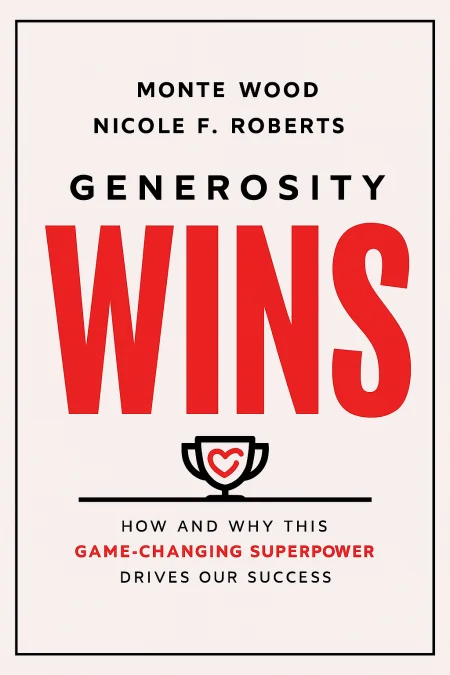
Generosity Wins
How and Why this Game-Changing Superpower Drives Our Success
byMonte Wood, Nicole F. Roberts
Book Edition Details
Summary
In the pulsating world of business fables, "Generosity Wins" shines a light on an unsung hero of success: the power of giving. Meet Emily Gardner, a driven executive seeking the transformative magic of generosity. Though Emily's journey is fictional, the wisdom she uncovers is profoundly real, drawn from the stories of today’s most influential leaders. As Emily delves into the minds of these experts, readers are invited to consider generosity not just as a virtue, but as a catalyst for authentic connections and vibrant communities. Monte Wood and Nicole Roberts weave a narrative that champions the radical impact of selflessness, revealing how acts of kindness can ripple through both personal and professional spheres, redefining what it means to be truly human. Ready to redefine your journey? Here, generosity isn't just an idea—it's your secret weapon.
Introduction
Picture this: You're standing at a crossroads in your career, watching colleagues who seem less qualified advance past you, wondering what invisible force propels their success. Meanwhile, you've been grinding away with your head down, focused solely on your own achievements, yet feeling increasingly isolated and unfulfilled. What if the secret to breakthrough success isn't about working harder or being smarter, but about fundamentally shifting how you show up in the world? This transformative journey begins with a radical reframe of what we think we know about success. While conventional wisdom tells us to climb the ladder by any means necessary, to guard our resources and compete fiercely, there's a hidden superpower that the most successful people have been leveraging all along. It's not about networking for personal gain or charitable donations for tax breaks. It's about something far more profound and infinitely more powerful. The science is clear: humans are the only species that shows generosity to complete strangers, and this unique trait has been the driving force behind our civilization's evolution. Yet most of us have never learned to harness this innate superpower consciously and strategically. When we understand generosity not as sacrifice but as investment, not as weakness but as strength, everything changes. The ripple effects touch every aspect of our lives, from our mental and physical health to our relationships and career trajectory. You're about to discover why authentic giving, with no expectation of direct return, becomes the ultimate success strategy.
Emily's Awakening: From Corporate Efficiency to Human Connection
Emily Gardner thought she had cracked the code of hotel management. At just thirty years old, she had transformed the San Diego Pinafore property from red to black, slashing costs and boosting profit margins. She cut turndown services, reduced concierge hours, and eliminated what she saw as unnecessary expenses. The numbers looked fantastic on paper. Yet when she walked into her boss Don's office for what she assumed would be a congratulatory review, his expression told a different story entirely. "You aren't getting it done," Don said simply, his words hitting Emily like a physical blow. Despite her financial success, she was being removed from her position. The confusion was overwhelming until Don began to explain: "The three housekeepers you let go, the services you cut, the way you've been operating—it's not the Pinafore way." He reminded her of her earlier acts of generosity: arranging a courier to return a guest's winter coat to Mongolia, hiring a helicopter to help a cancer patient reach his cruise ship. "Once you got your own property, it's like the whole generosity focus went out the window." Emily's story represents a common trap in our achievement-obsessed culture. We become so focused on metrics and efficiency that we lose sight of the human element that actually drives sustainable success. Don wasn't disappointed in Emily's results; he was concerned about her methods. The financial gains were short-term, built on a foundation of reduced service and demoralized staff. The negative reviews were starting to pile up, and occupancy remained flat even in a growing market. This awakening moment forced Emily to confront a fundamental truth: there are different types of success, and the most meaningful kind—what researchers call eudemonic success—comes not from taking but from giving. Don's challenge to Emily wasn't punishment; it was an invitation to discover a way of operating that would not only make her more successful but also more fulfilled. Sometimes our greatest professional setbacks become doorways to our most profound personal breakthroughs.
Masters of Generosity: Lessons from Visionary Leaders
When Emily embarked on her journey to understand generosity, she discovered a hidden community of leaders who had built their success on a foundation of giving. Will Little, the senior vice president at Shea Properties, exemplified this principle through both grand gestures and daily choices. At his company, senior executives work in windowless offices while younger employees enjoy natural light and views. This wasn't mere symbolism—it represented a fundamental philosophy that true leadership means elevating others. Little's personal story revealed the profound impact of receiving generosity. His grandfather, who had grown up in poverty, was given incredible opportunities by a business owner who eventually made him a partner. This experience of being lifted up created a generational commitment to lifting others. Little's wife Sara, a single mother of four when they met, demonstrated generosity despite her challenging circumstances, actively volunteering and giving to her church community even while struggling financially. When Little met her, he realized that her happiness and fulfillment came not from her material circumstances but from her generous spirit. The pattern became clear across every leader Emily interviewed. Leigh Steinberg, the legendary sports agent, built his career not just on contract negotiations but on encouraging athletes to give back to their communities. He created programs where football players funded scholarships, established foundations, and became role models for social responsibility. Mike Kaplan at Aspen Skiing Company created a culture where executives work alongside frontline employees, washing dishes and loading lifts during busy periods, demonstrating that leadership means service. These leaders understood something counterintuitive: the more you give away—whether it's recognition, opportunities, or support—the more you receive in return. Not because people owe you, but because generosity creates environments where everyone thrives. Their organizations had lower turnover, higher employee satisfaction, and stronger financial performance. They had discovered that generosity isn't just a nice-to-have value; it's a competitive advantage that creates sustainable success built on trust, loyalty, and genuine human connection.
The Science and Soul of Giving Without Expectation
Dr. Beth McQuiston's research at Abbott revealed the neurological foundation of what great leaders intuitively understand. When we act generously, our brains release a cocktail of feel-good chemicals: dopamine creates pleasure, oxytocin builds trust and connection, serotonin stabilizes mood, and endorphins provide a natural high. This isn't just nice science—it's evolutionary survival strategy. Humans thrived as a species precisely because we learned to cooperate and care for others beyond our immediate family groups. The research goes far beyond brain chemistry. Studies show that generous people live longer, have lower blood pressure, experience less depression, and maintain better cognitive function as they age. Companies with generous cultures see higher employee engagement, lower turnover, and improved financial performance. The ripple effects are measurable: when one person witnesses an act of generosity, they're more likely to be generous themselves, creating a contagious wave of positive behavior that can transform entire organizations and communities. But here's the crucial distinction that Emily learned: true generosity requires no expectation of return from the recipient. This isn't about quid pro quo relationships or strategic networking. It's about understanding that the act of giving itself provides the primary benefit to the giver. When we release attachment to specific outcomes, we open ourselves to receive unexpected gifts from unexpected sources. The universe seems to conspire to support those who consistently show up in service of others. Christopher Graves, through his work in behavioral science, helped Emily understand why this works. Humans are wired to respond to authentic generosity with trust, and trust is the foundation of all meaningful relationships—personal and professional. When we consistently demonstrate that we care about others' success and wellbeing without agenda, we build social capital that becomes more valuable than any financial asset. This isn't manipulation; it's the natural result of aligning our actions with our deepest human nature.
Transforming Business and Life Through Generous Leadership
The transformation Emily witnessed wasn't just about individual success—it was about fundamentally reimagining how organizations can operate. Andre Durand at Ping Identity created a company culture where believing in people became the primary leadership skill. Instead of micromanaging or controlling outcomes, generous leaders focus on creating environments where everyone can succeed. They understand that when you help others win, you win too, but in ways that go far beyond traditional metrics. This approach requires courage because it means releasing control and trusting in the process. Glenn Frommer's cross-country bike ride to raise awareness for kidney disease exemplified this principle. What started as a personal challenge became a movement that raised hundreds of thousands of dollars, connected patients with resources, and inspired countless others to take action. The ride succeeded not because Frommer had all the answers, but because his authentic generosity attracted others who wanted to contribute to something meaningful. The business applications are profound. Generous leaders create psychological safety where innovation thrives. They build cultures of trust that reduce the need for expensive oversight and compliance systems. They develop talent that stays longer and contributes more because people want to be part of something bigger than themselves. Most importantly, they create sustainable success because their organizations become magnets for other generous, talented people who want to make a difference. Emily's journey revealed that generosity isn't just about being nice—it's about tapping into the fundamental force that drives human cooperation and progress. When leaders understand this, they stop seeing generosity as a cost and start seeing it as their most powerful strategic tool. They realize that the question isn't whether they can afford to be generous, but whether they can afford not to be. In a world where technology can replicate many human functions, our capacity for authentic care and connection becomes our ultimate competitive advantage.
Summary
The most successful people aren't those who hoard resources or climb over others to reach the top—they're those who understand that lifting others is the most reliable way to rise themselves. Emily's transformation from a profit-focused manager to a leader who understood the power of generosity represents a shift available to all of us. The science is unequivocal: generosity rewires our brains for happiness, strengthens our relationships, and creates ripple effects that transform entire communities. This isn't about grand gestures or charitable donations, though those have their place. It's about the daily choice to show up with care, to listen with genuine interest, to offer help without keeping score. It's about understanding that in a interconnected world, your success is inextricably linked to the success of others. When you make someone else's day better, you make your own life richer in ways that compound over time. The path forward is both simple and profound: start where you are, with what you have, for the people around you. Notice opportunities to encourage, support, and uplift others. Trust that these acts of authentic generosity will come back to you in unexpected ways. Most importantly, remember that you possess a superpower that no algorithm can replicate—the uniquely human ability to care for others you may never meet. In a world hungry for genuine connection and meaning, your generosity isn't just a nice gesture—it's exactly what the world needs most.
Related Books
Download PDF & EPUB
To save this Black List summary for later, download the free PDF and EPUB. You can print it out, or read offline at your convenience.
By Monte Wood
