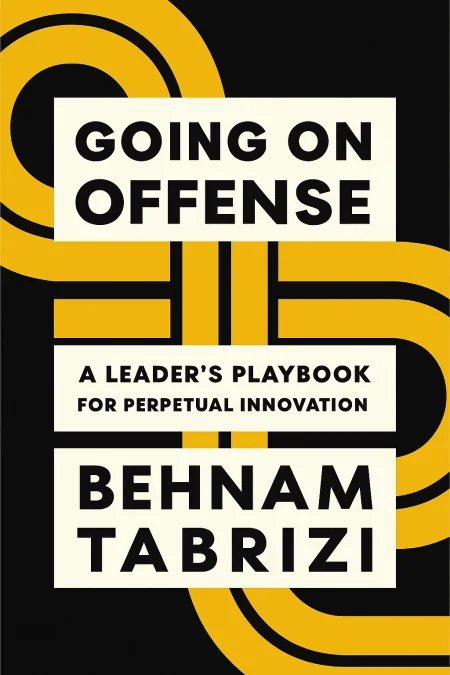
Going on Offense
A Leader's Playbook for Perpetual Innovation
Book Edition Details
Summary
In a world teetering on the edge of constant evolution, "Going on Offense" is your blueprint to cultivating a fearless culture of innovation. Renowned transformation guru Behnam Tabrizi unveils the secrets of 26 trailblazing companies, from the rebellious spirit of Tesla to the relentless drive of Amazon, revealing the alchemy behind their unyielding success. Through this riveting narrative, encounter a treasure trove of insights derived from a meticulous seven-year Stanford study. Witness how these giants keep their momentum in a cutthroat market, while dissecting the cautionary tales of others who faltered into stagnation. This book is not just a guide—it's a call to action for those daring enough to challenge the status quo and steer their organizations toward perpetual growth and breakthrough achievements. Prepare to be inspired, equipped, and ready to lead with a mindset that thrives on relentless curiosity and strategic audacity.
Introduction
Why do once-dominant companies like Nokia, Blockbuster, and Kodak suddenly find themselves obsolete while others like Amazon, Tesla, and Microsoft continuously reinvent themselves? The answer lies not in superior technology or market timing, but in developing what can be called an "innovation operating system" that enables perpetual adaptation and growth. This systematic approach to organizational transformation challenges the conventional wisdom that innovation is either a random lightning strike or a purely rational process. Instead, it reveals that sustainable innovation emerges from a carefully orchestrated interplay of existential purpose, emotional commitment, and structural agility. The framework presented here represents a synthesis of organizational psychology, strategic management, and cultural anthropology, offering leaders a comprehensive blueprint for building companies that thrive in perpetual uncertainty. The theoretical foundation rests on three fundamental questions that define organizational resilience: How do companies maintain their innovative edge as they scale? What cultural and structural elements enable continuous adaptation? How can leaders create organizations that are simultaneously generous in purpose, ferocious in execution, and courageous in their willingness to embrace uncertainty? These questions form the backbone of a new understanding of corporate evolution in the twenty-first century.
The Three Pillars of Innovation Culture
The foundation of perpetual innovation rests on three interconnected pillars that together create what might be called an "existential framework" for organizational excellence. These pillars represent the generous spirit that must permeate innovative companies, beginning with existential purpose, extending through customer obsession, and manifesting in cultural transformation. Existential purpose transcends traditional mission statements by addressing the fundamental question: Why does this organization deserve to exist? Unlike superficial corporate rhetoric, existential purpose demands that companies confront their deepest reason for being and align every decision with this North Star. This isn't merely about profit maximization or market share, but about identifying the specific problem in the world that only this organization can solve. Microsoft's transformation under Satya Nadella exemplifies this principle, shifting from "a PC on every desk" to "empowering every person and every organization on the planet to achieve more." Customer obsession represents the second pillar, operating as both emotional commitment and systematic discipline. This goes far beyond market research or customer service excellence to encompass what might be called "empathetic imagination" - the ability to anticipate customer needs before customers themselves recognize them. Amazon's development of AWS demonstrates this principle: rather than simply solving their own server problems, they imagined what other growing companies would need and built an entire industry around that insight. The third pillar, the Pygmalion effect, addresses the challenge of scale by creating cultural mechanisms that transmit purpose and obsession throughout the organization. Named after the mythological sculptor who brought his creation to life through passionate commitment, this effect describes how leaders can inspire ordinary employees to embody extraordinary standards. The key lies not in top-down mandates but in careful selection, authentic modeling, and the creation of environments where people naturally rise to meet elevated expectations. This cultural alchemy transforms individual excellence into organizational capability, ensuring that innovation becomes everyone's responsibility rather than the exclusive domain of a select few.
Building Organizational Agility and Execution
The second dimension of perpetual innovation centers on what can be termed "ferocious execution" - the ability to channel generous purpose into concrete results through disciplined action. This requires mastering three critical capabilities: startup mindset, tempo management, and bimodal operations. The startup mindset represents a psychological and operational orientation that must be cultivated even in large, established organizations. This mindset embodies what entrepreneurs call "missionary versus mercenary" thinking - the difference between those driven by purpose and those motivated primarily by profit. Maintaining this orientation requires conscious resistance to what Amazon's Jeff Bezos termed "Day 2" thinking, where companies become comfortable with their success and lose the urgency that drove their initial breakthrough. The startup mindset manifests in beginner's mind, willingness to experiment, and the courage to cannibalize existing products for better solutions. Tempo management addresses the crucial skill of organizational rhythm - knowing when to move slowly and when to accelerate rapidly. Like lions hunting on the savanna, innovative companies master the art of patient preparation followed by explosive action. This isn't simply about speed but about matching organizational energy to opportunity. Tesla's development process exemplifies this principle, with extended periods of careful engineering punctuated by rapid prototyping and market testing. The key insight is that sustainable innovation requires both deliberation and urgency, applied at the appropriate moments. Bimodal operations represent perhaps the most sophisticated capability, requiring organizations to simultaneously optimize existing processes while exploring revolutionary alternatives. One mode focuses on compression - making current operations faster, cheaper, and more reliable. The other mode emphasizes experiential development - creating entirely new possibilities through experimentation and learning. SpaceX demonstrates this principle by continuously improving rocket reliability while simultaneously developing reusable rocket technology. This dual capability prevents companies from the false choice between optimization and innovation, enabling them to excel at both incrementally and exponentially.
Leading Through Courage and Collaboration
The third dimension of perpetual innovation demands what can be characterized as "courageous leadership" - the willingness to make bold moves and create environments where others can do the same. This manifests through two essential capabilities: strategic boldness and radical collaboration. Strategic boldness involves the counterintuitive willingness to take significant risks precisely when things are going well. Most companies become conservative as they succeed, but innovative organizations recognize that comfort is the enemy of continued growth. This requires leaders who can resist the sunk cost fallacy, make difficult decisions to abandon profitable but limiting strategies, and invest in uncertain futures. Apple's decision to cannibalize its iPod business with the iPhone, despite the iPod's massive success, exemplifies this principle. Boldness also means knowing when to pull back - temporarily sacrificing growth to ensure quality and sustainability. The psychology of boldness extends beyond individual leadership to encompass organizational culture. Companies must create environments where employees feel both psychologically safe and deeply engaged - safe enough to propose radical ideas and engaged enough to want to do so. This requires moving beyond conventional risk management to embrace what might be called "intelligent risk-taking," where failures become learning opportunities rather than career limitations. Radical collaboration addresses the fundamental challenge of scale: how to maintain the fluid communication and shared purpose of small teams within large, complex organizations. Traditional organizational structures create silos that impede innovation, but simply removing structure creates chaos. The solution lies in what might be termed "structured flexibility" - maintaining clear roles and responsibilities while creating multiple pathways for cross-functional collaboration. Amazon's "two-pizza teams" and single-threaded leadership demonstrate one approach, while Apple's functional organization with horizontal dependencies represents another. The key insight is that collaboration must be designed into organizational DNA rather than hoped for through exhortation. This requires leaders who model collaborative behavior, systems that reward cross-functional success, and cultural norms that make collaboration more natural than isolation. When done effectively, radical collaboration creates organizational intelligence that exceeds the sum of individual capabilities, enabling companies to tackle challenges that would overwhelm any single team or department.
Summary
Perpetual innovation emerges not from random inspiration but from the systematic cultivation of generous purpose, ferocious execution, and courageous leadership working in concert to create organizational capabilities that transcend individual limitations. This framework offers a fundamentally different approach to corporate strategy, one that recognizes business success as ultimately dependent on human flourishing and social contribution. Rather than viewing innovation as a discrete activity or department, it reveals how entire organizations can be designed as living systems that continuously adapt, learn, and create value. For leaders willing to embrace this comprehensive approach, the reward is not merely competitive advantage but the profound satisfaction of building institutions that make meaningful contributions to human progress while achieving sustainable success in an uncertain world.
Related Books
Download PDF & EPUB
To save this Black List summary for later, download the free PDF and EPUB. You can print it out, or read offline at your convenience.
By Behnam Tabrizi
