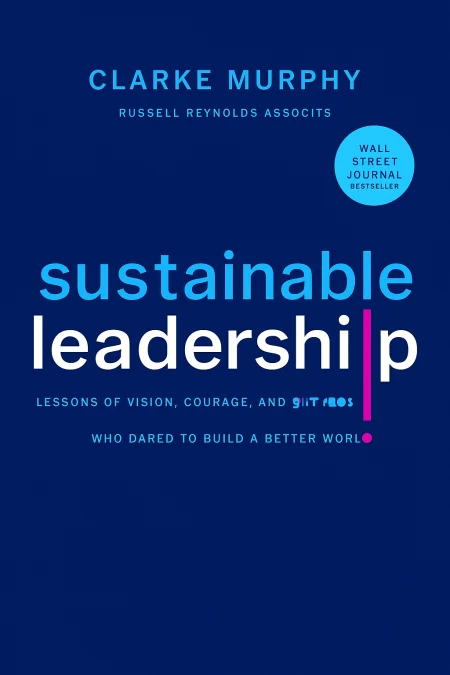
Sustainable Leadership
Lessons of Vision, Courage, and Grit from the CEOs Who Dared to Build a Better World
Book Edition Details
Summary
In the high-stakes world of corporate leadership, where profits often overshadow principle, "Sustainable Leadership" emerges as a beacon of hope. Clarke Murphy, a distinguished authority on leadership, unfurls a roadmap for transforming noble sustainability ideals into concrete action plans that boost both the planet and the bottom line. By drawing on the compelling narratives of trailblazing CEOs who dared to weave sustainability into the very fabric of their enterprises, this book shatters the myth that green initiatives are financially unsound. With pragmatic strategies and eye-opening insights, Murphy equips leaders to pioneer a legacy of sustainable success, balancing stakeholder expectations while fostering a new generation of eco-conscious executives. This is not merely a guide—it's a manifesto for those ready to lead with vision, courage, and grit.
Introduction
Corporate leadership stands at an unprecedented crossroads where traditional profit-maximization models face mounting pressure from environmental crises, social inequality, and stakeholder expectations. The fundamental question emerges: can business leaders simultaneously deliver financial performance while addressing humanity's most pressing challenges? This inquiry demands a thorough examination of what constitutes truly sustainable leadership in an interconnected world where corporate decisions ripple across global ecosystems and affect billions of lives. The exploration reveals a paradigm shift from shareholder primacy to stakeholder capitalism, where leaders must navigate complex trade-offs between immediate financial returns and long-term societal value creation. Through rigorous analysis of leadership competencies, organizational transformation strategies, and real-world implementation challenges, a comprehensive framework emerges that challenges conventional wisdom about the relationship between purpose and profit. The investigation employs both theoretical frameworks and empirical evidence from successful sustainable transformation cases, demonstrating that effective sustainable leadership requires not merely good intentions but specific skills, mindsets, and systematic approaches to embedding sustainability throughout organizational DNA and decision-making processes.
The Case for Sustainable Leadership: Why It's Business-Critical
The business imperative for sustainable leadership emerges from converging forces that fundamentally alter the operating environment for modern corporations. Climate change, resource scarcity, social inequality, and regulatory pressure create existential risks that traditional business models cannot adequately address. Companies face a stark choice: adapt to stakeholder capitalism or risk obsolescence in a world where license to operate increasingly depends on demonstrable positive impact. Evidence demonstrates that sustainable leadership transcends moral obligation to become strategic necessity. Organizations that integrate environmental, social, and governance factors into core strategy consistently outperform peers in long-term value creation, risk management, and talent attraction. The correlation between sustainability performance and financial returns reflects deeper market dynamics where consumers, investors, and employees increasingly align purchasing, investment, and career decisions with values-based criteria. The argument for sustainable leadership rests on systems thinking that recognizes business as embedded within broader ecological and social systems rather than separate from them. This perspective reveals how environmental degradation, social instability, and governance failures create material business risks while sustainable practices generate competitive advantages through innovation, efficiency, and stakeholder trust. The case builds methodically from individual company benefits to industry-wide transformation potential. Contemporary examples illustrate how sustainable leaders navigate apparent tensions between profitability and purpose by reconceptualizing value creation itself. Rather than viewing sustainability as constraint or cost center, these leaders identify opportunities where environmental and social solutions drive revenue growth, operational efficiency, and market differentiation, establishing sustainability as fundamental business strategy rather than peripheral corporate social responsibility initiative.
Inside the Sustainable Leader's Mind: Core Competencies and Development
Sustainable leaders possess distinct cognitive and behavioral patterns that differentiate them from conventional executives. The analysis reveals four critical competencies: multilevel systems thinking, stakeholder inclusion, disruptive innovation, and long-term activation. These capabilities enable leaders to perceive interconnections across economic, environmental, and social systems while translating complex sustainability challenges into actionable business strategies. Systems thinking represents the foundational competency that allows sustainable leaders to understand how their organizations interact with broader ecosystems. This perspective enables identification of leverage points where business actions can create positive ripple effects across multiple stakeholders and value chains. The competency manifests through strategic decisions that consider second and third-order consequences rather than immediate financial impacts alone. Stakeholder inclusion extends beyond traditional stakeholder management to genuine collaboration in defining problems and co-creating solutions. Sustainable leaders demonstrate exceptional ability to engage diverse constituencies including employees, communities, competitors, and even critics in productive dialogue that generates innovative approaches to shared challenges. This competency requires high emotional intelligence, cultural sensitivity, and communication skills that build trust across traditional boundaries. The development pathway for sustainable leaders combines formal learning with experiential exposure to sustainability challenges. International experience, cross-functional roles, and direct engagement with environmental or social issues emerge as common developmental experiences. The learning process often involves paradigm shifts where leaders reconceptualize business purpose and their role in society, suggesting that sustainable leadership development requires both skill building and fundamental mindset transformation that integrates personal values with professional responsibilities.
From Strategy to Implementation: Embedding Sustainability Throughout Organizations
The transition from sustainability intentions to organizational reality requires systematic embedding of sustainable practices across all business functions and decision-making processes. Implementation challenges include overcoming organizational inertia, aligning incentive systems, and developing capabilities necessary to execute complex sustainability initiatives while maintaining operational excellence and financial performance. Successful implementation begins with leadership alignment where senior executives model sustainable behaviors and integrate sustainability metrics into performance evaluation and compensation systems. The process demands restructuring governance mechanisms, updating hiring criteria, and redesigning training programs to ensure sustainability competencies permeate the organization rather than remaining isolated in specialized departments or roles. Cultural transformation represents the deepest implementation challenge as it requires shifting collective mindset from short-term optimization to long-term value creation. Organizations achieve this transformation through storytelling that connects sustainability initiatives to employee purpose, measurement systems that track both financial and sustainability outcomes, and recognition programs that celebrate innovations contributing to environmental and social goals alongside traditional business achievements. The embedding process involves careful attention to stakeholder engagement both internal and external to the organization. Employees must understand how their individual roles contribute to sustainability objectives while external partners including suppliers, customers, and communities participate in collaborative efforts to achieve shared goals. Success requires patience and persistence as cultural change occurs gradually through consistent reinforcement of sustainable behaviors and decision-making criteria across all organizational levels and functions.
Building the Future: Next-Generation Leaders and Ecosystem Collaboration
The acceleration of sustainable leadership impact depends critically on developing next-generation leaders who will inherit responsibility for addressing climate change, social inequality, and resource constraints. These emerging leaders demonstrate higher intrinsic motivation for sustainability issues and possess digital nativity that enables innovative approaches to complex global challenges requiring unprecedented collaboration across traditional boundaries. Next-generation sustainable leaders exhibit distinct characteristics including comfort with ambiguity, collaborative problem-solving orientation, and systems perspective that naturally integrates economic, environmental, and social considerations. Their development requires mentorship from current sustainable leaders combined with experiential learning opportunities that expose them to real-world sustainability challenges and cross-sector partnership dynamics. Ecosystem collaboration emerges as essential capability for addressing sustainability challenges that exceed any single organization's capacity to solve. Successful collaboration requires building trust across traditional competitive boundaries, aligning diverse stakeholder incentives, and creating governance structures that enable collective action while respecting individual organizational constraints and objectives. The future sustainable leadership pipeline benefits from organizational strategies that identify high-potential employees with sustainability passion and provide them with accelerated development opportunities including cross-functional projects, external partnership roles, and direct exposure to senior leadership decision-making processes. These investments create multiplier effects as next-generation leaders bring enhanced sustainability competencies to their future leadership roles while serving as catalysts for continued organizational transformation toward more sustainable business models and practices.
Summary
Sustainable leadership represents a fundamental evolution in business leadership that integrates financial performance with positive environmental and social impact through specific competencies, systematic implementation approaches, and collaborative ecosystem development. The evidence demonstrates that sustainability and profitability are not competing objectives but mutually reinforcing elements of long-term value creation that require leaders capable of navigating complexity, building stakeholder trust, and driving organizational transformation toward more regenerative business models that serve both shareholder and societal interests.
Related Books
Download PDF & EPUB
To save this Black List summary for later, download the free PDF and EPUB. You can print it out, or read offline at your convenience.
By Clarke Murphy
