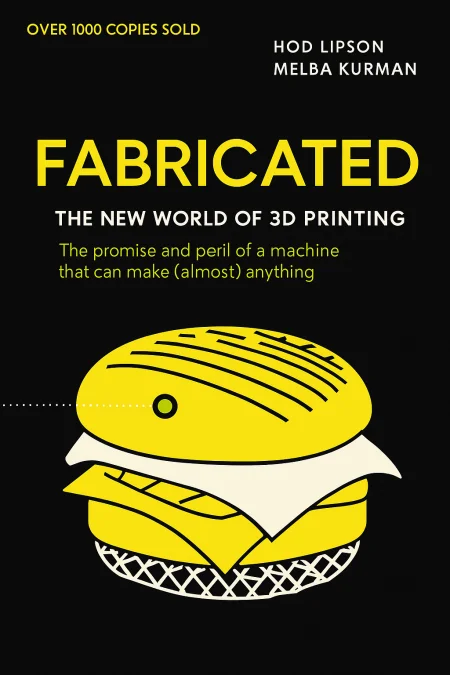
Fabricated
The New World of 3D Printing
Book Edition Details
Summary
In a world where the line between imagination and reality blurs with a simple command, "Fabricated" unveils the remarkable evolution of 3D printing. This transformative technology is not just reshaping industries—it's redefining the essence of creation itself. From classrooms to kitchens, catwalks to clinics, this riveting narrative exposes a future where crafting physical objects becomes as intuitive as typing. Dive into the fascinating confluence of digital wizardry and material innovation, where every layer of possibility is stacked with precision. With insights drawn from pioneers across diverse fields, this book challenges you to ponder: How will this revolution alter the very fabric of your life? Perfect for enthusiasts of business acumen, scientific marvels, and technological wonders, "Fabricated" invites readers to explore the profound implications of a world where the extraordinary becomes ordinary.
Introduction
Imagine walking into your local hospital and watching a surgeon hold up a perfect replica of a patient's heart, examining every valve and chamber before performing life-saving surgery. This heart wasn't carved by an artist or molded in a factory—it was printed layer by layer from a digital scan, emerging from a machine that builds objects the same way you might stack pancakes, one thin layer at a time. This is 3D printing, a technology that's quietly revolutionizing how we create everything from the shoes on your feet to the parts in jet engines. Unlike traditional manufacturing that cuts away material or forces it into molds, 3D printing adds material precisely where it's needed, following digital blueprints with incredible accuracy. Throughout this exploration, you'll discover how this technology is already transforming medicine by creating custom prosthetics that cost a fraction of traditional alternatives, how it's enabling engineers to design impossible geometries that make airplanes lighter and more efficient, and how it might soon democratize manufacturing itself, putting the power to create sophisticated objects into the hands of anyone with access to a printer and an internet connection.
From Digital Code to Physical Objects: How 3D Printing Works
At its heart, 3D printing works like a incredibly precise version of a soft-serve ice cream machine, but instead of swirling frozen dessert, it deposits layers of material according to exact digital instructions. The process begins when a computer takes a three-dimensional design and slices it into thousands of paper-thin cross-sections, like cutting a loaf of bread into incredibly thin slices. Each slice becomes a blueprint that tells the printer exactly where to place material for that particular layer. The magic happens in how these layers stack up to create complex three-dimensional objects. Traditional manufacturing is subtractive—you start with a block of material and carve away everything you don't need, like Michelangelo chiseling David from marble. 3D printing is additive, building objects from the ground up by depositing material only where it's needed. This fundamental difference means that a 3D printer can create hollow objects, interlocking parts that emerge pre-assembled, or internal geometries that would be impossible to machine using conventional methods. Different types of 3D printers use various approaches to build these layers. Some work like computer-controlled glue guns, heating plastic filament and extruding it through a tiny nozzle that moves in precise patterns. Others use lasers to fuse powdered materials together, melting only the particles that need to become part of the final object while leaving the rest as removable support material. Still others cure liquid resin with ultraviolet light, solidifying each layer in seconds before moving on to the next. What makes this technology truly revolutionary is its relationship with digital information. Once an object exists as a computer file, it can be instantly transmitted anywhere in the world, modified with software, or reproduced with perfect consistency. This digital-to-physical bridge is transforming manufacturing from a process of making thousands of identical items to one where each object can be completely unique without adding cost or complexity.
Revolutionizing Industries: Manufacturing, Medicine, and Beyond
The traditional manufacturing world operates on a simple economic principle: the more identical items you produce, the cheaper each one becomes. This economy of scale has shaped everything from the design of products to the layout of entire cities around factories. But 3D printing flips this logic completely, creating what we might call an economy of one, where producing a single custom item costs virtually the same as producing a thousand identical copies. This shift is already creating dramatic changes across industries. Boeing has replaced a complex assembly of twenty separate parts with a single 3D-printed component that's lighter, stronger, and requires no assembly time. General Electric prints fuel nozzles for jet engines that would be impossible to manufacture using traditional methods, incorporating internal cooling channels and complex geometries that improve performance while reducing weight. These aren't just incremental improvements—they represent fundamental rethinking of how objects can be designed when manufacturing constraints disappear. In medicine, 3D printing is creating possibilities that seemed like pure science fiction just a decade ago. Surgeons now routinely print exact replicas of patients' organs before complex operations, allowing them to practice procedures and identify potential complications in advance. Prosthetic limbs can be custom-fitted to individual patients and produced for hundreds of dollars rather than tens of thousands, making advanced prosthetics accessible to people worldwide who could never afford traditional alternatives. Children who outgrow prosthetics can have new ones printed as they develop, rather than being limited by expensive, one-size-fits-all solutions. Perhaps most remarkably, researchers are working toward bioprinting—using living cells as printing material to create actual human tissue. While we're still years away from printing complete organs, scientists have successfully created skin grafts, cartilage, and simple blood vessels using patients' own cells. This approach could eventually eliminate organ transplant waiting lists and the need for immunosuppressive drugs, since printed organs would be grown from the recipient's own biological material.
Environmental Impact and Legal Challenges of Digital Manufacturing
The environmental implications of 3D printing present a fascinating paradox that highlights both tremendous promise and significant concerns. On one hand, the technology offers the potential for dramatically more efficient manufacturing, since material is deposited only where needed rather than carved away from larger blocks. Traditional machining often wastes up to ninety percent of raw materials, while 3D printing can achieve near-zero waste in the actual printing process. The ability to produce items on demand also promises to reduce the massive inventories and global shipping networks that characterize modern manufacturing. However, the current reality is more complex. Most 3D printers consume significantly more energy per unit of production than traditional manufacturing methods like injection molding, especially for large quantities of identical items. The majority of 3D printing materials are petroleum-based plastics that don't biodegrade, potentially contributing to our growing plastic waste crisis. Perhaps more concerning is the psychological shift that might occur as physical objects become as easy to create as digital files, potentially leading to a throwaway mentality where people print items casually and discard them just as easily. The legal landscape surrounding 3D printing remains largely uncharted territory, with intellectual property laws struggling to address a world where anyone can reproduce complex designs with a desktop machine. The same technology that enables beneficial innovations also makes counterfeiting easier and raises thorny questions about liability when 3D-printed products fail. If someone downloads a design for a critical component, prints it with substandard materials, and it fails catastrophically, determining responsibility becomes incredibly complex. More troubling possibilities include the potential for printing weapons, drug manufacturing equipment, or other dangerous items that challenge existing regulatory frameworks. The democratization of manufacturing capabilities that makes 3D printing so powerful for positive applications also enables potentially harmful uses. As the technology becomes more accessible and capable, society will need to develop new approaches to regulation that balance innovation with safety and security concerns.
The Future of Fabrication: Smart Materials and Programmable Objects
The future of 3D printing extends far beyond simply making objects faster or cheaper—it points toward a fundamental transformation in our relationship with the physical world itself. We're rapidly moving from an era where we can only control the shape of objects to one where we can precisely control their composition, properties, and eventually their behavior. Future 3D printers will work with multiple materials simultaneously, creating objects with properties that vary throughout their structure—rigid where strength is needed, flexible where movement is required, and conductive where electrical function is necessary. This evolution toward what researchers call digital materials could revolutionize how we think about product design and functionality. Imagine printing a smartphone that emerges with its case, screen, circuits, and battery all integrated into a single manufacturing process. Or consider printing buildings where the walls themselves contain heating elements, sensors, and data networks, eliminating the need for separate installation of electrical and mechanical systems. The traditional distinction between manufacturing and assembly could disappear entirely as complex, multi-functional objects emerge fully formed from printers. The ultimate vision involves printing active, responsive systems—objects that can sense their environment, process information, and adapt their behavior accordingly. Researchers are already experimenting with printing batteries, electronic circuits, and mechanical actuators, working toward the goal of printing complete robots that could literally walk out of the printer, fully functional and ready to operate. This represents a shift from analog to digital manufacturing, where physical objects become composed of discrete, programmable elements that can be reconfigured and updated like software. Perhaps most intriguingly, advances in artificial intelligence and design software are making sophisticated product creation accessible to people without engineering training. Design tools are becoming more intuitive and game-like, potentially making product design as accessible as creating content for social media. When combined with AI systems that can optimize designs for specific requirements and 3D printers that can produce professional-quality results, we might witness an explosion of innovation as millions of people gain the ability to create sophisticated physical objects tailored to their exact needs and circumstances.
Summary
The 3D printing revolution represents far more than just a new manufacturing technique—it embodies a fundamental shift toward a world where the boundaries between digital and physical creation dissolve, where anyone can become a manufacturer, and where the design constraints that have shaped human-made objects for millennia are finally being overcome. This technology is quietly transforming industries from healthcare to aerospace while simultaneously raising profound questions about sustainability, intellectual property, and the very nature of creation and ownership in a digital age. As we stand on the threshold of being able to print not just static objects but active, intelligent systems that can sense and respond to their environment, we face both unprecedented opportunities for innovation and complex challenges that will require thoughtful navigation by individuals, companies, and governments alike. How will this democratization of manufacturing capability reshape economic structures and social relationships, and what new forms of creativity and collaboration will emerge when the primary limitation on turning imagination into reality becomes not technical capability, but rather our collective wisdom in choosing what should be created?
Related Books
Download PDF & EPUB
To save this Black List summary for later, download the free PDF and EPUB. You can print it out, or read offline at your convenience.
By Hod Lipson
