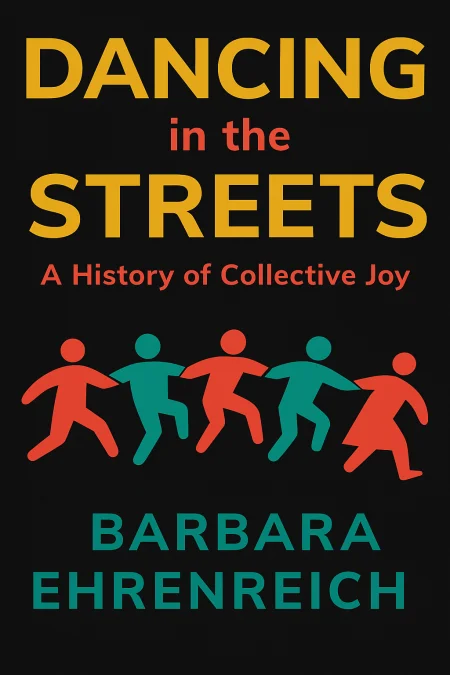
Dancing in the Streets
A History of Collective Joy
Book Edition Details
Summary
In "Dancing in the Streets," Barbara Ehrenreich unveils a hidden longing that pulses through human history—a craving for collective jubilation, long overshadowed by societal restraint. This electrifying narrative sweeps readers from the ecstatic rituals of ancient Greece to the rebellious spirit of the 1960s, tracing how communal revelry has been a defiant dance against oppression. As puritanical forces sought to stifle these exuberant expressions, celebrations found new life in rock-and-roll and sporting events, proving our innate need to connect through shared joy. Ehrenreich’s masterful exploration is both a historical revelation and a hopeful manifesto, championing our timeless capacity for unity and envisioning a world where joy knows no bounds.
Introduction
Picture a moonlit night ten thousand years ago. Around flickering fires, our ancestors gathered in circles, their bodies painted with red ochre, moving in synchronized rhythm to the beat of primitive drums. These weren't mere entertainments—they were the very foundation of human community, techniques of ecstasy that bound individuals into something larger than themselves. Fast-forward through history, and we find similar scenes: ancient Greeks losing themselves in Dionysian revelry, medieval Europeans celebrating carnival with wild abandon, indigenous peoples worldwide maintaining sacred dances that connected them to the divine. Yet something profound has been lost along the way. The communal joy that once defined human celebration has been systematically suppressed, transformed, or forgotten entirely. This transformation didn't happen by accident—it was the result of deliberate campaigns by religious authorities, colonial powers, and emerging capitalist systems that viewed collective ecstasy as dangerous to social order. The story of how we lost our capacity for communal transcendence reveals fundamental tensions between individual autonomy and collective belonging, between order and spontaneity, between the sacred and the secular. This exploration will resonate with anyone who has felt the electric energy of a crowd at a concert, the unity of a protest march, or the inexplicable joy of dancing with strangers. It speaks to those curious about why modern life often feels isolated despite our unprecedented connectivity, and why authentic community seems so elusive in our individualistic age.
Ancient Foundations: Prehistoric Rituals and Dionysian Democracy
The archaeological record tells a remarkable story. From the caves of prehistoric Europe to the rock art of ancient Africa, our earliest ancestors left behind images of one activity above all others: dancing. These weren't casual sketches but carefully rendered scenes of people moving in lines and circles, often wearing elaborate masks and costumes, their hair flowing as if caught in motion. Dancing wasn't peripheral to early human life—it was central, perhaps even essential to survival itself. The evolutionary purpose becomes clearer when we consider the challenges facing early humans. Unlike other primates who lived in small family groups, humans needed to cooperate in much larger bands to defend against predators and hunt massive game animals like mammoths and bison. Dancing provided the social glue that made this possible. Through synchronized movement to rhythm, individuals could literally feel their connection to the group, experiencing what anthropologists call "collective effervescence"—a transcendent sense of unity that dissolved petty rivalries and created genuine solidarity. This tradition reached its most sophisticated expression in ancient Greece with the worship of Dionysus, the god of wine, ecstasy, and collective joy. Unlike other Greek deities who demanded formal sacrifices, Dionysus required participation—wild dancing, wine drinking, and the achievement of trance states where worshippers felt possessed by divine energy. The god's followers, particularly women called maenads, would abandon their domestic duties to dance in the mountains, achieving states of consciousness that modern observers might call mystical experiences. What made Dionysian worship revolutionary was its democratic nature. While other religious cults were restricted by class or gender, anyone could join the god's sacred band. Slaves danced alongside free citizens, women took leadership roles typically denied them, and social hierarchies temporarily dissolved in the collective frenzy. This egalitarian spirit would prove deeply threatening to emerging civilizations built on rigid social stratification, setting the stage for centuries of conflict between ecstatic traditions and established authority.
The Great Suppression: Christianity, Reformation and Carnival's Demise (1200-1800)
As Christianity consolidated its power across Europe, it faced a fundamental dilemma. The new religion had emerged from ecstatic traditions—early Christians spoke in tongues, danced in worship, and experienced divine possession much like their pagan predecessors. Yet as the Church became institutionalized, these spontaneous expressions of faith became increasingly problematic. How could a hierarchical organization maintain control if ordinary believers could access the divine directly through ecstatic experience? The solution was gradual but decisive: ecstatic practices were systematically expelled from churches and relegated to the streets. What emerged was the medieval carnival tradition—a compromise that allowed people their moments of collective joy while keeping such dangerous energies away from sacred spaces. For several centuries, this arrangement worked remarkably well. European towns celebrated dozens of festivals annually, creating a calendar where nearly one day in four was devoted to some form of collective celebration. Medieval carnival was far more than mere entertainment. It was a complete inversion of normal social order, where peasants mocked nobles, women took men's roles, and the powerless briefly became powerful. These "rituals of inversion" served as both safety valve and subtle threat—they released social tensions while simultaneously demonstrating that existing hierarchies were arbitrary and changeable. The fact that authorities tolerated and even participated in these celebrations suggests they understood their importance for social cohesion. However, the Protestant Reformation shattered this delicate balance. Reformers like John Calvin viewed any form of collective pleasure as spiritually dangerous, a distraction from the serious business of individual salvation. The emerging capitalist economy reinforced this hostility—time spent in celebration was time not spent in productive labor. Across Protestant Europe, traditional festivals were banned, maypoles torn down, and dancing prohibited. The Puritans who colonized America carried this anti-festive ideology to new extremes, creating societies where collective joy was not merely discouraged but criminalized.
Colonial Destruction: Eliminating Indigenous Festivities Worldwide (1500-1900)
When European explorers and colonizers encountered indigenous peoples worldwide, they consistently found the same phenomenon that had once characterized their own cultures: elaborate collective rituals involving dancing, music, and the achievement of trance states. From the Aboriginal corroborees of Australia to the healing dances of African tribes, from Native American vision quests to Polynesian ceremonial gatherings, ecstatic ritual appeared to be a universal human practice. The European response was swift and brutal. Missionaries and colonial administrators collaborated in systematic campaigns to destroy these practices, viewing them as devil worship, primitive superstition, or dangerous threats to colonial order. The suppression took many forms: legal prohibitions on drumming and dancing, forced conversion to Christianity, removal of children to mission schools where indigenous practices were forbidden, and in extreme cases, outright genocide of peoples who refused to abandon their traditions. Yet indigenous peoples displayed remarkable creativity in preserving their cultural heritage under impossible circumstances. African slaves in the Americas managed to maintain elements of their ritual traditions by disguising them within Christian worship or secular celebrations like carnival. The result was a flowering of syncretic religions—Vodou, Santeria, Candomblé—that combined African spiritual practices with Christian symbolism. These hybrid traditions served not only as cultural preservation but as springboards for resistance and rebellion. The colonial assault on indigenous festivities reveals a crucial insight about the relationship between collective joy and political power. Authorities understood intuitively that people who could generate transcendent experiences through their own cultural practices were harder to control than those dependent on external sources of meaning and pleasure. By destroying traditional festivals and rituals, colonizers didn't just attack indigenous cultures—they attacked indigenous peoples' capacity for self-generated happiness and solidarity. This cultural destruction was as devastating as the physical violence that accompanied it, creating psychological wounds that persist across generations.
Modern Transformations: From Revolutionary Spectacles to Rock Revival
The French Revolution marked a crucial turning point in the history of collective gatherings. While revolutionary crowds initially displayed the carnivalesque energy of traditional festivals—dancing in the streets, inverting social hierarchies, celebrating with wine and song—the revolutionary leadership quickly moved to channel this energy into more controlled forms. The result was the invention of the modern political spectacle: carefully orchestrated events where masses of people gathered not to participate but to watch and applaud. These revolutionary festivals established the template for all subsequent nationalist rallies and political spectacles. Instead of the spontaneous, participatory joy of traditional carnival, they offered choreographed displays of military might, patriotic speeches, and symbolic pageantry. The audience's role was reduced to that of passive spectators, their energy harnessed for political purposes but never allowed to develop its own direction or momentum. The mid-twentieth century witnessed an unexpected resurrection of collective ecstasy through rock and roll music. Young people, raised in the emotionally constrained atmosphere of post-war suburbia, suddenly encountered rhythms and movements that awakened dormant capacities for group transcendence. Early rock concerts became battlegrounds between authorities determined to maintain order and audiences instinctively seeking the freedom to move and respond collectively. The counterculture of the 1960s expanded these musical innovations into comprehensive alternative communities, with festivals like Woodstock recreating many elements of ancient carnival. Contemporary manifestations continue to emerge despite commercial co-optation and official discouragement. Sports events have become increasingly carnivalesque, with elaborate fan rituals and synchronized chanting. Protest movements regularly incorporate elements of celebration and performance, while electronic dance music creates temporary communities united by rhythm and shared experience. These developments suggest that collective ecstasy remains a fundamental human need that will continue finding expression regardless of official attitudes.
Summary
The history of collective joy reveals a fundamental tension that has shaped human civilization: the conflict between the human need for transcendent community experience and the requirements of social control. From prehistoric dancing circles to medieval carnivals to indigenous healing rituals, humans have consistently created techniques for achieving collective ecstasy—moments when individual boundaries dissolve and people experience themselves as part of something larger and more meaningful. Yet these same practices have been systematically suppressed by authorities who recognized their subversive potential. Religious hierarchies, colonial administrators, capitalist employers, and political leaders have all understood that people capable of generating their own transcendent experiences are harder to control than those dependent on external sources of meaning and validation. The result has been a centuries-long campaign against collective joy, leaving modern individuals isolated and yearning for authentic community. This historical perspective offers crucial insights for contemporary life. We must recognize that our current epidemic of loneliness and depression may be partially rooted in the loss of collective practices that once provided meaning and connection. We should be suspicious of top-down spectacles that promise community while actually reinforcing passivity and control. Finally, we might consider how to revive authentic forms of collective celebration—not as nostalgic recreation but as essential practices for human flourishing. The techniques of ecstasy that sustained our ancestors for millennia haven't disappeared; they're waiting to be rediscovered by communities brave enough to dance together once again.
Related Books
Download PDF & EPUB
To save this Black List summary for later, download the free PDF and EPUB. You can print it out, or read offline at your convenience.
By Barbara Ehrenreich
