
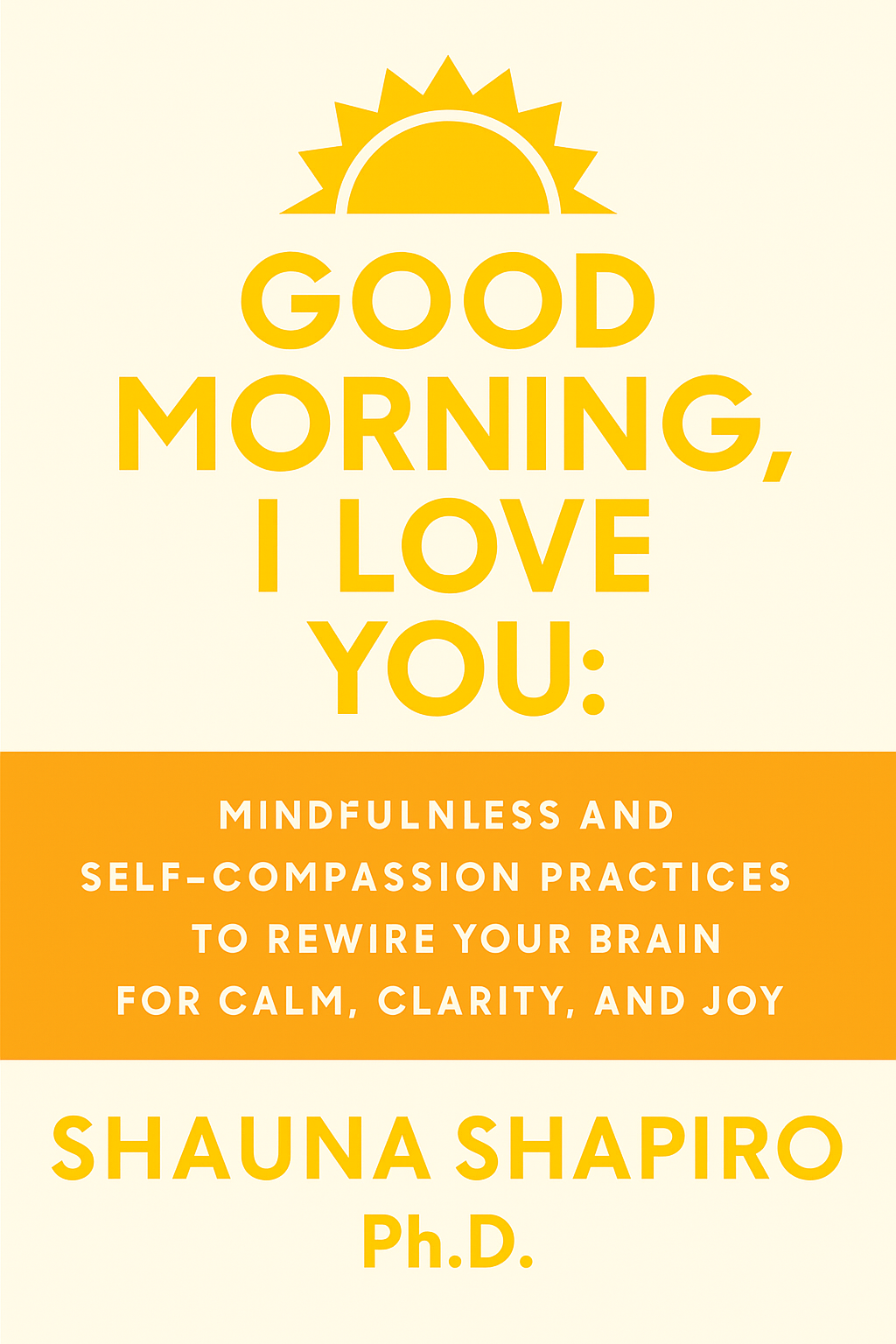
Good Morning, I Love You
Mindfulness and Self-Compassion Practices to Rewire Your Brain
Book Edition Details
Summary
In a world where self-doubt whispers louder than self-love, Dr. Shauna Shapiro offers a groundbreaking revelation: the art of being kind to oneself can rewire your very essence. "Good Morning, I Love You" isn't just a mantra but a gentle revolution against our ingrained negativity. With a perfect blend of science and storytelling, Shapiro unveils the surprising truth that our brains are programmed for self-criticism, yet can be transformed through mindful compassion. Imagine starting each day by embracing yourself with the warmth of those simple words. This book, a beacon of hope, guides you through practices that promise not just fleeting moments of peace, but a profound and lasting shift towards joy and clarity. Dive into this transformative journey and discover the power of saying "I love you" to the most important person—yourself.
Introduction
At seventeen, lying in a hospital bed with a metal rod freshly inserted into her spine, Shauna Shapiro watched her carefully constructed world collapse around her. The former volleyball champion and prom princess faced a devastating reality: the scoliosis surgery that was supposed to save her life had seemingly destroyed everything she valued about herself. In that moment of profound darkness, she couldn't have imagined that this experience would ultimately lead her to become one of the world's leading researchers in mindfulness and self-compassion, touching millions of lives through her revolutionary approach to healing and happiness. Dr. Shapiro's journey from a frightened teenager to a pioneering psychologist and professor offers a compelling testament to the transformative power of mindfulness. Her story illuminates how ancient wisdom can be validated by modern neuroscience, showing us that we possess an extraordinary capacity to rewire our brains for greater joy, resilience, and connection. Through her personal struggles and scientific discoveries, readers will discover the profound truth that our greatest wounds often become our greatest sources of wisdom and strength. This exploration reveals how we can cultivate genuine self-compassion, navigate life's inevitable challenges with grace, and ultimately create a more connected and meaningful existence for ourselves and others.
From Suffering to Awakening: Early Struggles and Discovery
Shauna's early life in beautiful Laguna Beach, California, seemed like a perfect dream. As a talented athlete and popular student with a bright future at Duke University, she embodied the American ideal of success and possibility. Yet beneath this surface perfection lay a spinal condition that would soon shatter her carefully constructed identity and force her into an unexpected journey of self-discovery. The devastating diagnosis that her scoliosis required immediate surgery marked the beginning of what she would later recognize as her true education. During the months of painful recovery that followed, Shauna encountered not just physical agony but a profound psychological crisis. The athletic, confident teenager she had been seemed to vanish, replaced by someone she barely recognized—fearful, immobilized, and consumed by catastrophic thoughts about her future. Traditional approaches to healing felt inadequate against the storm of anxiety and despair that threatened to overwhelm her. The turning point came through an unexpected source: her father's gift of a book on mindfulness by Jon Kabat-Zinn. In those pages, Shauna discovered a revolutionary idea—that while we cannot always control what happens to us, we can transform our relationship to those experiences. This insight sparked a voracious appetite for learning about contemplative practices and their potential for healing. What began as a desperate search for relief gradually evolved into a deep fascination with the mechanisms of human consciousness and resilience. The journey from her hospital bed to a monastery in Thailand represented more than geographical distance; it embodied a complete transformation in how she understood the nature of suffering and healing. Through meditation retreats and encounters with wise teachers, Shauna began to realize that her physical crisis had opened doorways to profound psychological and spiritual insights that would shape not only her personal recovery but her life's work.
The Science of Transformation: Neuroplasticity and Mindfulness
Returning from Thailand with transformative personal experiences, Shauna faced a crucial challenge: how to bridge the ancient wisdom of contemplative traditions with the rigorous demands of modern scientific inquiry. Her graduate studies became a quest to understand the mechanisms underlying the profound changes she had witnessed in herself and others through mindfulness practice. This pursuit would ultimately contribute to establishing mindfulness as a legitimate field of scientific research. Her groundbreaking doctoral research focused on medical students, exploring whether mindfulness training could preserve the empathy and compassion that typically declined during the stressful years of medical education. The results were remarkable: students who received mindfulness training maintained their capacity for empathy while showing reduced levels of anxiety and depression. This work helped establish the scientific foundation for what would become a revolution in healthcare, education, and psychology. Central to Shapiro's contributions was her development of a comprehensive model of mindfulness that integrated three essential components: intention, attention, and attitude. Unlike simplified approaches that focused solely on attention training, her framework recognized that the quality of our awareness—characterized by kindness and curiosity rather than judgment—was equally crucial for transformation. This insight would prove essential for understanding why some mindfulness practices succeeded while others failed to produce lasting change. The emerging field of neuroplasticity provided the scientific backbone for understanding these transformative experiences. Research demonstrated that the brain remains remarkably adaptable throughout life, capable of forming new neural pathways and abandoning old, unhealthy patterns through focused practice. Shauna's work helped bridge Eastern contemplative traditions and Western neuroscience, showing that ancient practices could be understood and validated through modern scientific methods while maintaining their profound capacity for human transformation.
Building Inner Strength: Self-Compassion and Resilience
Through years of clinical practice and research, Shauna encountered a universal human struggle that transcended demographics and circumstances: the tendency toward self-criticism and the persistent feeling of not being good enough. This discovery led her to explore one of the most powerful yet overlooked aspects of psychological wellbeing—our capacity for self-compassion. Her research revealed that how we treat ourselves in moments of difficulty profoundly influences our ability to learn, grow, and recover from setbacks. The scientific evidence for self-compassion's importance proved compelling. Studies showed that people who approached their mistakes and failures with kindness rather than harsh self-judgment demonstrated greater resilience, motivation for positive change, and overall psychological wellbeing. Paradoxically, being gentle with ourselves actually enhanced rather than diminished our capacity for growth and achievement. This challenged popular cultural beliefs about the necessity of self-criticism for motivation and success. Shapiro's work illuminated the neurological mechanisms underlying these phenomena. Self-criticism activates threat systems in the brain, releasing stress hormones that impair learning and creative problem-solving. In contrast, self-compassion triggers the release of oxytocin and other chemicals associated with feelings of safety and connection, creating optimal conditions for growth and healing. This research provided a scientific foundation for understanding why harsh self-treatment often perpetuates rather than resolves our struggles. The practical implications of this research extended far beyond individual psychology. Shapiro's work with diverse populations—from veterans struggling with PTSD to medical professionals experiencing burnout—demonstrated that cultivating self-compassion could serve as a powerful antidote to various forms of psychological distress. By learning to become our own inner ally rather than our harshest critic, we develop the emotional resources necessary to navigate life's inevitable challenges while maintaining our capacity for joy, connection, and meaningful contribution to the world.
Living with Purpose: Spreading Mindfulness to the World
As Shapiro's understanding of mindfulness deepened through research and practice, she began to recognize its profound implications for addressing some of humanity's most pressing challenges. Her work expanded beyond individual healing to explore how contemplative practices could transform institutions, relationships, and entire communities. This vision drove her to collaborate with schools, healthcare systems, corporations, and military organizations, demonstrating mindfulness applications across diverse contexts. The integration of mindfulness into mainstream culture required careful navigation between preserving the depth and wisdom of traditional practices while making them accessible to secular audiences. Shapiro's role in this movement involved rigorous scientific validation, practical program development, and thoughtful consideration of how ancient wisdom could address contemporary challenges. Her research showed that even brief mindfulness interventions could produce measurable improvements in attention, emotional regulation, and overall wellbeing. One of her most significant contributions was recognizing mindfulness as fundamentally about connection rather than individual achievement. Her research revealed that regular practice naturally increased empathy, reduced unconscious bias, and enhanced our capacity for compassionate action. This understanding reframed mindfulness from a self-help technique to a pathway for healing the divisions and suffering that characterize much of modern life. The practice became a bridge connecting personal transformation with collective healing. The development of her signature "Good morning, I love you" practice exemplified this integration of personal and universal transformation. What began as a simple self-compassion exercise during her own difficult divorce evolved into a global phenomenon, with millions of people incorporating this practice into their daily lives. This widespread adoption demonstrated how individual practices of self-kindness could create ripple effects of healing and connection throughout communities, embodying the fundamental truth that transforming ourselves contributes to transforming the world.
Summary
Shauna Shapiro's remarkable journey from a suffering teenager to a pioneering researcher in mindfulness and self-compassion reveals the extraordinary human capacity for transformation and healing. Her life's work demonstrates that our greatest challenges often become our most profound sources of wisdom, and that the ancient practice of mindful awareness, validated by modern neuroscience, offers genuine pathways to lasting happiness and resilience. Through rigorous scientific inquiry combined with deep personal experience, she has shown that we can literally rewire our brains for greater joy, compassion, and connection, not through positive thinking or willpower alone, but through the patient cultivation of kind attention to our present-moment experience. Her story offers hope and practical guidance for anyone struggling with self-criticism, life transitions, or the search for meaning and purpose. By learning to treat ourselves with the same kindness we would offer a good friend, we develop the emotional resources necessary to navigate life's inevitable difficulties while remaining open to its countless opportunities for growth and connection. Dr. Shapiro's work serves as a powerful reminder that healing ourselves is never a purely individual endeavor—it creates waves of positive change that extend far beyond our personal boundaries, contributing to the creation of a more compassionate and connected world for all.
Related Books
Download PDF & EPUB
To save this Black List summary for later, download the free PDF and EPUB. You can print it out, or read offline at your convenience.
By Shauna Shapiro
