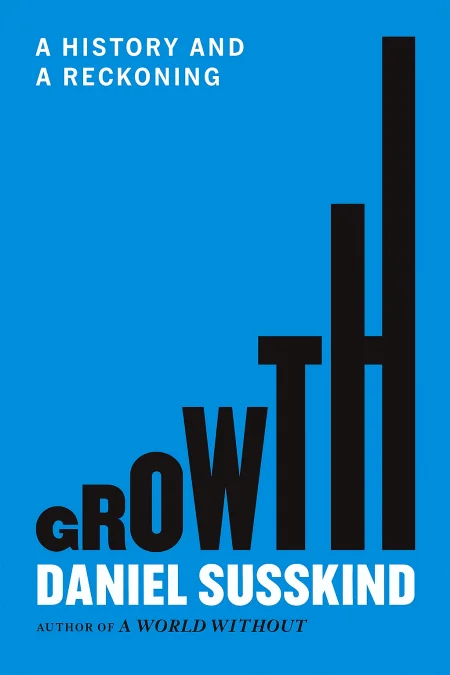
Growth
A History and a Reckoning
Book Edition Details
Summary
In "Growth," Daniel Susskind weaves a compelling tapestry of economic history and future vision, revealing the intricate dance between prosperity and its unintended consequences. As the relentless pursuit of GDP has lifted billions from poverty, it has also scarred our planet and widened societal divides. Susskind challenges the status quo with a bold proposition: reimagine growth itself. With keen insight, he argues for a paradigm shift, urging societies to balance progress with sustainability, equity, and moral courage. This narrative invites readers to ponder an economy not driven by endless expansion but enriched by the boundless realm of ideas, reshaping our collective future with wisdom and innovation.
Introduction
Imagine a world where your great-great-grandfather's standard of living was virtually identical to yours, where technological progress crawled at a glacial pace, and where the idea of sustained prosperity seemed like an impossible dream. For most of human history, this was reality. From the emergence of our species 300,000 years ago until roughly 1800, economic life remained trapped in what scholars call the "Malthusian prison" - a cruel cycle where any improvement in living conditions was quickly erased by population growth and resource constraints. Then, in the blink of an historical eye, everything changed. The Industrial Revolution shattered this ancient pattern, unleashing unprecedented economic growth that would transform civilization itself. But this liberation came with unexpected consequences that continue to shape our world today. How did humanity escape its age-old economic trap? Why did the pursuit of growth become the defining obsession of modern nations? And as we grapple with climate change, inequality, and technological disruption, what price are we paying for our relentless quest for ever-greater prosperity? This historical journey reveals how economic growth evolved from an impossible dream into humanity's greatest achievement, and ultimately into one of its most complex challenges. For anyone seeking to understand how we arrived at our current crossroads between prosperity and sustainability, between material progress and human flourishing, this story offers both sobering lessons and surprising hope for charting a wiser path forward.
The Malthusian Prison: 300,000 Years of Economic Stagnation
For the vast sweep of human existence, economic progress was not merely slow - it was virtually nonexistent. Archaeological evidence paints a stark picture of stagnation that persisted from our species' earliest days until the dawn of the modern era. English wage records stretching back to 1209 reveal that a laborer in 1800 could purchase no more wheat with his earnings than his ancestor had managed six centuries earlier. Human height, that reliable indicator of nutritional well-being, remained essentially flat across millennia, only beginning its dramatic climb after 1800. The architect of this economic prison was later identified by Thomas Malthus, whose theory explained why sustained growth seemed impossible. Any temporary improvement in living standards would trigger population growth, which would then drive conditions back to subsistence through the mathematics of diminishing returns. The Black Death provided a grim illustration of this trap in action: as plague killed nearly half of Europe's population, wages for survivors temporarily soared, but within generations, population recovery had erased these gains entirely. This pattern held across the globe, from ancient China to pre-Columbian America. The fundamental constraint was always the same: limited resources relative to growing populations ensured that prosperity remained fleeting. Even the most ingenious innovations - the plow, the printing press, new crops from distant lands - could provide only temporary relief before the iron logic of scarcity reasserted itself. Yet within this apparent stagnation, the seeds of transformation were quietly germinating. The Scientific Revolution and Enlightenment began reshaping how people understood their relationship with the natural world. For the first time in history, significant numbers of people began to believe that human reason could systematically unlock nature's secrets and improve material conditions. This cultural shift, though invisible to contemporaries, would prove to be the key that finally unlocked humanity's economic potential.
The Great Breakthrough: Industrial Revolution and Growth's Birth (1800-1950)
Around 1800, humanity achieved something unprecedented in its long history: sustained escape from the Malthusian trap. The breakthrough began in Britain but would eventually spread across the globe, marking the birth of modern economic growth. For the first time, living standards began rising alongside population increases, shattering the ancient pattern that had governed human existence for millennia. The transformation was breathtaking in its scope and speed. Between 1800 and 1900, real wages in Britain doubled, then doubled again. Life expectancy began its steady upward climb, while the variety and quality of goods available to ordinary people expanded beyond anything previous generations could have imagined. Steam engines, textile machinery, and new methods of iron production represented more than mere inventions - they embodied a revolutionary new relationship between human knowledge and material progress. The key insight, developed much later by economists like Robert Solow and Paul Romer, was that sustained growth required something entirely different from what classical economists had assumed. Rather than simply accumulating more land, labor, and capital - a strategy doomed by diminishing returns - the Industrial Revolution revealed that continuous technological progress could overcome natural limits. Ideas, unlike physical resources, possessed unique properties: they could be shared without being diminished and built upon indefinitely. This breakthrough didn't happen by accident. What historian Joel Mokyr called the "Industrial Enlightenment" had created a new cultural framework that emphasized the systematic pursuit of useful knowledge. The same intellectual ferment that produced the Scientific Revolution now turned toward practical applications, transforming innovation from an occasional accident into a regular feature of economic life. Humanity had finally learned not just to invent, but to invent the method of invention itself, launching the modern world's faith that tomorrow could be materially better than today.
The GDP Century: Growth Becomes Global Obsession (1940-2000)
The idea of economic growth as a deliberate policy objective is surprisingly recent. Until the mid-twentieth century, neither economists nor politicians paid systematic attention to the concept. Classical economists were pessimistic about long-term growth prospects, and even when sustained growth began, there was no reliable way to measure it. The notion of pursuing "more growth" would have been inconceivable to most leaders throughout history - not because they didn't want prosperity, but because they lacked the tools to quantify or track economic progress. This changed dramatically during World War II, when the urgent need to mobilize resources for the war effort forced governments to develop new statistical tools. John Maynard Keynes, struggling to determine how much of Britain's economy could be diverted to military purposes, helped create what would eventually become Gross Domestic Product. This wasn't initially intended as a measure of societal wellbeing - it was simply a bureaucratic tool for wartime resource allocation. But once the war ended, this statistical innovation would reshape global politics in ways its creators never imagined. The Cold War transformed GDP from a technical accounting measure into the ultimate scorecard of ideological competition. As the United States and Soviet Union faced off, economic growth rates became the primary metric for determining which system was winning. The Marshall Plan required European recipients to calculate and report their GDP figures. International institutions like the World Bank made GDP their "magnetic north" for development policy. Countries began competing in league tables of economic performance, with growth rates becoming sources of national pride or shame. Political leaders discovered that growth seemed to offer solutions to virtually every domestic challenge. It promised to create jobs for returning veterans, fund ambitious social programs, and make politics easier by providing benefits for everyone without requiring difficult tradeoffs. By the 1960s, signs in the U.S. Department of Commerce asked employees, "What have you done for Growth today?" The pursuit of ever-higher GDP had become the defining political obsession of the modern era, transforming from a wartime necessity into peacetime orthodoxy that would dominate policy thinking for decades to come.
The Reckoning Era: When Growth's Promise Met Its Price (2000-Present)
By the dawn of the twenty-first century, the promise of economic growth had delivered extraordinary results that would have seemed miraculous to previous generations. Global extreme poverty had plummeted from affecting eight in ten people in 1820 to just one in ten today. Life expectancy had soared, literacy had become nearly universal, and technological marvels that would have seemed like magic to our ancestors had become commonplace. The escape from the ancient Malthusian trap had succeeded beyond the wildest dreams of its early champions. Yet this remarkable success story came with an increasingly visible dark side that could no longer be ignored. The same growth-promoting technologies that had lifted billions from poverty were also transforming the climate in dangerous ways, with carbon emissions skyrocketing and global temperatures rising at an accelerating pace. The benefits of growth were being distributed increasingly unequally, creating vast disparities in wealth and income both within and between countries. Automation threatened to eliminate jobs faster than new ones could be created, while digital technologies concentrated unprecedented power in the hands of a few tech giants. The fundamental challenge became clear: we could no longer treat growth as an unqualified good. The pursuit of ever-higher GDP had created what economists call "negative externalities" - costs imposed on society that weren't reflected in market prices. Environmental destruction, social fragmentation, technological unemployment, and political instability were all, in various ways, byproducts of the same economic dynamism that had created modern prosperity. The growth that had once seemed like humanity's salvation was beginning to look like a potential source of its destruction. This creates what might be called the "growth dilemma" of our time - the recognition that we desperately need the benefits that growth provides, but we can no longer afford to ignore the costs it imposes. Simply pursuing more growth threatens to accelerate climate change and social breakdown. But abandoning growth would condemn billions to continued poverty and foreclose the possibility of solving humanity's remaining challenges. The question facing the modern world is not whether to choose growth or reject it, but how to harness its promise while managing its price - a challenge that requires fundamentally rethinking not just how much we grow, but what kind of growth we pursue.
Summary
The story of economic growth reveals one of history's most dramatic reversals of fortune, offering profound lessons for navigating our current challenges. For 300,000 years, humanity remained trapped in a cycle where any improvement in living standards was quickly erased by population growth and resource constraints. Then, in just two centuries, we broke free through a combination of cultural transformation and technological innovation that turned the systematic pursuit of useful knowledge into the engine of sustained prosperity. Yet this triumph carried within it the seeds of our current predicament. The same growth that lifted billions from poverty also created existential threats to our climate, democracy, and social cohesion. We now face a fundamental choice about the future direction of human civilization. We cannot simply pursue more growth while ignoring its mounting costs, nor can we abandon growth without condemning much of humanity to continued suffering. The path forward requires recognizing that growth is not a monolithic force but a process we can shape and direct. Just as the original Industrial Revolution emerged from specific incentives and cultural changes, we can create new frameworks that channel technological progress toward solving rather than creating problems. This means moving beyond the narrow focus on GDP growth toward a more nuanced understanding of what constitutes genuine human progress. The future belongs not to those who can grow fastest, but to those who can grow wisest, harnessing the same innovative capacity that created our current challenges to build a more sustainable and equitable form of prosperity.
Related Books
Download PDF & EPUB
To save this Black List summary for later, download the free PDF and EPUB. You can print it out, or read offline at your convenience.
By Daniel Susskind
