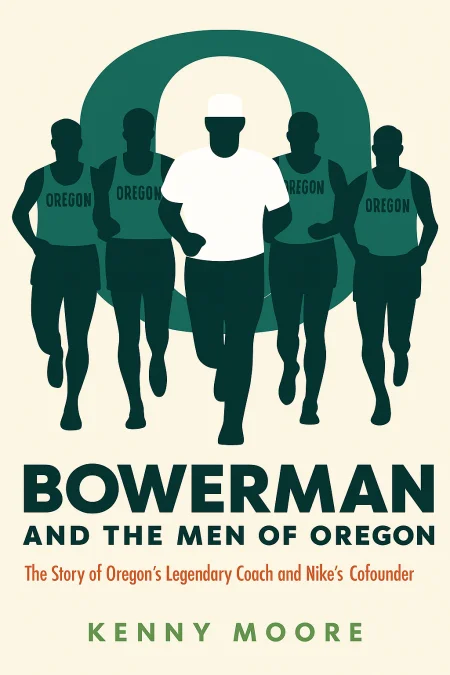
Bowerman and the Men of Oregon
The Story of Oregon's Legendary Coach and Nike's Cofounder
Book Edition Details
Summary
Bill Bowerman: a visionary whose legacy sprints through the annals of athletic history. In "Bowerman and the Men of Oregon," Kenny Moore captures the essence of a man who didn’t just coach track and field at the University of Oregon—he transformed it. Bowerman's coaching prowess led his teams to four national titles, while his inventive spirit birthed the iconic waffle-sole shoe that launched Nike. Through a tapestry of personal anecdotes and intimate interviews, Moore, an Olympian under Bowerman's tutelage, unveils a portrait of relentless innovation and inspiration. This narrative isn't just about athletic triumphs; it’s a chronicle of how one man's passion for running sparked a movement, forever changing the sport's landscape and those who dared to chase greatness alongside him.
Introduction
In the crisp Oregon morning air of 1964, a coach stood at the edge of Hayward Field, stopwatch in hand, watching his athletes warm up for what would become one of the most transformative seasons in American track and field history. Bill Bowerman, then fifty-three, possessed an unusual combination of military precision and innovative spirit that would revolutionize not just how elite athletes trained, but how millions of ordinary Americans thought about exercise and movement. His piercing blue eyes missed nothing as he observed the subtle mechanics of human motion, constantly questioning conventional wisdom and seeking better ways to unlock human potential. Bowerman's influence extended far beyond the confines of competitive athletics. While coaching Olympic champions and setting world records, he simultaneously pioneered the jogging movement that would sweep across America, transforming a nation's relationship with fitness. His relentless experimentation with training methods challenged the brutal mentality that dominated sports, replacing it with intelligent, individualized approaches that maximized performance while minimizing injury. Perhaps most remarkably, his garage-based experiments with athletic footwear would eventually grow into Nike, fundamentally changing how the world thinks about sports equipment and athletic culture. From this remarkable figure, readers will discover the power of questioning established methods and pursuing continuous innovation, the importance of balancing intense ambition with scientific wisdom, and how one person's refusal to accept limitations can create ripple effects that transform entire industries and millions of lives.
From War Hero to Coaching Pioneer
Bill Bowerman's transformation from small-town Oregon boy to legendary figure began in the crucible of World War II, where he served with distinction in the 10th Mountain Division. The harsh realities of combat in the Italian Alps forged in him an unshakeable resolve and a deep understanding of human endurance under extreme conditions. These wartime experiences would later inform his revolutionary approach to training athletes, teaching him that the mind's limits often impose greater constraints than the body's capabilities. His leadership of troops through some of the war's most challenging mountain warfare demonstrated the tactical thinking and calm under pressure that would later make him legendary in coaching circles. Returning to civilian life, Bowerman initially pursued teaching and coaching at the high school level, where he first began experimenting with unconventional training methods. His early coaching years revealed a restless intellect constantly questioning established practices. Why did runners train the same way regardless of their individual strengths? Why did conventional wisdom dictate that more training was always better? These questions would drive him to develop his famous hard-easy training philosophy, alternating intense workouts with recovery periods that allowed the body to adapt and grow stronger. When Bowerman arrived at the University of Oregon in 1949, he inherited a modest program with limited resources but unlimited potential in his eyes. He immediately set about creating something unprecedented: a track program built around scientific observation, individual attention, and relentless innovation. His early years established the foundation for what would become known as the Oregon way, a holistic approach that considered each athlete's unique physiology, psychology, and personal circumstances. The coach's military background instilled in him both discipline and adaptability, qualities that would prove essential as he began attracting talented but diverse athletes to Eugene. He understood that leadership meant serving those under your command, and he applied this principle to coaching with remarkable results. His athletes didn't just run for him; they ran with him, creating a culture of mutual respect and shared purpose that would define Oregon track for decades.
Innovation in Training and Equipment Design
Bowerman's genius lay not in following established formulas but in treating each athlete as a unique experiment requiring customized solutions. He possessed an almost supernatural ability to observe minute details in running form, breathing patterns, and psychological makeup, then craft training programs that maximized individual potential. This personalized approach flew in the face of conventional coaching wisdom, which typically applied uniform methods regardless of individual differences. His revolutionary hard-easy system became the foundation of modern distance running training, proving that intelligent recovery was just as important as intense effort. The coach's innovative spirit extended beyond training methods to equipment and facilities. Frustrated by the poor quality of running shoes available to his athletes, Bowerman began experimenting with modifications in his garage workshop. Using his wife's waffle iron to create better traction patterns, he pioneered designs that would eventually revolutionize athletic footwear. His relentless tinkering with spikes, cushioning, and materials demonstrated a craftsman's attention to detail combined with an inventor's willingness to challenge assumptions about what athletic shoes could and should be. At Oregon, Bowerman created what amounted to a laboratory for human performance, where scientific curiosity merged with practical application. He studied altitude training effects, experimented with interval training variations, and even researched optimal hydration strategies decades before sports science became mainstream. His athletes became willing participants in this ongoing research, understanding that their coach's innovations gave them competitive advantages unavailable elsewhere. The results spoke for themselves as Oregon began producing an unprecedented string of world-class athletes who dominated both collegiate and international competition. The culture Bowerman fostered emphasized continuous improvement over immediate results. He taught his athletes to think critically about their training, encouraging them to understand the reasoning behind each workout rather than blindly following instructions. This educational approach produced not just better runners but more thoughtful individuals who carried lessons learned on the track into their professional and personal lives long after their competitive careers ended.
Building Nike and Olympic Champions
The partnership between Bill Bowerman and Phil Knight, his former student, represented one of the most significant entrepreneurial collaborations in American business history. What began as Knight's graduate school project importing Japanese running shoes evolved into a global empire when combined with Bowerman's technical expertise and innovative vision. Their early years required tremendous faith, as they operated from car trunks and spare bedrooms while established companies dominated the athletic footwear market. Bowerman's contributions extended far beyond product development, though his innovations in shoe design remained central to the company's success. His famous waffle sole design, created during a Sunday morning breakfast experiment, provided superior traction and cushioning that gave Nike shoes immediate credibility among serious runners. More importantly, his philosophy of designing products for athletes rather than marketing departments established Nike's reputation for performance-driven innovation. The coach's influence on Nike's culture proved as valuable as his technical contributions, as he insisted that the company maintain its connection to actual athletes and their needs, resisting the temptation to prioritize style over function. Bowerman's Olympic legacy was cemented through the achievements of his athletes on the world's biggest stage. From Bill Dellinger's bronze medal in the 1964 Tokyo Olympics to the multiple champions he coached in subsequent games, Bowerman proved that American distance runners could compete with anyone when properly trained and prepared. His appointment as head coach for the 1972 Munich Olympics represented both the height of his professional recognition and his greatest challenge, as the terrorist attack transformed the games into a tragedy that tested his leadership under extreme pressure. The success of Bowerman's athletes at Munich and other international competitions helped establish American credibility in distance running, a sport long dominated by European and African nations. His coaching philosophy proved that systematic training, individual attention, and intelligent race tactics could overcome traditional advantages in natural talent or altitude training. Athletes like Steve Prefontaine became global stars under his guidance, inspiring a generation of American runners to believe they could compete at the highest levels while embodying the Oregon spirit of innovation and determination.
Legacy of Excellence and Cultural Impact
The true measure of Bill Bowerman's impact extends far beyond the impressive statistics of his coaching career, the Olympic medals, world records, and championship teams. His greatest achievement lay in fundamentally changing how people thought about human potential and the role of mentorship in unlocking it. The athletes he coached carried his lessons into careers as educators, business leaders, and coaches themselves, multiplying his influence across generations and establishing a legacy that continues to shape American athletics today. Bowerman's coaching philosophy emphasized the development of the whole person rather than just athletic performance. He understood that the discipline, goal-setting, and resilience required for athletic success translated directly to other life challenges. His athletes frequently spoke of learning more about character and determination from their coach than about running technique, lessons that served them long after their competitive careers ended. This holistic approach created not just champions but leaders who would influence their communities and professions for decades. The coach's influence on American running culture proved transformational, helping to democratize a sport once considered the domain of elite athletes. Through his co-authorship of the book on jogging and his promotion of running as accessible exercise, Bowerman showed that running could benefit anyone willing to start slowly and build gradually. This inclusive vision helped fuel the running boom of the 1970s and established jogging as a mainstream activity for health and recreation, fundamentally changing how Americans thought about fitness and personal wellness. Perhaps most significantly, Bowerman demonstrated that true innovation requires the courage to question established practices and the patience to develop better alternatives. His willingness to experiment, fail, and try again created breakthroughs that seemed impossible to those trapped in conventional thinking. Whether designing revolutionary footwear or developing training methods that maximized individual potential, he showed that meaningful progress comes from those bold enough to challenge the status quo while remaining grounded in fundamental principles of human performance and dignity.
Summary
Bill Bowerman's extraordinary life demonstrates that the greatest innovations often emerge from the intersection of deep curiosity, practical problem-solving, and genuine care for others. His legacy reminds us that true leadership involves seeing potential where others see limitations, then providing the guidance and tools necessary to transform that potential into achievement. From his humble beginnings as a small-town coach to his role in creating a global athletic empire, Bowerman never lost sight of the individual human being at the center of every endeavor. The lessons from Bowerman's journey offer valuable guidance for anyone seeking to make a meaningful impact in their chosen field. His approach suggests that sustainable success comes not from following established formulas but from maintaining the courage to experiment, the wisdom to learn from failure, and the persistence to keep improving. His story encourages us to question conventional wisdom while remaining grounded in fundamental principles, to innovate with purpose rather than novelty, and to remember that our greatest achievements often come through helping others discover and develop their own unique capabilities. For coaches, entrepreneurs, educators, and anyone in a position to influence others' development, Bowerman's example provides a timeless model of how to balance high standards with genuine care, pushing people toward excellence while respecting their individual needs and potential.
Related Books
Download PDF & EPUB
To save this Black List summary for later, download the free PDF and EPUB. You can print it out, or read offline at your convenience.
By Kenny Moore
