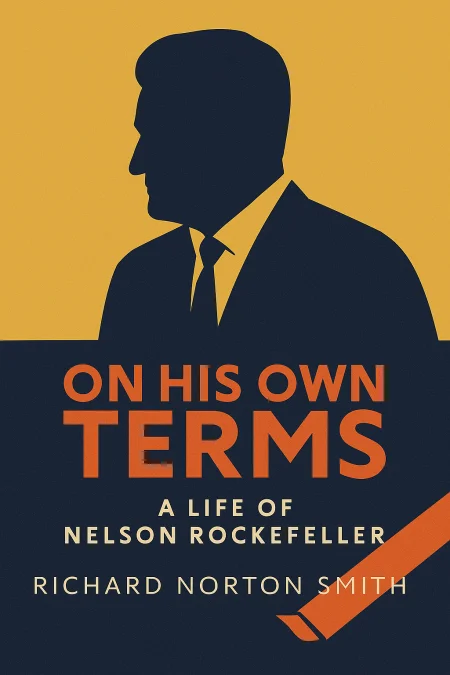
On His Own Terms
A Life of Nelson Rockefeller
Book Edition Details
Summary
In the mosaic of American history, few figures dazzle and confound as much as Nelson Rockefeller. Crafted by the deft hand of historian Richard Norton Smith, "On His Own Terms" unveils the life of a man whose ambition knew no bounds, shaped by privilege and a restless spirit. Born into the formidable Rockefeller dynasty, Nelson carved his own path, from the urban vistas of Rockefeller Center to the political arenas of New York and beyond. His passion for liberal Republicanism saw him champion civil rights and healthcare reform, even as he battled within his own party. Yet, this biography doesn't merely recount political maneuvers; it delves into the vibrant, and often tumultuous, personal tapestry of Rockefeller's life. From infamous marital shifts to the haunting mystery of his son’s disappearance, Smith paints a portrait of a man driven by dreams that seemed ever just out of reach. Here lies Rockefeller's legacy—complex, controversial, and utterly captivating.
Introduction
In the summer of 1964, at the Republican National Convention in San Francisco's Cow Palace, a lone figure stood at the podium as boos and jeers rained down from the galleries above. Nelson Rockefeller, heir to America's greatest fortune, faced a hostile crowd with characteristic defiance, his jaw set in determination as he declared, "This is still a free country, ladies and gentlemen." The scene crystallized the central paradox of a man who spent his life caught between privilege and populism, between the expectations of his legendary name and his own restless ambitions. Born into unimaginable wealth in 1908, Nelson Aldrich Rockefeller would become one of the most fascinating and contradictory figures in twentieth-century American politics. He was a Republican who championed liberal causes, a capitalist who believed in government activism, and an aristocrat who genuinely connected with common people. His story spans the transformation of America from an industrial powerhouse to a global superpower, from the Great Depression through the Cold War, from the New Deal to the Reagan Revolution. Through Rockefeller's extraordinary journey, we witness the evolution of American liberalism and the complex relationship between wealth and public service. His life reveals the possibilities and limitations of using private resources for public good, the challenges of translating idealism into political reality, and the personal costs of living in the shadow of greatness. From his early struggles with dyslexia to his rise as a four-term governor of New York, from his pioneering work in Latin America to his frustrated presidential ambitions, Nelson Rockefeller's story illuminates the tensions between individual ambition and collective responsibility that continue to shape American democracy today.
From Privilege to Purpose: Early Life and Political Formation
Nelson Aldrich Rockefeller entered the world on July 8, 1908, carrying the weight of two legendary American names. His birth coincided with his great-grandfather John D. Rockefeller Sr.'s sixty-ninth birthday, a symbolic passing of the torch that would define much of Nelson's early consciousness. Named for his maternal grandfather, Senator Nelson Aldrich of Rhode Island, the boy inherited not just vast wealth but also the political instincts and cultural sophistication of two of America's most powerful families. The Rockefeller household was a study in contrasts that would shape Nelson's character throughout his life. His father, John D. Rockefeller Jr., embodied the stern Protestant work ethic that had built the family fortune, demanding detailed financial accounting from his children and instilling in them a sense of moral obligation that came with their privilege. Yet it was his mother, Abby Aldrich Rockefeller, who provided the warmth and cultural curiosity that would become Nelson's trademark. She introduced him to modern art, encouraged his natural exuberance, and taught him that wealth was meaningless without the sensitivity to appreciate beauty and the wisdom to serve others. From his earliest years, Nelson displayed the restless energy and competitive spirit that would define his adult career. He was the child who descended into New York sewers to retrieve a lost baseball rather than face his father's lecture about carelessness, who organized elaborate schemes to make money from rabbit breeding and rose-picking, and who never hesitated to challenge authority when it conflicted with his own sense of justice. His struggles with dyslexia, undiagnosed at the time, forced him to develop alternative strategies for learning and communicating that would later serve him well in politics, where his ability to connect with people emotionally often mattered more than his command of written details. The transformation of Nelson Rockefeller from wealthy patron of the arts to influential government official began with a journey to South America in 1937 that opened his eyes to both the possibilities and responsibilities of American power. His early forays into public service during World War II, as coordinator of inter-American affairs, revealed both his strengths and limitations as a leader. He pioneered what would later be called "soft power," using cultural exchanges and economic development projects to counter Nazi influence in Latin America. Yet these same years exposed the contradictions that would plague his entire career—his impatience with bureaucratic constraints and his tendency to personalize policy disagreements, creating unnecessary enemies and undermining otherwise sound initiatives.
The Governor's Vision: Transforming New York Through Liberal Leadership
Nelson Rockefeller's fifteen years as governor of New York represented both the pinnacle of his political achievement and a laboratory for activist government that would influence American politics for decades. Taking office in 1959, he transformed the Empire State into a showcase for liberal Republican governance, launching ambitious programs in education, transportation, housing, and the arts that established him as the nation's most prominent progressive leader outside the Democratic Party. His approach to leadership reflected his lifelong belief that there was no problem that could not be solved with sufficient resources, expertise, and determination. The creation of the State University of New York system stands as perhaps his greatest achievement, transforming what had been a collection of modest teachers' colleges into one of the world's largest and most comprehensive public university systems. His Pure Waters program pioneered environmental protection measures decades before ecology became a national priority, while his transportation initiatives revolutionized mass transit in the New York metropolitan area through the creation of the Metropolitan Transportation Authority. Rockefeller's governing style was intensely personal and hands-on, reflecting both his genuine passion for public service and his need to control every detail of his administration. He surrounded himself with brilliant advisors, commissioned exhaustive studies of complex issues, and refused to accept conventional wisdom about what government could or should accomplish. His famous Monday morning meetings became legendary for their freewheeling discussions of everything from urban planning to cultural policy, sessions that could stretch for hours as the governor probed every aspect of proposed initiatives. Yet the same qualities that made Nelson an effective governor also contained the seeds of his ultimate political downfall. His impatience with opposition led him to circumvent normal political processes through creative financing mechanisms that mortgaged the state's future. His use of moral obligation bonds and public authorities allowed him to build on an unprecedented scale but saddled New York with enormous debt obligations. The tragic climax came in September 1971 with the uprising at Attica Correctional Facility, when his refusal to visit the prison personally and his authorization of a violent assault that resulted in thirty-nine deaths became a permanent stain on his legacy, symbolizing the limits of liberal good intentions when confronted with fundamental questions of justice and power.
Presidential Dreams Deferred: Three Campaigns and Political Reality
Nelson Rockefeller's pursuit of the presidency became the defining obsession of his political career, a quest that would span three decades and reveal both his extraordinary talents and his fundamental misunderstanding of the Republican Party's evolution. His campaigns in 1960, 1964, and 1968 each told a story of a man whose vision of progressive Republicanism was increasingly at odds with his party's conservative base, yet who never abandoned his belief that he could unite the nation around pragmatic solutions to complex problems. The 1964 campaign proved particularly devastating, pitting him against the rising conservative movement embodied by Senator Barry Goldwater of Arizona. The contest became a bitter ideological struggle for the soul of the Republican Party, with Rockefeller positioning himself as the champion of moderate, enlightened governance against Goldwater's uncompromising conservatism. His remarriage to Happy Murphy during the campaign created a personal scandal that reinforced perceptions of him as an out-of-touch aristocrat, while his confrontational style and liberal positions alienated the party's increasingly powerful right wing. The dramatic climax came at the Republican National Convention in San Francisco, where Rockefeller faced a hostile crowd of Goldwater supporters who booed and jeered him mercilessly as he tried to address the delegates. His defiant response to the crowd's hostility became legendary, as he stood at the podium and declared that the forces of extremism would not be allowed to take over the Republican Party. The image of Rockefeller facing down the conservative mob became symbolic of the broader struggle between moderate and conservative Republicans, a battle that would ultimately reshape American politics for generations. His final attempt at the presidency came in 1968, when he entered the race late in hopes of capitalizing on the turmoil surrounding the Vietnam War and urban unrest. Despite assembling an impressive campaign organization and spending enormous sums, Rockefeller discovered that his moment had passed. The Republican Party had moved decisively to the right, and his brand of activist government seemed increasingly anachronistic. His defeat by Nixon at the Miami convention marked not just the end of his presidential ambitions but the eclipse of the moderate Republican tradition he had championed throughout his career.
Legacy of a Complex Statesman: Vice Presidency and Final Years
When Gerald Ford selected Nelson Rockefeller as his vice president in 1974, it seemed like the culmination of a lifetime of public service and the fulfillment of his long-deferred ambition to serve at the highest levels of national government. Ford promised his new running mate an unprecedented role in domestic policy, offering him the kind of substantive responsibilities that previous vice presidents had been denied. For Rockefeller, who had grown restless after fifteen years as governor, the vice presidency represented both a capstone to his career and a potential stepping stone to the presidency he had always coveted. The reality of the vice presidency proved far more frustrating than Rockefeller had anticipated. Despite Ford's initial promises, he found himself marginalized by White House Chief of Staff Donald Rumsfeld and other administration officials who viewed him as a political liability. His efforts to create a meaningful role for himself in energy policy and domestic affairs were repeatedly thwarted by bureaucratic resistance and conservative opposition. The man who had been accustomed to wielding enormous power as governor found himself reduced to a largely ceremonial role, attending state funerals and ribbon-cutting ceremonies while the real decisions were made by others. Rockefeller's liberal positions on social issues and his activist approach to government made him increasingly unpopular with conservative Republicans, who viewed him as a symbol of everything they opposed about the party's moderate wing. When Ford decided to drop him from the 1976 ticket in favor of Senator Bob Dole, Rockefeller accepted the decision with characteristic grace, though privately he was deeply wounded by what he saw as a betrayal. The final blow to his political career came not from his enemies but from his supposed allies, who sacrificed him to appease the conservative movement that had opposed him throughout his career. The final years of Rockefeller's life were marked by a gradual withdrawal from public affairs and a renewed focus on his family and artistic interests. He established foundations dedicated to promoting the arts and preserving American cultural heritage, while pursuing business ventures that reflected his lifelong interest in combining profit with social purpose. His sudden death in January 1979, under circumstances that generated considerable controversy and speculation, marked the end of an era in American politics. He had been the last great representative of the moderate Republican tradition that had once dominated the party, and his passing symbolized the final triumph of the conservative movement that had consistently rejected his vision of enlightened governance.
Summary
Nelson Rockefeller's life embodied the promise and peril of American liberalism in the twentieth century, demonstrating both the extraordinary achievements possible when private wealth is dedicated to public service and the tragic consequences when good intentions are not tempered by humility and wisdom. His greatest legacy lies not in any single accomplishment but in his unwavering belief that government could and should be a force for human betterment, a conviction that inspired a generation of public servants even as his own career ended in disappointment and controversy. From Rockefeller's complex story, we can draw two essential lessons for our own time. First, that effective leadership requires not just vision and energy but also the patience to build consensus and the wisdom to accept that even the best ideas must be implemented through imperfect human institutions. Second, that the tension between idealism and pragmatism, between the desire to do good and the need to do what is possible, remains at the heart of democratic governance and demands constant attention from those who would serve the public interest. His life reminds us that in a democracy, the most important question is not whether our leaders are perfect, but whether they are committed to the ongoing work of making society more just, more prosperous, and more humane for all its citizens.
Related Books
Download PDF & EPUB
To save this Black List summary for later, download the free PDF and EPUB. You can print it out, or read offline at your convenience.
By Richard Norton Smith
