
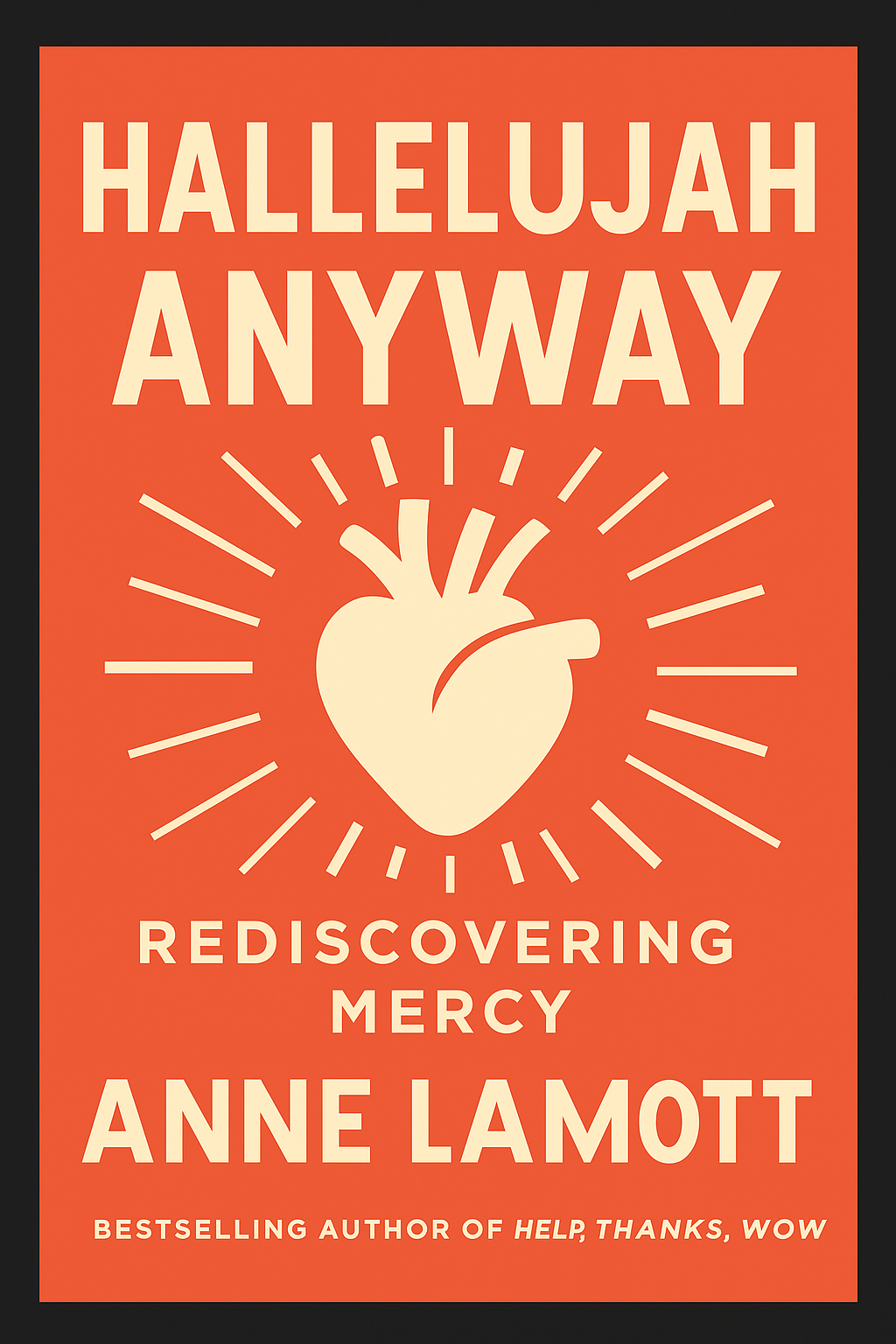
Hallelujah Anyway
Rediscovering Mercy
Book Edition Details
Summary
Can the heart find sanctuary amidst life's chaos? Anne Lamott's "Hallelujah Anyway: Rediscovering Mercy" invites readers to a profound reunion with the often overlooked virtue of mercy. With her signature blend of wit and candidness, Lamott uncovers mercy as a radical act of kindness—an unexpected grace that allows us to forgive and liberate ourselves from the burdens of judgment and pain. Through a tapestry of personal insights and engaging anecdotes, she challenges us to embrace life's messiness and rediscover the compassion that lies within and around us. This book isn't just an exploration; it's a call to cultivate a generous heart and forge deeper, more authentic connections with the world. Step into a narrative that is both comforting and transformative, offering a hopeful guide to finding meaning amid the tumult of everyday life.
Introduction
In the landscape of contemporary American letters, few voices resonate with the raw honesty and fierce tenderness that defines Anne Lamott's work. A writer who transforms personal struggle into universal wisdom, Lamott emerged from the depths of addiction, despair, and spiritual searching to become one of our most beloved chroniclers of the human condition. Her journey from a troubled young woman grappling with alcoholism and eating disorders to a celebrated author and spiritual teacher offers profound insights into the nature of recovery, faith, and self-acceptance. What makes Lamott's story particularly compelling is her refusal to sanitize the messy realities of human existence. She writes about mercy not as an abstract theological concept, but as a daily practice forged in the crucible of real-life relationships, parenting challenges, and the ongoing work of staying sober. Through her exploration of these themes, readers discover how vulnerability can become strength, how brokenness can lead to wholeness, and how the very imperfections we try to hide might actually be our greatest gifts. Her life demonstrates that spiritual growth happens not despite our flaws, but often because of our willingness to embrace them with compassion and humor.
Early Wounds and the Quest for Mercy
Anne Lamott's childhood was marked by the kind of subtle trauma that shapes a person's worldview in profound ways. Growing up in a progressive family in Northern California during the 1960s, she was surrounded by intellectual stimulation and social awareness, yet beneath this veneer lay deeper currents of pain and disconnection. Her father, though well-meaning, was emotionally distant and often critical, while her mother struggled with her own demons of perfectionism and anxiety. These early experiences planted seeds of self-doubt that would grow into full-blown addictions in her adult years. A pivotal moment occurred when Lamott was just five years old, fishing with her father at Stinson Beach. A racist comment from a fellow fisherman about her curly hair, met with her father's laughter rather than protection, became emblematic of the countless small betrayals that taught her to mistrust her own worth. This incident, which she would later explore in therapy decades later, represented the moment when her natural capacity for mercy began to close down, replaced by hypervigilance and the desperate need to please others at the expense of her authentic self. The wounds of childhood created a particular kind of spiritual hunger in Lamott, a longing for the very mercy she felt had been withdrawn from her. She learned to navigate the world by being exceptionally good, exceptionally smart, and exceptionally accommodating, all while harboring a secret conviction that she was fundamentally flawed. This pattern would persist well into adulthood, manifesting in her struggles with alcohol, food, and relationships. Yet even in her darkest moments, there remained a glimmer of the merciful child she had once been, buried but not destroyed. These early experiences with judgment and conditional love would later inform her understanding of divine mercy as something radically different from human approval. Through her writing, she explores how the absence of mercy in childhood can create both a deep wound and a profound wisdom about what true acceptance looks like. Her journey suggests that sometimes we must experience the lack of something before we can fully appreciate its presence and power to transform lives.
Finding Grace Through Sobriety and Faith
The path to sobriety began for Lamott not with a dramatic revelation, but with the quiet desperation of someone who had simply run out of options. At thirty-two, despite outward success as a published author, she found herself drinking daily, battling bulimia, and living in a state of constant internal chaos. The elevator of her life, as she put it, only went down. Her conversion to Christianity occurred while she was still drinking, drawn to a small, diverse church in Marin County where she felt welcomed despite her obvious struggles. The real transformation began when she encountered Loretta, a fellow recovering addict who became her sponsor and spiritual guide. Loretta, a former junkie with a gardener's hands and an outlaw's spirit, embodied a different kind of Christianity than Lamott had ever encountered. She taught practical spirituality through daily phone calls, shared meals, and the patient work of learning to live sober one day at a time. Under Loretta's guidance, Lamott began to understand recovery not as a moral victory, but as a daily practice of surrender and self-compassion. Sobriety brought with it the challenge of facing life without the buffer of alcohol and compulsive behaviors. Lamott discovered that getting sober was only the beginning; learning to live with her unmedicated feelings, her perfectionist tendencies, and her deep-seated fears required an entirely new set of skills. The twelve-step program provided structure, but it was the community of other recovering people that offered the real medicine: honest sharing, mutual support, and the revolutionary idea that she didn't have to get better before she could be accepted. Through this process, Lamott began to experience what she would later call "grace eventually" – the slow, imperfect unfolding of divine love in ordinary circumstances. Her faith became less about theological correctness and more about showing up authentically in relationship with God and others. This spiritual awakening didn't eliminate her character defects or transform her into a serene saint; instead, it gave her tools for living with her humanity more gracefully and extending that same grace to others who struggled.
Teaching and Healing Through Storytelling
Lamott's emergence as a spiritual teacher came not through formal theological training, but through her willingness to share her struggles with radical honesty. Her writing about faith, recovery, and motherhood struck a chord with readers who were hungry for authentic spiritual voices in a culture often dominated by superficial self-help and prosperity theology. She discovered that her deepest wounds, when shared with vulnerability and humor, became sources of healing for others grappling with similar challenges. Her approach to teaching was conversational rather than prescriptive, rooted in storytelling rather than doctrine. Lamott understood that people learn best not from being told what to do, but from hearing stories that help them recognize their own experiences and possibilities. She wrote about the messy realities of single motherhood, the ongoing challenges of sobriety, and the daily practice of trying to be a good person in an imperfect world. Her readers found in her work a permission to be human that they had rarely encountered in religious contexts. The healing power of Lamott's storytelling extended beyond her published works to her teaching and speaking engagements. She became known for her ability to create safe spaces where people could laugh about their mistakes, cry about their pain, and find hope in the shared experience of being flawed humans trying to love each other better. Her Sunday school classes, her writing workshops, and her public appearances all became opportunities for collective healing through honest sharing and mutual support. Central to her teaching philosophy was the revolutionary idea that we don't have to be perfect to be worthy of love and belonging. This message, simple as it sounds, proved transformative for people who had spent their lives trying to earn acceptance through achievement, appearance, or good behavior. Lamott's life demonstrated that grace is not something we achieve but something we receive, often in the most ordinary moments and through the most imperfect messengers.
Living with Compassion in an Imperfect World
As Lamott matured as both a person and a spiritual teacher, her understanding of mercy deepened from personal recovery to a broader compassion that embraced the suffering of the world. She learned to extend the same patience she had developed for her own flaws to others, including family members who disappointed her, political opponents who enraged her, and strangers whose stories broke her heart. This expansion of mercy was not always easy or natural; it required constant practice and frequent failure. Her relationship with her son Sam became a particular laboratory for practicing unconditional love as he grew from an adored child into a challenging teenager and eventually an independent adult. Through the trials of parenting, Lamott learned that loving someone deeply means accepting them as they are while still holding hope for their growth and healing. This lesson extended to her relationships with friends, her aging parents, and even herself as she navigated the indignities and losses that come with growing older. Lamott's compassion was never abstract or sentimental; it was grounded in practical action and sustained by spiritual practice. She volunteered at her church, supported friends through illness and loss, and used her platform as a writer to advocate for social justice and human dignity. Her mercy was expressed not just in grand gestures but in small acts of kindness: bringing food to grieving friends, listening without judgment, showing up when others needed support, and practicing the radical act of forgiveness even when it felt impossible. Perhaps most importantly, Lamott learned to live with the paradoxes inherent in a compassionate life. She could simultaneously hold rage at injustice and love for those who perpetrated it, grief for the world's pain and joy in its beauty, despair at human cruelty and hope in human capacity for growth. This ability to contain contradictions without resolving them became a hallmark of her mature spirituality, offering others permission to live with ambiguity and uncertainty while still choosing love over fear.
Summary
Anne Lamott's life stands as a testament to the transformative power of mercy – not as a religious concept to be understood intellectually, but as a daily practice to be lived imperfectly but persistently. Her journey from wounded child to addicted adult to recovering spiritual teacher illustrates how our deepest struggles can become our greatest gifts when met with honesty, community support, and divine grace. The mercy she learned to extend to herself became the foundation for a life of service to others seeking their own paths to healing and wholeness. For readers grappling with addiction, spiritual seeking, or simply the challenge of being human in a broken world, Lamott's story offers profound encouragement: we don't have to be perfect to be worthy of love, and our flaws don't disqualify us from participating in the sacred work of healing the world. Her life demonstrates that spiritual growth happens not despite our imperfections but often because of our willingness to face them with courage and compassion. Through her example, we learn that the practice of mercy – toward ourselves and others – might be the most revolutionary act available to us in a world too often defined by judgment and division.
Related Books
Download PDF & EPUB
To save this Black List summary for later, download the free PDF and EPUB. You can print it out, or read offline at your convenience.
By Anne Lamott
