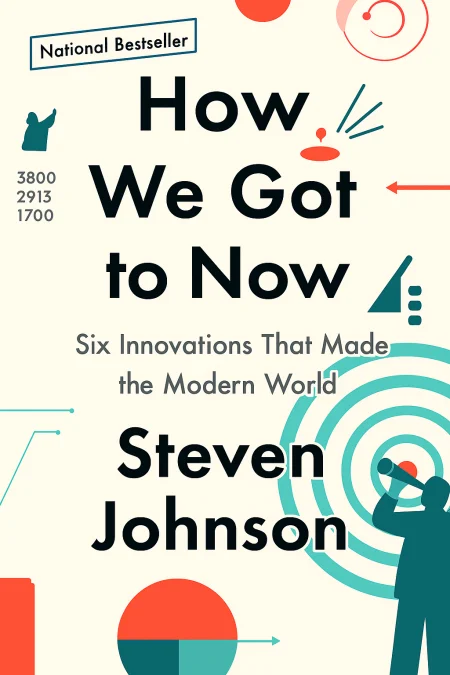
How We Got to Now
Six Innovations that Made the Modern World
Book Edition Details
Summary
Great inventions don’t just shape our world; they redefine it in unexpected ways. In "How We Got to Now," Steven Johnson, a maestro of innovative storytelling, takes us on a vivid journey through time, unearthing the surprising origins of everyday marvels. Through riveting anecdotes, he unveils the unsung heroes of innovation—those visionary hobbyists and accidental geniuses whose creations, like refrigeration and eyeglasses, ripple through history with unforeseen impact. Imagine a world where air-conditioning reshapes human migration or where pendulum clocks ignite industrial revolutions. Johnson's narrative, as enlightening as it is entertaining, connects the dots between disparate innovations, revealing a web of interdependence that binds humanity. Accompanying a captivating PBS series, this exploration of ingenuity and serendipity invites you to see the ordinary as extraordinary, as each invention echoes with profound, global consequences.
Introduction
Picture yourself standing in a modern city at night, surrounded by the brilliant glow of streetlights, neon signs, and illuminated windows stretching toward the sky. Now imagine that same scene just 150 years ago—a world plunged into near-total darkness after sunset, where the most advanced lighting came from whale oil candles and the concept of a glass skyscraper was pure fantasy. This dramatic transformation represents just one thread in the intricate web of innovation that created our modern world. The story of human progress is often told through the lens of great leaders, wars, and political movements. But there's another history hiding in plain sight—one written in the everyday objects we barely notice. The glass in our windows, the ice in our drinks, the precise timing of our digital clocks—each carries within it centuries of human ingenuity, failed experiments, and unexpected discoveries that rippled outward to reshape civilization itself. This perspective reveals how innovation actually works in the real world. Ideas don't emerge from isolated geniuses having sudden breakthroughs. Instead, they grow from networks of collaboration, accidental discoveries, and the strange ways that solving one problem often creates entirely new possibilities. A glassmaker's technique developed in medieval Venice eventually enables the Hubble Space Telescope. A doctor's attempt to cool fever patients leads to the air-conditioned cities that redraw America's political map. This book is for anyone curious about the hidden connections that shape our world, those who wonder how we got from there to here, and why understanding these patterns matters for navigating an uncertain future. By examining six fundamental innovations through a wide-angle lens, we can see not just what changed, but how change itself actually happens.
The Age of Light and Vision: From Medieval Glass to Electric Illumination
The medieval world was largely opaque to human vision. People lived their entire lives seeing only what their naked eyes could perceive, bounded by the limits of natural light and the fuzzy boundaries of aging eyesight. Yet within the workshops of 13th-century Venice, a quiet revolution was beginning that would eventually allow us to peer into the heart of atoms and gaze back toward the beginning of time itself. When glassmakers fled Constantinople's fall in 1204 and established themselves on the island of Murano, they created more than just beautiful vessels. Their innovations in creating transparent glass triggered a cascade of discoveries that transformed human perception. The development of spectacles around 1280 initially served only scholarly monks straining to read manuscripts by candlelight. But when Gutenberg's printing press made books widely available, suddenly millions of Europeans discovered they were farsighted. This surge in demand for spectacles created pools of expertise with lens-making that would prove crucial for the next breakthrough. By 1590, Dutch spectacle makers began experimenting with aligning lenses in sequence, accidentally inventing both the microscope and telescope within decades of each other. Galileo's telescopic observations of Jupiter's moons shattered the medieval worldview, while Robert Hooke's microscope revealed the cellular building blocks of life itself. The same material that started as decorative goblets had become humanity's window into both the cosmic and microscopic realms. This pattern—where solving one practical problem accidentally opens vast new territories of possibility—would repeat throughout history. The mirror, perfected by Venetian craftsmen, didn't just allow people to see their reflections clearly for the first time. It enabled the artistic revolution of Renaissance perspective painting and contributed to the cultural shift toward individualism that would reshape politics and philosophy. When you can see yourself clearly, you begin to think about yourself differently.
Mastering Cold and Sound: Industrial Revolution to Modern Communications
The industrial age brought humanity's first systematic attempts to control the invisible forces that had always governed daily life. Temperature and sound, once entirely at nature's mercy, became raw materials for human manipulation. These conquests would ultimately reshape everything from where we live to how we think about ourselves. Frederic Tudor's seemingly mad scheme to ship ice from New England to the Caribbean in 1806 represented more than entrepreneurial ambition—it was humanity's first attempt to separate cold from climate. After decades of failure and ridicule, Tudor's ice trade eventually enabled the growth of Chicago's meatpacking industry, which transformed the American landscape from prairie to industrial feedlot. The ability to preserve and transport perishable goods didn't just change diets; it changed the fundamental geography of civilization. The pursuit of artificial cold followed a similar trajectory. When Dr. John Gorrie built his ice-making machine in 1840s Florida to cool yellow fever patients, he was drawing on decades of scientific discoveries about air pressure and thermodynamics. By the 1920s, these principles had evolved into domestic air-conditioning, which enabled the explosive growth of Sun Belt cities like Phoenix and Miami. The political map of America shifted as populations moved south and west, changing everything from presidential elections to congressional power. Meanwhile, humanity was learning to capture and manipulate sound itself. The journey from Edison's tinfoil phonograph to Bell's telephone to radio broadcasting created the first truly mass media, but it also did something more profound—it began breaking down the barriers between different communities. When jazz music, created by African-American musicians in New Orleans, could suddenly be heard in living rooms across America, it challenged social boundaries that had seemed permanent. The mastery of these invisible forces revealed a crucial pattern in technological development. Innovations rarely stay confined to their original purpose. Air-conditioning didn't just make hot climates comfortable; it enabled new forms of architecture, changed migration patterns, and ultimately shifted political power. Radio didn't just transmit information; it created shared cultural experiences that transcended geographic and social boundaries.
Clean Water and Precise Time: Public Health Revolution and Global Standardization
The 19th century witnessed two parallel revolutions that seem unrelated but were intimately connected: humanity's conquest of microscopic disease and its mastery of precise timekeeping. Both required new ways of measuring invisible phenomena, and both transformed society in ways their pioneers never anticipated. When Chicago engineer Ellis Chesbrough decided to raise an entire city by ten feet in the 1850s, he was solving an immediate problem—how to install sewers in perfectly flat terrain left behind by ancient glaciers. But his solution, moving thousands of buildings with jackscrews while life continued normally inside them, established the template for modern urban infrastructure. Cities became systems, supported by invisible networks of pipes and tunnels and cables that would make possible the vertical growth of the 20th century. The sewer system was only half the solution, however. Clean water required understanding what couldn't be seen. The development of powerful microscopes revealed the bacterial world for the first time, while pioneers like John Snow mapped disease patterns to prove that cholera spread through contaminated water, not "bad air" as commonly believed. This knowledge enabled Dr. John Leal's audacious 1908 decision to secretly add chlorine to Jersey City's water supply—the first mass chlorination in history. The results were dramatic: a 43 percent reduction in total mortality and a 74 percent drop in infant mortality in the average American city. Simultaneously, humanity was learning to measure time with unprecedented precision. Galileo's observation of a swinging lamp in Pisa Cathedral led to the pendulum clock, which brought accuracy to the second rather than the hour. This precision made possible the railroad networks that connected continents, but it also imposed a new rhythm on human life—the discipline of clock time that regulated industrial work and created our modern relationship with schedules and deadlines. The conquest of germs and time shared a crucial insight: accurate measurement creates new possibilities for control. Just as microscopes revealed bacteria that could be killed with chlorine, precise clocks enabled the coordination necessary for complex industrial society. Both revolutions required thinking at scales beyond human perception—microscopic organisms and nanosecond intervals—but their effects reshaped the most fundamental aspects of daily existence.
The Network Effects: How Six Innovations Reshaped Human Civilization
By the 20th century, the accumulated power of these innovations began creating something unprecedented in human history—a global technological civilization where changes in one field instantly rippled across all others. The age of isolated inventions was ending, replaced by an era of systems thinking and network effects. Electric lighting illustrates this transformation perfectly. Thomas Edison's lightbulb emerged not from a lone genius but from a collaborative team of "muckers" at Menlo Park, working with innovations from around the world—Japanese bamboo filaments, German glassmaking techniques, British electrical theory. Edison's real breakthrough wasn't the bulb itself but the complete electrical system that made it practical: power stations, distribution networks, meters, and safety devices all working together. This systems approach enabled innovations to compound exponentially. The vacuum tubes that powered early electronics led to radio, television, and the first computers. The precision timing of quartz crystals enabled not just accurate clocks but the microprocessors that would digitize human culture. Glass fibers, originally developed for their strength, became the backbone of global internet communications when combined with laser technology. Perhaps most remarkably, these innovations began to accelerate human perception itself. Telescope mirrors revealed distant galaxies, while electron microscopes showed individual atoms. High-speed photography captured the flight of hummingbirds, revealing the aerodynamic principles that would later inspire aircraft design. Photography, film, and eventually digital media created new ways of seeing and sharing human experience. The network effects became increasingly visible in how innovations solved problems their creators never imagined. Air-conditioning enabled the growth of desert cities, but it also made possible the computer clean rooms necessary for microchip manufacturing. GPS satellites keep precise time using atomic clocks, but they also enable everything from ride-sharing apps to precision agriculture. Each innovation became a platform for others, creating a technological ecosystem where breakthroughs in one field instantly became tools for advancement in seemingly unrelated areas.
Summary
The story of these six innovations reveals a fundamental truth about progress: it emerges not from isolated breakthroughs but from the collision and combination of ideas across different domains. Glass, cold, sound, cleanliness, time, and light each followed similar patterns—beginning as solutions to immediate practical problems, then triggering unexpected changes that rippled across society in ways no one could have predicted. This perspective offers crucial insights for navigating our own era of rapid technological change. Innovation isn't primarily about individual genius or sudden inspiration. It's about creating environments where diverse ideas can collide and recombine, where failure is tolerated as part of exploration, and where the unexpected connections between different fields are actively cultivated. The garage workshops and collaborative research labs that produce today's breakthroughs are direct descendants of the Murano glassmakers and Edison's muckers. Understanding how innovation actually works can help us make better choices about which technologies to develop and how to guide their implementation. History shows that every powerful new technology brings both benefits and costs, often in unpredictable combinations. The same industrial processes that enabled modern medicine also created environmental pollution. The same digital networks that democratize information also threaten privacy and spread misinformation. By studying how past innovations shaped society, we can better anticipate and navigate the consequences of emerging technologies. Most importantly, this history suggests that progress isn't inevitable but it is achievable. The accumulated innovations of the past thousand years created unprecedented possibilities for human flourishing, but only because countless individuals chose to experiment, collaborate, and persevere through failure. The future will be shaped not by impersonal technological forces but by the choices we make about which problems to solve and how to solve them together.
Related Books
Download PDF & EPUB
To save this Black List summary for later, download the free PDF and EPUB. You can print it out, or read offline at your convenience.
By Steven Johnson
